
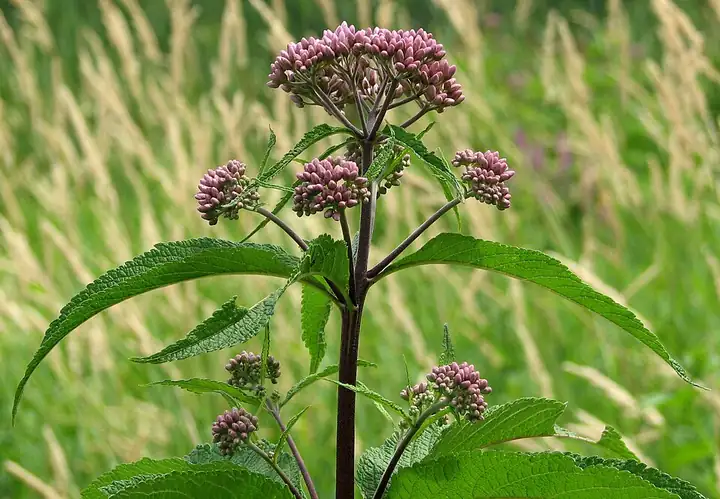
Joe-Pye weed
Eutrochium purpureum, E. maculatum, E. fistulosum and E. dubium (formerly Eupatorium) · Aster family (Asteraceae)
| Hardiness zones | 3 to 9 |
|---|---|
| Sun | full sun to part shade |
| Water | high |
| Life cycle | perennial |
| Frost | Hardy: takes frost |
About Joe-Pye weed
Joe-Pye weed is a big native wildflower of wet meadows, with tall stems and huge domes of dusty-pink to purple flowers that smell faintly of vanilla. From midsummer into fall it is swarmed by butterflies, bees and other beneficial insects, and birds eat the seeds. Compact cultivars such as 'Little Joe' fit smaller gardens.
NC State lists E. maculatum for zones 3-8, E. dubium for 3-9 and E. purpureum for 4-9; Clemson gives 4-8 for the group.
When to plant
Timing is counted from your average last spring frost (and first fall frost). Sow & Tell works out the actual dates for your ZIP code.
Keep new plants consistently moist the first year (Clemson). Divide clumps in fall after they go dormant, or in spring (Clemson; NC State). For seed, gather it in late September and sow outdoors in fall or keep it in the refrigerator; NC State says seed needs about 3 months of cold, moist conditions and sprouts poorly, and Clemson says seedlings flower in their second season.
Soil
Moist to occasionally wet soil with organic matter, clay is fine; leaves scorch if the soil dries out (NC State; Clemson; Penn State).
Choose a sunny, moist spot and work in organic matter; keep the soil consistently moist the first year (Clemson). Follow a soil test.
Feeding
- early spring, just before new shoots come up (optional): slow-release fertilizer such as 12-6-6, or a 1-inch layer of compost. Joe-Pye weed grows wild in unfertilized wet meadows, and MSU notes most perennials need little feeding. Clemson's general rate for perennial beds is 1-2 lb of a slow-release 12-6-6 per 100 sq ft just before shoots emerge; MSU advises no more than 1 lb of nitrogen per 1,000 sq ft. Scatter it around the plants and water it in. Follow a soil test.
Letting the soil dry out scorches the leaves (NC State; Penn State). Too much fertilizer makes tall stems even more likely to flop (MSU).
Harvest
Flowers open from July to October. For shorter, fuller plants with more flower heads, cut stems halfway down by mid-June (Clemson); NC State says cutting back before early July gives sturdier stems. Leave seed heads for birds and winter interest, then cut plants to the ground in late winter or early spring (Penn State).
Varieties (8)
Extension sources document 8 cultivars. Sizes for Clemson's cultivars come from its table of trial-grown plants.
| Variety | Type | Days | Notes |
|---|---|---|---|
| Baby Joe | Coastal plain Joe-Pye weed (E. dubium) | About 5 ft tall and 4.5 ft wide with light purple flowers. | |
| Little Joe | Coastal plain Joe-Pye weed (E. dubium) | Compact, about 5 ft tall and 3 ft wide in Clemson's listing, with purple flowers. | |
| Bartered Bride | Hollow Joe-Pye weed (E. fistulosum) | Very tall, about 7.5 ft, with white flowers. | |
| Carin | Hollow Joe-Pye weed (E. fistulosum) | Tall, about 6.5 ft, with pale pink flowers. | |
| Gateway | Spotted Joe-Pye weed (E. maculatum) | 4-6 ft tall, reddish stems and large clusters of dusky-pink flowers. | |
| Phantom | Spotted Joe-Pye weed (E. maculatum) | About 4.5 ft tall and 5 ft wide with purplish-pink flowers. | |
| Purple Bush | Spotted Joe-Pye weed (E. maculatum) | About 5 ft tall with purple flowers. | |
| Little Red | Sweet Joe-Pye weed (E. purpureum) | Shorter selection, 3-4 ft tall. |
Good neighbors
Clemson suggests Joe-Pye weed with ironweed, goldenrods and native asters for a fall show; this is a design pairing, not a pest-control claim.
Diseases and problems
Powdery mildew, Rust
In the kitchen
Safety: The sources we checked list no toxic parts and no research-based guidance on pregnancy, drug interactions or allergies.
Pets: Not listed by the ASPCA
Sources
- hgic.clemson.edu
- plants.ces.ncsu.edu
- plants.ces.ncsu.edu
- plants.ces.ncsu.edu
- plants.ces.ncsu.edu
- extension.psu.edu
- extension.psu.edu
- aspca.org
- aspca.org
- hgic.clemson.edu
- homesoiltest.msu.edu
Photo: Photo: D. Gordon E. Robertson, CC BY-SA 3.0, via Wikimedia Commons (CC BY-SA 3.0). Photo resized for the web.

Planting dates and advice are general guidance; check with your local Cooperative Extension office for your area.