
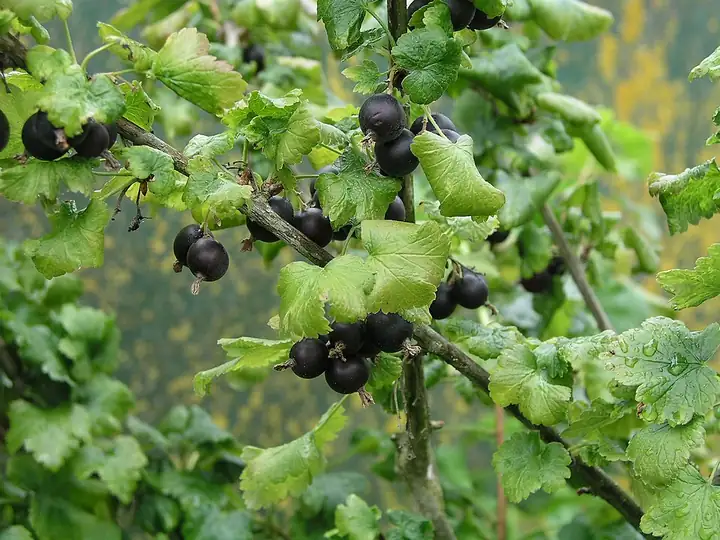
Jostaberry
Ribes x nidigrolaria (black currant x gooseberry) · Currant family (Grossulariaceae)
| Hardiness zones | 3 to 8 |
|---|---|
| Sun | full sun to part shade |
| Water | moderate |
| Life cycle | perennial |
| Frost | Hardy: takes frost |
| Spacing | 36 to 60 inches |
About Jostaberry
Jostaberry is a thornless cross between black currant and gooseberry, with clusters of dark berries that taste like a mild, sweet black currant. It is vigorous, heavy-yielding and resistant to powdery mildew and white pine blister rust (University of Minnesota). It is still a Ribes, so check your state's rules before planting: North Carolina bans all Ribes.
University of Minnesota rates its hardiness excellent to very good in zones 3-5; it is grown through about zone 8 where summers aren't too hot.
When to plant
Timing is counted from your average last spring frost (and first fall frost). Sow & Tell works out the actual dates for your ZIP code.
Plant once temperatures below 20 F are past (University of Minnesota). Give currant-family shrubs at least 3 feet, and vigorous black-currant types 4-5 feet. Expect fruit 1 to 3 years after planting; fruit forms on 1- to 3-year-old wood.
Soil
Rich, well-drained soil gives the best crops, though currant-family shrubs tolerate marginal soil; test the soil first (University of Minnesota).
Test the soil for pH and nutrients and choose rich, well-drained ground (University of Minnesota).
Feeding
- Each year in late fall: well-composted manure or other nitrogen-rich compost. A few shovelfuls spread around each plant (University of Minnesota).
Keep the canopy open with yearly late-winter pruning, leaving 9-12 canes on a mature shrub (University of Minnesota).
Harvest
Pick when the berries change color and flavor, soften slightly and come away easily; cool them quickly (University of Minnesota). The fruit clings tightly and does not drop (UW-Madison CIAS).
Jostaberry, a gooseberry and black currant cross, is grown like its parents, which give one crop a year in June-July; the berries hold on the bush, so one or two pickings usually do it.
Varieties (4)
Only 4 named jostaberries are documented by sources we could open (USDA GRIN, UMass). Most jostaberries sold in the US are simply labeled "jostaberry," and the University of Wisconsin found plants from different sources were likely the same old clone. Sources do not give zones for single cultivars; the Minnesota Extension rates jostaberry as a group very hardy in zones 3-5.
| Variety | Type | Days | Notes |
|---|---|---|---|
| Jogranda | Jostaberry (black currant x gooseberry) | ||
| Josta | Jostaberry (black currant x gooseberry) | Berries look more like a black currant than a gooseberry, with a much milder taste. Good for cooking and jam. Very vigorous, spreading, thornless bush with high yields. Resists powdery mildew, white pine blister rust and gall mites. | |
| Jostine | Jostaberry (black currant x gooseberry) | Medium to large berries with very good flavor; good for jams, jellies and pies. Vigorous, spreading, thornless bush with high yields. Berries come one to three per cluster and ripen unevenly. Resists powdery mildew, white pine blister rust, leaf spot and gall mites. | |
| Orus 8 | Jostaberry (black currant x gooseberry) | Purple berries of about 1.5-2 grams; flavor varied from poor to excellent across years in USDA trials. Moderately vigorous, semi-upright bush with some thorns and pink flowers. Showed no powdery mildew and no white pine blister rust in USDA trials. |
Pests to watch for
Aphids, Twospotted spider mite
Diseases and problems
Powdery mildew, White pine blister rust
In the kitchen
Good for fresh eating and for cooking and processing (UW-Madison CIAS).
Keeping it: Cool berries quickly after picking; covered in the fridge they keep up to several weeks.
Safety: The sources we checked list no toxic parts, and we found no research-based guidance on pregnancy, drug interactions or allergies. Currant-family plants can host white pine blister rust, so some states restrict them: North Carolina bans growing any Ribes (NC Department of Agriculture); jostaberry itself resists the disease (University of Minnesota).
Pets: Not listed as toxic by the ASPCA
Sources
Photo: Photo: Oknarf2004 / Wikimedia Commons, CC BY-SA 4.0 (CC BY-SA 4.0). Photo resized for the web.

Planting dates and advice are general guidance; check with your local Cooperative Extension office for your area.