
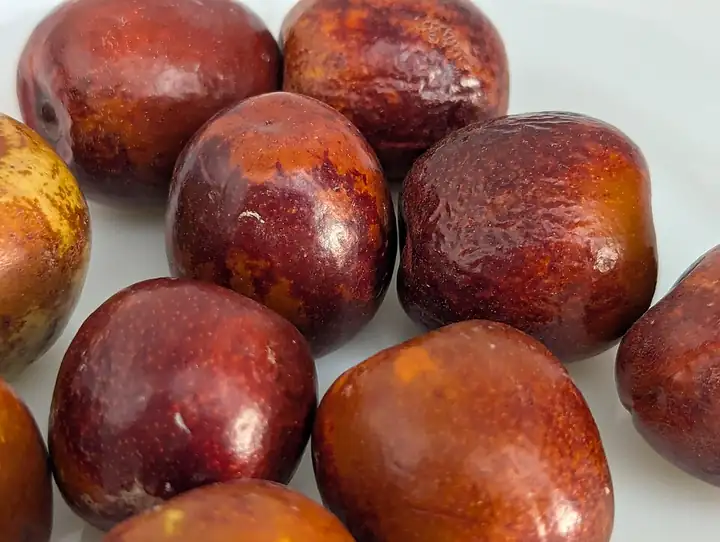
Jujube
Ziziphus jujuba · Buckthorn family (Rhamnaceae)
| Hardiness zones | 5 to 10 |
|---|---|
| Sun | full sun |
| Water | low |
| Life cycle | perennial |
| Frost | Hardy: takes frost |
| Soil pH | 5.0–8.5 |
| Spacing | 72 to 144 inches |
About Jujube
Jujube, or Chinese date, is a tough deciduous tree with zigzag, thorny branches and small fruit that eats like a crisp, sweet apple when fresh and like a date when dried. It shrugs off heat, drought and poor soil, leafs out late enough to miss spring frosts, and has few pests in the U.S. Its big drawback is root suckers that can pop up several feet away and form thorny thickets; Texas A&M's rangeland guide calls it an exotic invasive.
UF/IFAS reports it in zones 5-10, doing best in 6-9, and established trees take about -20 F; Texas A&M lists zones 6-9. Fruit needs long, hot summers to ripen (Arizona Extension). It has escaped along the Gulf Coast (USDA Forest Service), and in Texas and western Oklahoma it is treated as invasive on rangeland.
When to plant
Timing is counted from your average last spring frost (and first fall frost). Sow & Tell works out the actual dates for your ZIP code.
Plant 1- to 2-year-old container or bare-root trees as you would other fruit trees, 6 to 12 feet apart, and water regularly until they settle in (Texas A&M AgriLife). Trees often flower the year they are planted, but real crops start in about 3 to 5 years (UF/IFAS; NMSU).
Soil
Grows in sandy, loam or clay soil as long as it drains fairly well; above pH 7.8 it may run short of minor nutrients (NMSU; Texas A&M).
Plant in full sun in well-drained soil; get a soil test first, since the right fertilizer depends on soil pH (Texas A&M AgriLife).
Feeding
- First and second years: April, May and June: Nitrogen fertilizer. Split the year's nitrogen into three equal monthly feedings, scattered around the tree and watered in (Texas A&M).
- Each spring after that, just before new growth: Nitrogen fertilizer; or a 3-1-2 ratio fertilizer where soil pH is below 7.5. Texas A&M suggests about 0.2 lb of actual nitrogen per inch of trunk diameter, up to 1 lb a year, spread under the canopy; use nitrogen only where pH is above 7.5.
Heavy doses of quick-release nitrogen can make fruit drop (UF/IFAS); jujubes do well on little fertilizer (Arizona Extension).
Harvest
Fruit ripens unevenly over several weeks, mostly August to October (NMSU). For fresh eating, pick from the cream-colored stage until it is red-brown but still firm; many people like the few days between the first brown color and wrinkling (NMSU; Arizona Extension). For drying, let it turn fully red-brown.
One crop a year, but fruit ripens unevenly, so you pick the same tree several times over a few weeks. Fruit left on the tree dries like raisins.
Varieties (21)
| Variety | Type | Days | Notes |
|---|---|---|---|
| Mopan | Ornamental | Also sold as 'Mushroom'; fruit shaped like a button mushroom. Recommended for ornamental use in Texas. | |
| Teapot | Ornamental | Odd fruit with up to five bumps; recommended for ornamental use in Texas. | |
| Alcalde #1 | Very good fresh quality. Large fruit on a small tree; suits short-season areas. UF/IFAS lists it as 'Autumn Beauty' (Qi Yue Xian). | ||
| Black Sea | Excellent fresh quality. Also called 'Russian 2'. Small fruit; productive while young and does well in wet climates. | ||
| Chico | Good flavor even when green; somewhat tart. Oval fruit up to about 2 inches long, for fresh eating or drying. | ||
| Dongzao | Superb fresh: thin skin and fine texture. Medium fruit; China's top fresh jujube. Not very productive while young. | ||
| GA866 | Very high sugar; excellent quality. Long, pointed fruit on an upright tree; slow to start bearing. | ||
| Honey Jar | Very sweet and crisp; excellent fresh. Small round fruit on a short tree; can fruit the year it is planted. | ||
| Kongfucui | Excellent fresh quality. Shiny skin; very productive across New Mexico; also dries. | ||
| Lang | Best when fully red-brown. Large pear-shaped fruit, heavy crops, good for drying; spreading tree. Fruit may split if it rains at harvest. | ||
| Li | Crisp, apple-like and among the best flavored. Large round fruit up to about 3 oz with mahogany skin; good fresh or dried. | ||
| Maya | Excellent fresh quality. Small, football-shaped fruit; good for home gardens. | ||
| Norris #1 | Good quality. Found near Norris Dam in eastern Tennessee; bears heavily in warm, humid climates. | ||
| Shanxi Li | Large, sweet, apple-like fruit. Bears young and heavily; similar to Li. | ||
| Sherwood | Sweet, firm fruit. Good fresh and dried; thornless, upright young tree from Louisiana. Needs a long season; UF notes erratic size and yields. | ||
| Sihong | Firm; many consider it the best flavored. Good fresh and excellent dried; bears young. | ||
| So | Balanced sweet-tart. Ornamental tree with contorted zigzag branches; medium round fruit for fresh or drying. | ||
| Sugar Cane | Very sweet and crunchy. Small to medium round fruit, good fresh or dried; spiny tree. | ||
| Tigertooth | Small, plentiful fruit; grows well on its own roots but suckers freely. Noted for heavy crops in Florida. | ||
| Winter Delight | Spicy-sweet. Large egg-shaped fruit; superior cold tolerance. | ||
| Yazoo Li | Better flavor than Li. Very large fruit; thought to be a seedling of Li, from Mississippi. |
Pests to watch for
Birds, Stink bugs, Deer, Rabbits, Pocket gophers
Diseases and problems
Cotton root rot, Alternaria leaf spot, Fruit cracking
In the kitchen
Eaten fresh like a small crisp apple, or dried like dates or raisins; also candied, pickled or canned, and used in desserts, sauces, salads, soups and teas (Texas A&M AgriLife; NMSU).
Keeping it: Fresh jujubes picked at first ripeness keep two weeks or more at about 40 F (NMSU). Dried fruit keeps well at room temperature and for years in the refrigerator (UF/IFAS).
Safety: The fruit is a common food, but every jujube has a hard, pointed pit, so eat carefully (Texas A&M AgriLife). The thorny branches can hurt children and pets; keep trees away from walks and play areas (Texas A&M AgriLife).
Pets: Not listed by the ASPCA
Sources
- pubs.nmsu.edu
- ask.ifas.ufl.edu
- aggie-horticulture.tamu.edu
- mytexas.ag.tamu.edu
- extension.arizona.edu
- fs.usda.gov
- rangeplants.tamu.edu
- aspca.org
- aspca.org
- aspca.org
Photo: Photo: Ismael Olea / Wikimedia Commons, CC BY 4.0 (CC BY 4.0). Photo resized for the web.

Planting dates and advice are general guidance; check with your local Cooperative Extension office for your area.