
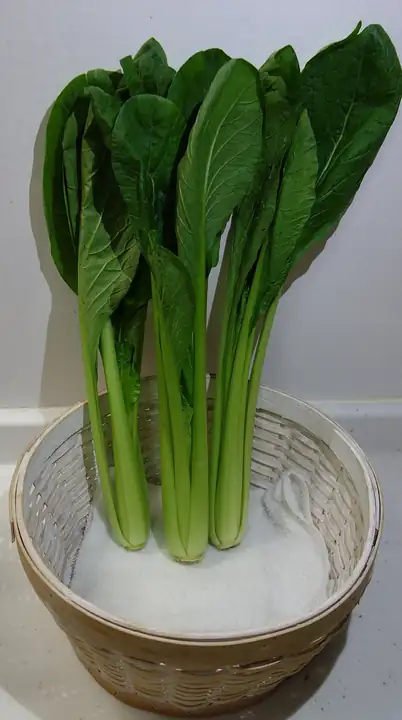
Komatsuna
Brassica rapa var. perviridis · Cabbage family (Brassicaceae)
| Hardiness zones | 2 to 11 |
|---|---|
| Sun | full sun |
| Water | moderate |
| Life cycle | annual |
| Frost | Half-hardy: takes a light frost |
| Days to harvest | 35 to 50 days |
About Komatsuna
Komatsuna, also called mustard spinach, is a Japanese leafy green with smooth, dark-green leaves on slender stems. It is a fast, easy cousin of turnip and bok choy. California master gardeners found it vigorous and hardy, giving leaves from late spring through fall and holding up in summer heat.
Grown as an annual in every zone, in spring, summer and fall. It is the same species as field mustard, which the California Invasive Plant Council rates Limited (advisory).
When to plant
Timing is counted from your average last spring frost (and first fall frost). Sow & Tell works out the actual dates for your ZIP code.
Days count from seeding (Cornell lists 35 days; Texas A&M 50). Sow seed directly in the garden in spring and again in late summer; in the Northeast, late-summer sowings are picked from mid-October into December.
Soil
Fertile, well-drained soil prepared as for turnip and mustard greens, with fertilizer worked in before sowing.
Follow a soil test. Texas A&M's guide for turnip and mustard greens, the closest crops with tested advice, scatters 2 to 3 lb of a complete fertilizer such as 10-20-10 per 100 sq ft before planting.
Feeding
- when plants are 4 to 5 inches tall: complete fertilizer such as 10-20-10. About 1/2 cup per 10 ft of row beside the plants, mixed in lightly and watered in; repeat later on sandy soil in a wet season.
Harvest
Pick outer leaves as you need them or cut whole young plants. Plants kept picked keep making new leaves for months.
Keep picking leaves and the plants keep making more; in a California trial one sowing gave leaves from late spring through fall.
Varieties (1)
Extension sources name only 1 komatsuna variety; Texas A&M lists it simply as komatsuna (about 50 days).
| Variety | Type | Days | Notes |
|---|---|---|---|
| Summer Fest | Crisp, spicy leaves. Vigorous and hardy; in a California master gardener trial it gave leaves from late spring through fall and held up in summer heat. |
Pests to watch for
Flea beetles
In the kitchen
Leaves and stems are cooked in soups, stir-fries and sautes.
Keeping it: Keep leaves in a closed plastic bag in the refrigerator and use them within several days, as with other greens.
Safety: If you take the blood thinner warfarin, keep the amount of leafy greens you eat about the same from day to day, because they are rich in vitamin K (NIH Office of Dietary Supplements).
Pets: Not listed by the ASPCA
Sources
- ccfruitandnuts.ucanr.edu
- extension.oregonstate.edu
- rvpadmin.cce.cornell.edu
- agrilifeextension.tamu.edu
- aggie-horticulture.tamu.edu
- cal-ipc.org
- ods.od.nih.gov
- aspca.org
- aspca.org
Photo: Photo: ぱたごん, CC0, via Wikimedia Commons (CC0). Photo resized for the web.

Planting dates and advice are general guidance; check with your local Cooperative Extension office for your area.