
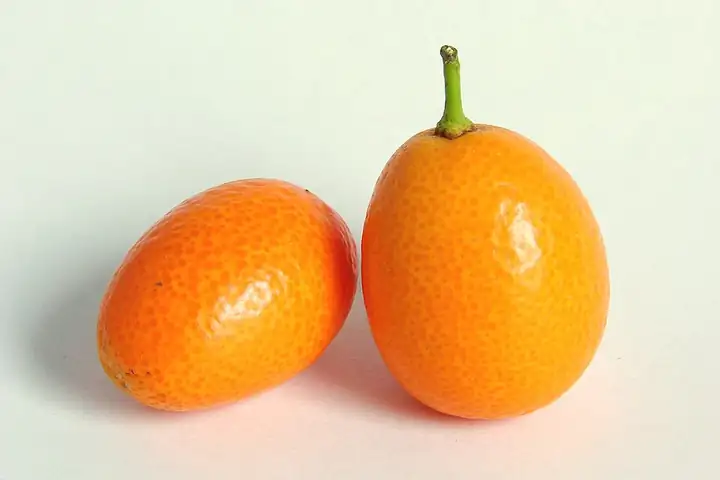
Kumquat
Citrus japonica (Fortunella spp.) · Citrus family (Rutaceae)
| Hardiness zones | 8 to 11 |
|---|---|
| Sun | full sun |
| Water | moderate |
| Life cycle | perennial |
| Frost | Half-hardy: takes a light frost |
| Soil pH | 5.5–6.5 |
| Spacing | 72 to 120 inches |
About Kumquat
Kumquats are small, bushy citrus with bite-size fruit that you eat whole: the thin peel is sweet and the flesh is tart. They are the most cold-hardy of the common citrus because they rest through winter, and they fruit from fall through early spring. Their small size makes them a natural pick for a big pot.
We found no source giving zones. UF says kumquats take about 16 F (fully dormant trees have survived 10 F), and UGA gives 15-17 F, so they are the hardiest common citrus for in-ground planting. Those temperatures fall in USDA zone 8b (winter lows of 15-20 F), so the 8-11 range shown is our estimate from them.
When to plant
Timing is counted from your average last spring frost (and first fall frost). Sow & Tell works out the actual dates for your ZIP code.
- Set out plants: up to 2 weeks after the last frost
A potted tree goes outside after the last spring frost and is eased into full sun over about two weeks (Maryland Extension; Wisconsin says wait until temperatures stay above 50 F). In the ground, UGA spaces small citrus like kumquats 6 to 10 feet apart and plants in early spring.
Soil
Well-drained soil in a sunny spot (UF says kumquats tolerate a little shade); in pots a fast-draining bark-based mix (UF/IFAS; Mississippi State).
Pot it in a fast-draining, slightly acid potting mix (bark-based, or palm-and-cactus mix) in a container with drainage holes, never garden soil; in the ground, test the soil and keep the pH around 6.0-7.0 (Mississippi State; UC Master Gardeners; UGA).
Feeding
- First feeding after planting, once new growth starts (about 4 to 6 weeks): citrus fertilizer with micronutrients (about a 2-1-1 or 3-1-1 N-P-K ratio with iron, manganese and zinc, or a slow-release 12-6-6 or 12-4-6). Follow the label for a pot; in the ground, UGA starts a young tree with about 1/3 lb of 8-8-8 with micronutrients spread in a 30-inch circle and watered in.
- Early spring each year, as new growth begins: citrus fertilizer with micronutrients (N-P-K about 2-1-1 or 3-1-1). Slow-release granules need 2 to 3 feedings a season; a water-soluble citrus food can instead go on about once a month from late winter to fall (Clemson; Maryland; UC Master Gardeners; Texas A&M).
- Early summer: citrus fertilizer with micronutrients. Repeat the spring feeding at the label rate and water it in (Maryland Extension).
- Late summer (the last feeding of the year): citrus fertilizer with micronutrients. Give the final feeding, then stop by early fall so new growth can harden before winter; in the ground, UGA says no fertilizer from August 1 to February 15.
- Any time young leaves turn yellow with green veins: chelated iron fertilizer or a sulfur soil acidifier. Apply as the label directs; this pattern usually means iron is short or the mix is not acid enough (Maryland Extension).
Don't feed through the winter indoors (Wisconsin and Minnesota feed only about April to September), and don't overwater or let the root ball dry out: too much water drops leaves and too little drops flowers (Maryland; Mississippi State). Kumquats are especially prone to zinc deficiency, so pick a fertilizer that lists zinc (UC Riverside).
Harvest
Fruit colors up from about October and keeps coming through March; pick when fully orange and eat it skin and all (UF/IFAS). Nagami and Meiwa fruit hold well on the tree (UC Riverside).
Kumquats give one long harvest each year: fruit is ripe by October and the tree keeps offering fruit through March.
Varieties (11)
Sources document 6 true kumquats and 5 kumquat hybrids (limequats, mandarinquat, orangequat) that are grown the same way.
| Variety | Type | Days | Notes |
|---|---|---|---|
| Centennial Variegated | Kumquat (USDA-ARS, 1993) | Sour, juicy flesh with few seeds. Striped green-and-yellow young fruit that turn orange; leaves marked with cream and pale yellow. Fruit up to 2 1/2 in long, with more juicy flesh and a thinner peel than Nagami. Small, thornless, upright shrub. | |
| Indio mandarinquat | Kumquat hybrid | A kumquat x mandarin hybrid with orange fruit; UC Riverside's page gives little other description. | |
| Fukushu (Changshou) | Kumquat hybrid (Fortunella obovata) | Sour flesh; the rind is sweet but a bit sharp from its oils. Oval fruit about 1 1/2 in long with a thinner rind than Nagami or Meiwa and a few seeds. Small, spreading, thornless tree with larger leaves than other kumquats. | |
| Nippon orangequat | Kumquat hybrid (satsuma x Meiwa) | More sour than sweet. Small oval fruit, larger than a kumquat, with a thick spongy rind and few seeds. Slow-growing, medium-small, spreading tree. | |
| Eustis limequat | Limequat (lime x kumquat) | Like a Key lime; a fair lime substitute. Fruit about the size, shape and color of a Key lime, with an edible peel and seeds. Hardier than lime but much less hardy than kumquat. | |
| Lakeland limequat | Limequat (lime x kumquat) | Very cold-hardy for a lime type (about the same as tangerine, in the low 20s F). | |
| Tavares limequat | Limequat (lime x kumquat) | Lime-like. Lime-size fruit with the orange color of a kumquat; more upright than other limequats. | |
| Nagami | Oval kumquat (Fortunella margarita) | Sweet rind and sour flesh; UF calls it the more sour kumquat. Oval fruit about 1 1/4 in long with about five or six seeds. Small to medium, dense tree; very cold-hardy because it rests in winter. | |
| Nordmann Seedless | Oval kumquat (Fortunella margarita) | Tart and fairly juicy, like Nagami. Seedless, teardrop-shaped fruit up to 2 in long with a yellow-orange rind. Small to medium tree that bears heavily and is fairly cold-hardy. | |
| Meiwa | Round kumquat (Fortunella crassifolia) | Thick, sweet rind that makes the whole fruit taste sweeter than Nagami; UC Riverside calls it the best kumquat for eating fresh. Nearly round fruit up to about 1 1/2 in across with few or no seeds. Slightly less cold-hardy than Nagami; survived about 16 F in Clemson's cold-hardiness table. | |
| Marumi | Round kumquat (Fortunella japonica) | Rind is spicy and aromatic; pulp is sparse and sour. Small, round fruit about 1 to 1 1/4 in across with one to three seeds. Very small, slightly thorny shrub. |
Pests to watch for
Scale insects, Mealybugs, Aphids, Whiteflies, Twospotted spider mite, Citrus leafminer, Asian citrus psyllid
Diseases and problems
Zinc deficiency, Root rot, Sooty mold, Citrus greening (HLB)
In the kitchen
Eaten fresh like grapes, peel and all, or made into marmalade, jelly and chutney (UF/IFAS).
Keeping it: Fruit keeps ripening from fall into March, so pick a handful as you need them. Like other citrus, picked fruit keeps a few weeks in the fridge.
Safety: The sources we checked list no toxic parts, and we found no research-based guidance on use in pregnancy, drug interactions or allergies.
Pets: Not listed by the ASPCA; the ASPCA does list orange, lemon, lime and calamondin as toxic to dogs, cats and horses because of essential oils and psoralens in the plant.
Sources
- gardeningsolutions.ifas.ufl.edu
- gardeningsolutions.ifas.ufl.edu
- ufdcimages.uflib.ufl.edu
- fieldreport.caes.uga.edu
- extension.msstate.edu
- ask.ifas.ufl.edu
- citrusvariety.ucr.edu
- citrusvariety.ucr.edu
- citrusvariety.ucr.edu
- citrusvariety.ucr.edu
- hort.extension.wisc.edu
- extension.umd.edu
- ucanr.edu
- hgic.clemson.edu
- aspca.org
- aspca.org
- aphis.usda.gov
- usda.gov
- sandiegocounty.gov
- aggie-horticulture.tamu.edu
- agrilifetoday.tamu.edu
- extension.umn.edu
Photo: Photo: David R. Tribble (Loadmaster), CC BY-SA 3.0, via Wikimedia Commons (CC BY-SA 3.0). Photo resized for the web.

Planting dates and advice are general guidance; check with your local Cooperative Extension office for your area.