
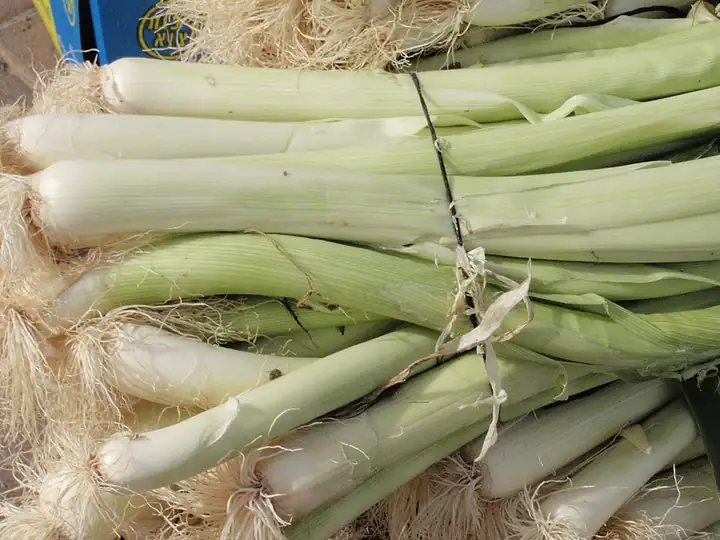
Leek
Allium ampeloprasum var. porrum · Amaryllis family (Amaryllidaceae)
| Hardiness zones | 2 to 11 |
|---|---|
| Sun | full sun |
| Water | moderate |
| Life cycle | biennial |
| Frost | Hardy: takes frost |
| Soil pH | 6.0–7.0 |
| Spacing | 2 to 6 inches |
| Days to harvest | 90 to 150 days |
| Soil temperature to plant | at least 40°F |
About Leek
Leeks are mild members of the onion family grown for their thick white shafts rather than bulbs. They are slow but easy, and many varieties stand well into fall frosts.
Grown as an annual in every zone; some varieties survive temperatures near 20F, so they can be harvested late into fall.
When to plant
Timing is counted from your average last spring frost (and first fall frost). Sow & Tell works out the actual dates for your ZIP code.
- Start seeds indoors: 12 to 14 weeks before the last frost
- Set out plants: 4 weeks before the last frost
Days count from seeding; most varieties need 120 days or more, and a few newer ones mature in about 90. Start seed indoors 8 to 10 weeks before transplanting, and set plants into a 6-inch-deep furrow that you fill in as they grow.
Soil
Well-drained soil high in organic matter; water the soil rather than the leaves to limit disease.
Use well-drained soil high in organic matter with pH 6.0 to 7.0; follow a soil test for phosphorus and potassium (without one, about 2.5 lb of 5-10-10 per 100 sq ft before planting).
Feeding
- midsummer: balanced fertilizer such as 10-10-10. Use about 1 cup per 10 ft of row, 6 inches from the plants, scratch it in and water.
Do not use fresh manure; skip extra phosphorus unless a soil test calls for it.
Harvest
Dig leeks once the stem is more than an inch wide, with a firm white shaft at least 3 inches long. Hilling soil or compost around the stems a few times during the season makes a longer white shaft.
Each leek is dug once, when the stem is over an inch thick with at least 3 inches of white shaft. Leeks handle several frosts, so with mulch you can keep digging them into late fall.
Varieties (11)
Few extension sources describe leek varieties in detail; most give names only. Most leeks need about 120 to 150 days, though some newer types are faster (Minnesota Extension).
| Variety | Type | Days | Notes |
|---|---|---|---|
| Tadorna | Fall leek | 100 days | Kentucky lists it as a fall leek. |
| American Flag | Heirloom | 130 days | A long-season heirloom, also sold as Large American Flag. It is on lists from Texas and Florida to Utah and Wisconsin. |
| Arkansas | Clemson recommends it for South Carolina. | ||
| Comanche | Utah State lists it among excellent leeks. | ||
| Frontier | Recommended for North Central Texas. | ||
| Giant Musselburgh | On Wisconsin Extension's allium guide list. | ||
| King Richard | 75 days | Texas lists it at about 75 days, much shorter than older leeks. Utah State rates it excellent. | |
| Lancelot | 95 days | On Kentucky's and Wisconsin's lists. | |
| Lincoln | On Wisconsin Extension's list. | ||
| Otina | On Wisconsin Extension's lists. | ||
| Pancho | An early, vigorous leek with 12- to 16-inch shafts. Plants are medium green, upright, easy to peel and tolerant of bolting. Also called Cisco. |
Pests to watch for
Onion maggot, Thrips, Slugs, Allium leafminer
Diseases and problems
Rust, Purple blotch, Neck rot
In the kitchen
Cooked in soups (like potato-leek), braised, sauteed or roasted; rinse well, since soil hides between the layers.
Keeping it: Refrigerate leeks unwashed and use them within 7 to 10 days for best flavor; they keep longer but slowly lose quality. Many varieties can also stay in the garden into fall frosts.
Safety: Handling leeks can irritate the skin of some people, and eating very large amounts can upset the stomach (NC State).
Pets: Toxic to dogs, cats and horses (ASPCA): contains N-propyl disulfide, which damages red blood cells and can cause vomiting, anemia, weakness, a fast heart rate and panting.
Sources
- extension.umn.edu
- plants.ces.ncsu.edu
- hgic.clemson.edu
- extension.unh.edu
- extension.colostate.edu
- aspca.org
Photo: Photo: Ariel Palmon, CC BY 3.0, via Wikimedia Commons (CC BY 3.0). Photo resized for the web.

Planting dates and advice are general guidance; check with your local Cooperative Extension office for your area.