
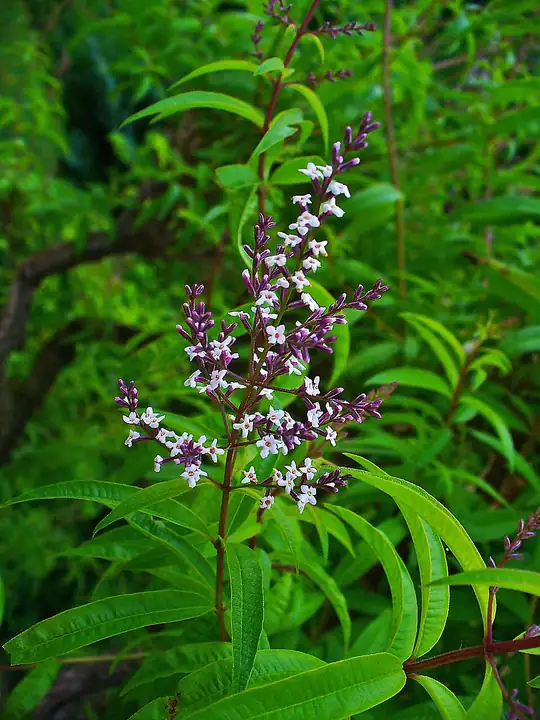
Lemon verbena
Aloysia citrodora (syn. A. triphylla, A. citriodora) · Verbena family (Verbenaceae)
| Hardiness zones | 8 to 10 |
|---|---|
| Sun | full sun |
| Water | moderate |
| Life cycle | tender perennial (grown as an annual) |
| Frost | Half-hardy: takes a light frost |
| Spacing | 36 to 72 inches |
About Lemon verbena
Lemon verbena is a woody shrub from Argentina and Chile whose leaves smell and taste strongly of lemon. In mild climates it can reach 6-8 feet, while elsewhere it is grown in a pot or as a summer plant. Small white to lavender flowers appear from July to September.
Hardy only in zones 8-10 (NC State); in colder areas grow it in a container and bring it indoors for winter, where it drops its leaves.
When to plant
Timing is counted from your average last spring frost (and first fall frost). Sow & Tell works out the actual dates for your ZIP code.
Start from stem cuttings; seed set is unreliable in North America (NC State), though MU Extension also lists spring seeding. It rarely survives winter outdoors in cold areas but does well indoors (MU Extension). In pots it stays 2-4 feet tall (NC State).
Soil
Well-drained soil rich in organic matter, loam or sand, kept evenly moist (NC State).
Plant in full sun in well-drained soil rich in organic matter; herbs grow best at a pH of about 6.0-7.5. Follow a soil test.
Feeding
- once per growing season, for plants in the ground: complete fertilizer such as 5-10-5. Scatter about 3 oz per 10 feet of row around the plants and water it in.
- every 3-4 weeks in summer, for plants in outdoor pots (every 6 weeks indoors): liquid fertilizer at half strength. Water it in at half the label strength.
Avoid heavy clay, soggy soil and overly fertile sites, as for most herbs.
Harvest
Pick leaves through the summer for tea and cooking; they can be used fresh or dried (UMN).
Pick leaves through the summer for tea and cooking, and prune in early spring for bushier growth. In cold areas grow it in a pot and bring it indoors for winter, where it drops its leaves.
Pests to watch for
Aphids, Whiteflies, Twospotted spider mite
In the kitchen
Leaves and flowers flavor teas, cold drinks, desserts, fruit salads, jams and jellies, and dried leaves make a lemon syrup (NC State, MU Extension, UMN).
Keeping it: Use fresh leaves within a few days, kept wrapped in the fridge. Dried leaves hold their lemon scent well in a sealed container.
Safety: Europe's medicines agency (EMA) knows of no side effects or drug interactions but does not recommend lemon verbena products for children or during pregnancy and breastfeeding, for lack of safety data. Skip it if you are allergic to verbena-family plants.
Pets: Toxic to dogs, cats and horses (ASPCA): its essential oils can cause stomach upset and colic, though small amounts used in cooking are not a concern.
Sources
- plants.ces.ncsu.edu
- extension.missouri.edu
- extension.umn.edu
- ema.europa.eu
- aspca.org
- plantsservices.sc.egov.usda.gov
- extension.umn.edu
Photo: Photo: H. Zell / Wikimedia Commons, CC BY-SA 3.0 (CC BY-SA 3.0). Photo resized for the web.

Planting dates and advice are general guidance; check with your local Cooperative Extension office for your area.