
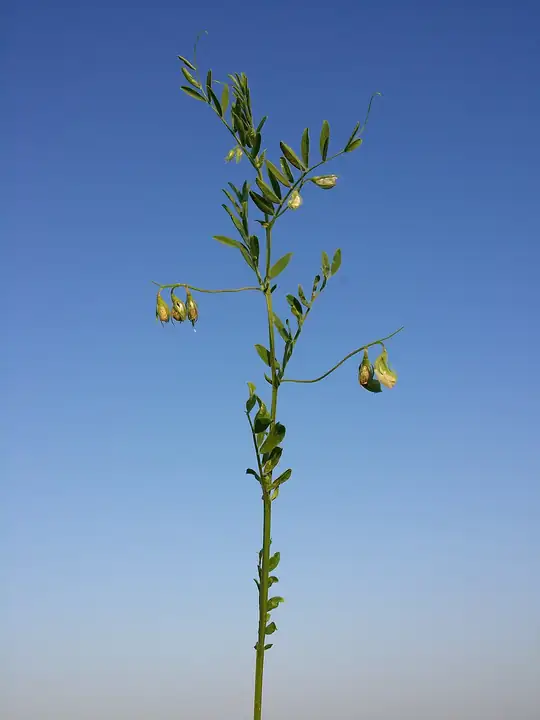
Lentil
Lens culinaris · Pea family (Fabaceae)
| Hardiness zones | 3 to 11 |
|---|---|
| Sun | full sun |
| Water | low |
| Life cycle | annual |
| Frost | Hardy: takes frost |
| Soil pH | 6.0–8.0 |
| Spacing | 4 to 6 inches |
| Days to harvest | 80 to 100 days |
| Soil temperature to plant | at least 40°F |
About Lentil
Lentils are a small, cool-season legume, 12 to 16 inches tall, grown for flat seeds in green, brown, red, golden and black types. They are planted early in spring, shrug off frost, need little water, and cook quickly without soaking. Montana grows almost 40% of U.S. lentils.
Grown as a cool-season annual: sown in early spring in the North, and in the South Clemson plants it from January to May as a winter-spring crop. Seedlings survive frosts down to about 21F.
When to plant
Timing is counted from your average last spring frost (and first fall frost). Sow & Tell works out the actual dates for your ZIP code.
- Sow seeds outdoors: 1 to 2 weeks before the last frost
Days count from seeding to dry seed (Montana State: about 80-100 days; some varieties took 113-116 days in Clemson trials). Sow 1 to 2 inches deep and about 2 inches apart, 1 to 2 weeks before the last spring frost once soil is at least 40F, then thin to 4-6 inches. Inoculate with the pea/lentil Rhizobium.
Soil
Well-drained sandy loam with pH 6 to 8; too much water can kill the plants.
Add phosphorus and potassium as a soil test recommends; a little starter nitrogen helps only on soils very low in nitrogen.
Feeding
Don't overwater: lentils need only about 10 inches of water in a season, and too much can kill them; stop watering when pods start to dry.
Harvest
Green pods can be picked and shelled like peas. For dry lentils, let pods dry fully on the plant (about 80-100 days), stop watering as pods begin to dry, then pull plants, thresh, and take the lentils out of the pods before storing.
Lentils are harvested once, when pods are fully dry, about 80 to 100 days after sowing; a few green pods can be picked earlier and shelled like peas.
Varieties (13)
Montana State and Clemson describe 13 lentil varieties and types; most U.S. lentils are bred for farm production and sold to gardeners by color (red, green, brown, French green, black).
| Variety | Type | Days | Notes |
|---|---|---|---|
| Black Beluga | Black | Small, round black lentil that holds its shape in salads and soups. | |
| Pardina | Brown (Spanish brown) | Small, round brown lentil that holds its shape; good sprouted or in soups and salads. | |
| CDC Peridot | French green | French green-type lentil. | |
| Riveland | Green (extra large) | Extra-large green lentil, about 8 mm across. | |
| Avondale | Green (medium) | 115 days | Medium green lentil; the top yielder in Clemson's trial. |
| CDC Impress | Green (medium) | Clearfield green lentil that did well in Montana trials. | |
| CDC Imvincible | Green (small) | Small green lentil. | |
| CDC Impact | Red (extra small) | Extra-small red lentil, about 3 mm. | |
| CDC Impala | Red (extra small) | Clearfield (herbicide-tolerant) red lentil that did well in Montana trials. | |
| Crimson | Red (extra small) | Extra-small red lentil, about 3 mm. | |
| CDC Dazil | Red (small) | Small red lentil; the lowest yield in Clemson's trial. | |
| CDC Maxim | Red (small) | Small red lentil. | |
| CDC Proclaim | Red (small) | 113 days | Small red lentil in Clemson's South Carolina trials. |
Pests to watch for
Grasshoppers, Tarnished plant bug, Cutworms, Wireworms, Aphids
Diseases and problems
Ascochyta blight, Anthracnose, Stemphylium blight, Gray mold (Botrytis), White mold, Root and crown rot, Mosaic viruses
In the kitchen
Simmer lentils without soaking for soups, stews, salads, Indian dals and veggie burgers; red and golden types cook down soft for sauces and purees, while green, brown, French green and black lentils hold their shape.
Keeping it: Shell dry lentils and keep them in airtight containers in a cool, dry place for up to a year; refrigerate cooked lentils up to 5 days.
Safety: The Extension sources we used list no toxic parts. Rinse and sort lentils before cooking to remove small stones, and cook them before eating (Montana State).
Pets: Not listed by the ASPCA
Sources
Photo: Photo: Stefan.lefnaer, CC BY-SA 4.0, via Wikimedia Commons (CC BY-SA 4.0). Photo resized for the web.

Planting dates and advice are general guidance; check with your local Cooperative Extension office for your area.