
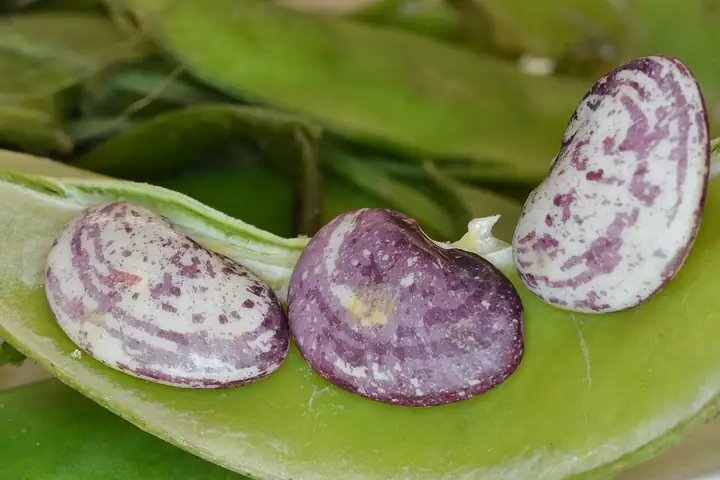
Lima beans
Phaseolus lunatus · Pea family (Fabaceae)
| Hardiness zones | 3 to 11 |
|---|---|
| Sun | full sun |
| Water | moderate |
| Life cycle | annual |
| Frost | Tender: killed by frost |
| Soil pH | 6.0–6.8 |
| Spacing | 3 to 4 inches |
| Days to harvest | 65 to 110 days |
| Soil temperature to plant | at least 65°F |
About Lima beans
Lima beans (butter beans) are grown for their big, creamy seeds, picked green for shelling. They need warmer soil and a longer season than snap beans, and come in bush and climbing pole types.
Grown as a warm-season annual in every zone; it is killed by frost, so plant it after the danger of frost has passed. Limas need warm soil and a long season; they are perennial only in frost-free climates (NC State lists zones 10-12).
When to plant
Timing is counted from your average last spring frost (and first fall frost). Sow & Tell works out the actual dates for your ZIP code.
- Sow seeds outdoors: 1 to 4 weeks after the last frost
- Fall planting: 8 to 10 weeks before the first fall frost
Days count from seeding: about 65 to 75 for bush limas and 85 to 110 for pole limas. Wait until the soil stays at 65F for several days. The spacing is for bush limas; pole limas need 12 to 18 inches, and the Texas fall window for them is 14 to 16 weeks before the first freeze.
Soil
Moist, well-drained soil rich in organic matter; water deeply during dry spells, especially once pods form.
Aim for a pH of about 6.0-6.8 and soil with moderate fertility; beans need only a medium level of nutrients from organic matter or fertilizer.
Feeding
Extra nitrogen delays flowering, so side-dressing is usually not needed.
Harvest
Pick when the pods are bright green and plump with full-sized seeds and the pod tips feel spongy.
Pole limas bear over a longer period and out-yield bush limas, which mature 10 to 15 days sooner. Pick pods when they are plump and bright green.
Varieties (15)
| Variety | Type | Days | Notes |
|---|---|---|---|
| Baby Fordhook | Bush | A smaller plant, pods and beans than regular Fordhook, with plump, high-quality seeds. | |
| Packers | Bush | Earlier and more concentrated pod set than most limas. Seeds are lime green, smooth and medium-small. | |
| Dixie Butterpea | Bush, baby lima, heirloom | 70 to 76 days | Sets pods even in high temperatures. Comes in white and speckled forms. |
| Henderson Bush | Bush, baby lima, heirloom | 65 to 68 days | Mississippi State calls it the most popular older variety. |
| Nemagreen | Bush, green-seeded | A nematode-resistant lima similar to Early Thorogreen. | |
| Fordhook 242 | Bush, large-seeded | 72 to 78 days | A heat-resistant improvement of the Fordhook type. The plant is larger than older Fordhooks, with slightly smaller beans but higher yields. |
| Early Thorogreen | Bush, small green-seeded | 72 days | Hardy and heavy-yielding, with a concentrated pod set and green seeds at the fresh stage. |
| Jackson Wonder | Bush, speckled, heirloom | 65 days | A small plant with purple-and-black mottled seeds. It dates to 1880s Georgia. |
| Red Calico | Butterbean, heirloom | An heirloom kept by the Thweat family of Tennessee since 1794. | |
| Carolina Sieva | Pole, heirloom | 75 to 80 days | An heirloom pole lima on the Central Texas list. Also sold as Sieva or Carolina. |
| Christmas | Pole, heirloom | 88 days | Climbing vines with large white seeds streaked with maroon. |
| Snow on the Mountain | Pole, heirloom | An 1800s pole lima with maroon seeds marked with white. | |
| King of the Garden | Pole, large-seeded, heirloom | 85 to 90 days | Large clusters of pods about 6 inches long. |
| Florida Speckled | Pole, speckled | 85 days | Keeps bearing well in hot weather. |
| Big Mama | On Wisconsin Extension's lima bean list. |
Pests to watch for
Stink bugs, Mexican bean beetle, Twospotted spider mite, Tarnished plant bug, Squash beetle, Cowpea curculio
Diseases and problems
Anthracnose, Bacterial blights of beans, Rust
In the kitchen
Shelled green beans are simmered, added to succotash and soups, or frozen; dried limas are soaked and cooked.
Keeping it: Refrigerate beans in the pod and shell them within 2 to 3 days; shelled beans keep only a day or two. Don't wash them before storing.
Safety: Never eat lima beans raw. The raw mature seeds contain compounds that release hydrocyanic acid and can be seriously poisonous; soak dried beans and cook them thoroughly (NC State).
Pets: Not listed as toxic by the ASPCA
Sources
- extension.umd.edu
- plants.ces.ncsu.edu
- agrilifeextension.tamu.edu
- extension.umd.edu
- hgic.clemson.edu
- hgic.clemson.edu
- aspca.org
- aspca.org
- horticulture.oregonstate.edu
- ucanr.edu
Photo: Photo: Jud McCranie, CC BY-SA 4.0, via Wikimedia Commons (CC BY-SA 4.0). Photo resized for the web.

Planting dates and advice are general guidance; check with your local Cooperative Extension office for your area.