
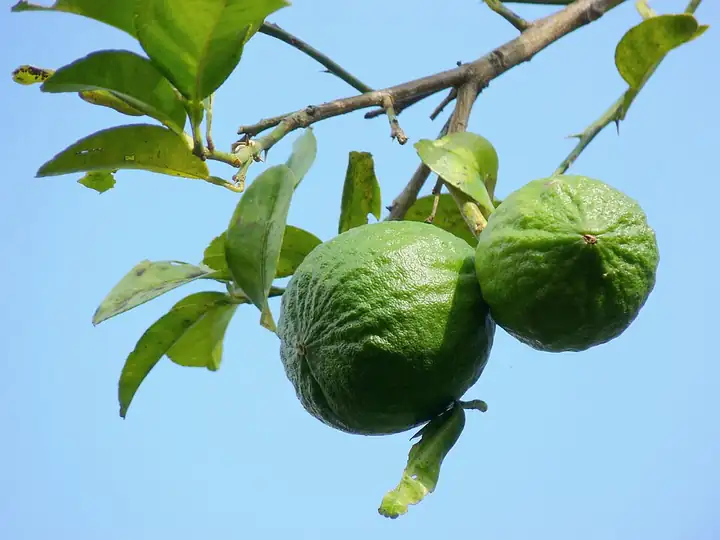
Lime (key and Persian)
Citrus aurantiifolia (key lime); Citrus × latifolia (Persian lime) · Citrus family (Rutaceae)
| Hardiness zones | 9 to 11 |
|---|---|
| Sun | full sun |
| Water | moderate |
| Life cycle | perennial |
| Frost | Tender: killed by frost |
| Spacing | 144 to 240 inches |
About Lime (key and Persian)
Two limes are grown at home. The key lime (also called Mexican or West Indian lime) is a small, thorny, bushy tree with small, seedy, very sour and fragrant fruit, and it is very sensitive to cold. The Persian lime ('Tahiti' or 'Bearss') has bigger, seedless fruit on a nearly thornless tree and is hardier than key lime (UC Riverside; UC Master Gardeners). Both bear fruit without a second tree.
NC State lists zones 9-11 for both. Key lime leaves are hurt at 30-32 F and wood below 29 F; Persian lime leaves are hurt below 28 F and trees are badly damaged below 24 F (UF/IFAS).
When to plant
Timing is counted from your average last spring frost (and first fall frost). Sow & Tell works out the actual dates for your ZIP code.
Move potted trees outdoors in spring once the danger of frost has passed (UMD). In zones 9-11, plant 12 to 20 feet from buildings and trees (UF/IFAS). Grafted key limes bear within about 3 years (UF/IFAS); Clemson says lemons and limes start fruiting in 1 to 3 years.
Soil
Many soils work if they drain well; limes can't stand flooding, and overwatering causes root rot (UF/IFAS; NC State). They grow in neutral to alkaline soils on the right rootstock (UF/IFAS).
Pot in a light, well-drained citrus, cactus or general potting mix in a pot with drainage holes (UMD). In the ground, limes need good drainage and can't take flooding (UF/IFAS).
Feeding
- Potted trees: early spring, as new growth starts: citrus fertilizer with micronutrients, with an N-P-K ratio near 2-1-1 or 3-1-1. Feed only while the tree is actively growing (UMD). Either mix slow-release fertilizer into the pot, or use a liquid citrus fertilizer once or twice a month (UC Master Gardeners); follow the label, since trees in pots need less than trees in the ground (UC IPM).
- Potted trees: early summer: citrus fertilizer with micronutrients. Give the second of at least three growing-season feedings (UMD), or keep up the liquid feeding. Potted citrus outdoors may need watering daily in summer (UMD), so check the pot often.
- Potted trees: late summer (last feeding of the year): citrus fertilizer with micronutrients. Give the last feeding in late summer and stop by early fall; don't feed through winter (UMD).
- Any time new leaves come out yellow with green veins (zinc, iron or manganese shortage): chelated micronutrient spray (zinc, iron, manganese). Spray the new spring growth with a chelated micronutrient product, or add zinc or iron sulfate to the soil (UC IPM); follow the label.
- In-ground trees (zones 9-11), first year, spread through the growing season: citrus fertilizer such as 6-6-6-2 with minor elements. UF/IFAS gives young key lime trees about 1/4 to 1/2 pound of 6-6-6-2 per feeding, 2 to 4 times the first year, rising each year; for Persian ('Tahiti') limes it gives 1/4 to 1/2 pound 3 to 4 times the first year, with minor-element sprays of copper, zinc, manganese and boron in spring and summer. Follow a soil test.
Don't feed in fall or winter (UMD; UC IPM). Extra nitrogen makes key lime anthracnose worse (UF/IFAS). Overwatering potted limes leads to root rot (NC State).
Harvest
Key limes are ripe when the peel turns yellow; the main crop comes in early summer in south Florida and later farther north (UF/IFAS). Persian limes are picked green, at about 1 3/4 inches across and dark to medium-dark green, 90 to 120 days after bloom; left on the tree they turn yellow and drop (UF/IFAS; UC Master Gardeners).
Persian (Tahiti) limes bear all year, with the most fruit June-August in Florida, about 90-120 days after bloom. Pick at about 1 3/4 inches across while still dark to medium-dark green; smaller fruit may have little juice.
Varieties (6)
Sources document 6 home-garden key and Persian limes. Key limes come true from seed, so few named selections exist (UF/IFAS), and the many Persian lime clones are nearly identical (UF/IFAS; UC Riverside). Sweet limes, Rangpur 'limes' and limequats are different plants and are not listed here.
| Variety | Type | Days | Notes |
|---|---|---|---|
| Giant Key | Key lime (small-fruited acid lime) | True key lime flavor and aroma. Fruit more than twice the size of an ordinary key lime. | |
| Mexican (Key lime) | Key lime (small-fruited acid lime) | Highly acidic and very aromatic; the classic key lime pie lime. Bushy, medium-sized tree with small, slender thorns and small pale leaves. Fruit about 1.5 inches across with a thin, smooth rind that turns greenish-yellow; seedy. | |
| Thornless Mexican | Key lime (small-fruited acid lime) | The same fruit as the regular Mexican lime on a tree without thorns. | |
| Bearss | Persian lime (large-fruited acid lime) | Acidic and juicy, with fine-textured, pale greenish-yellow flesh. Vigorous, spreading, nearly thornless tree. Seedless fruit about 2 to 2.5 inches across with a thin, smooth rind that turns light yellow when fully ripe; ripe fruit drops. | |
| Tahiti | Persian lime (large-fruited acid lime) | Very acidic with true lime flavor. Vigorous, broad-spreading, nearly thornless tree with drooping branches. Medium-small seedless fruit; pick it green at about 1 3/4 inches across. | |
| Variegated Tahiti | Variegated lime (sold as a Tahiti lime sport) | Green-and-white leaves and striped fruit about the size of a key lime, with a thick rind, many seeds and pale green flesh; new growth and flowers are purple-tinged. |
Pests to watch for
Asian citrus psyllid, Citrus leafminer, Aphids, Scale insects, Mealybugs, Twospotted spider mite, Whiteflies
Diseases and problems
Key lime anthracnose, Citrus canker, Citrus greening (HLB), Greasy spot, Foot rot, Tristeza virus, Root rot
In the kitchen
Juice goes into limeade, cocktails, iced tea, key lime pie and marinades, and is squeezed over seafood, papaya and avocado (UF/IFAS).
Keeping it: Keep limes in a plastic bag in the fridge. Key limes last about a week; firmer Persian limes usually hold longer.
Safety: The fruit is a common food. Lime juice or peel oil left on skin in sunlight can cause a burn-like rash (RHS advises gloves when handling the fruit). Persian lime may cause contact dermatitis in some people (NC State). Key lime trees carry short, sharp thorns (UF/IFAS).
Pets: Toxic to dogs, cats and horses (ASPCA): the peel and plant contain essential oils and psoralens that can cause vomiting, diarrhea, depression and skin irritation; the fruit flesh itself is edible.
Sources
- ask.ifas.ufl.edu
- ask.ifas.ufl.edu
- citrusvariety.ucr.edu
- citrusvariety.ucr.edu
- citrusvariety.ucr.edu
- plants.ces.ncsu.edu
- plants.ces.ncsu.edu
- extension.umd.edu
- lsuagcenter.com
- ucanr.edu
- hgic.clemson.edu
- rhs.org.uk
- aphis.usda.gov
- usda.gov
- aspca.org
- ipm.ucanr.edu
Photo: Photo: Jeevan Jose, CC BY-SA 4.0, via Wikimedia Commons (CC BY-SA 4.0). Photo resized for the web.

Planting dates and advice are general guidance; check with your local Cooperative Extension office for your area.