
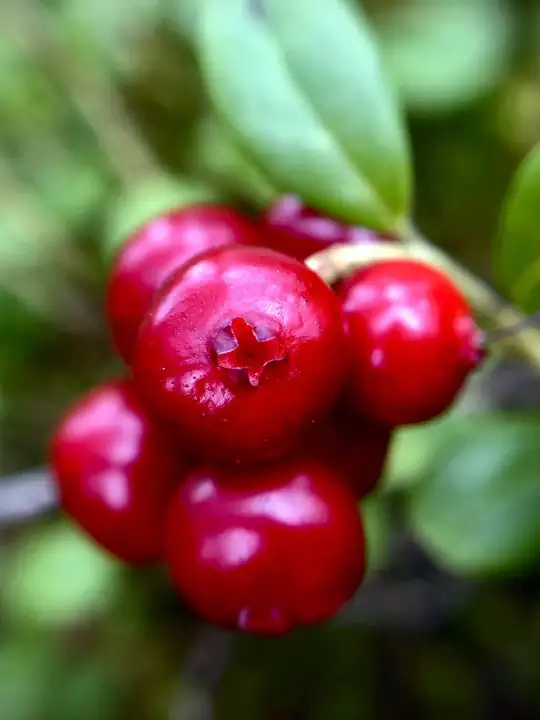
Lingonberry
Vaccinium vitis-idaea · Heath family (Ericaceae)
| Hardiness zones | 2 to 7 |
|---|---|
| Sun | full sun |
| Water | moderate |
| Life cycle | perennial |
| Frost | Hardy: takes frost |
| Soil pH | 4.3–5.5 |
| Spacing | 12 to 18 inches |
About Lingonberry
Lingonberry is a low evergreen groundcover, about 12 to 18 inches tall, with glossy leaves and tart red berries used much like cranberries. It needs very acid, well-drained soil and grows best in a cool climate. European types can bear two crops a year, a small one in summer and a larger one in fall.
Lingonberry is rated hardy to zone 2; it survives about -30 F under snow (University of Minnesota) and does well in the maritime Pacific Northwest, but it grows best where summers are cool, and Maryland experts call it a poor fit for their climate. The commercial type is the larger European lingonberry (var. vitis-idaea); var. minus is the smaller native mountain cranberry.
When to plant
Timing is counted from your average last spring frost (and first fall frost). Sow & Tell works out the actual dates for your ZIP code.
Plant in spring once the soil can be worked (fall also works in Oregon), 12 to 18 inches apart, and mulch with at least 2 inches of peat, sawdust or bark (UMass; Oregon State; Cornell). Plants spread by underground runners and fill a bed in 4 to 5 years. Fruiting starts in 2 to 3 years, with full crops in 4 to 5 years (UMass; Cornell).
Soil
Light, well-drained sandy or silt loam with 2-6% organic matter; heavy, wet soil leads to root rot, and salty soil harms it (Oregon State; Cornell). In alkaline areas, grow it in a raised bed of peat and soil (University of Minnesota).
The fall before planting, lower the pH to about 4.3-5.5 and work in peat moss (UMass suggests 7-10 lb per 100 sq ft); in alkaline areas use a raised bed of about 2 parts sphagnum peat to 1 part soil (University of Minnesota).
Feeding
- 2-3 weeks after planting: liquid fertilizer. A light feeding, watered in (UMass).
- At bloom each year: complete low-nitrogen fertilizer such as 5-10-10, or ammonium sulfate as the nitrogen source. Spread lightly around the plants and water in; follow a soil test (UMass).
- About one month after bloom: complete low-nitrogen fertilizer such as 5-10-10. A second light feeding (UMass).
Use ammonium-type, chloride-free fertilizers and go easy: too much nitrogen cuts flowering and yield (Oregon State); overwatering heavy soil invites root rot (Cornell).
Harvest
Pick when berries turn light to dark red (Oregon State). The spring bloom ripens in midsummer to August and a second bloom ripens in fall, mid-October in Oregon (Oregon State; UMass). Frost on the flowers can cut the crop by up to half.
Lingonberries bloom twice, in spring (March-April) and again in midsummer (July-August), giving one harvest in mid-August and another in mid-October in the Pacific Northwest. Frost during bloom can cost up to half the crop, so shelter plants from late frosts.
Varieties (16)
| Variety | Type | Days | Notes |
|---|---|---|---|
| Red Candy | Compact (Netherlands) | Compact, bushy plant about 7 in tall and 11 in wide in the patent, with many white flowers. Large, dark red berries about 0.4 to 0.5 in across, bigger and darker than 'Red Pearl' in Canadian tests. | |
| Erntedank | Fruiting (Germany) | Mild-flavored, small to medium bright red berries. Plant about 14-16 in tall that starts to spread by year three; fruit forms at the branch tips. High yields. | |
| Erntekrone | Fruiting (Germany) | Mild-flavored, medium-large, bright red berries. Upright, vigorous plant about 8-12 in tall with rounded leaves; high yields. | |
| Erntesegen | Fruiting (Germany) | Very large, bright dark red berries; mild flavor and the highest sugar in WSU/OSU trials. Vigorous, upright plant about 12-15 in tall; the highest yields in those trials. | |
| Ammerland | Fruiting (Netherlands) | Medium-large berries. Vigorous plant about 12-14 in tall; high yields. | |
| Koralle | Fruiting (Netherlands) | Tangy, well-flavored berries, light to dark red; bears young. Vigorous, bushy, upright plant about 12-14 in tall; easy to pick. Moderate yields. | |
| Masovia | Fruiting (Poland) | Medium, bright red berries. Vigorous plant, 8-12 in tall, that spreads quickly; high yields. | |
| Ida | Fruiting (Sweden) | Very large, dark red berries with good acidity and deep color. Low plant, about 5-7 in tall, that spreads slowly at first. Top yields and the biggest berries in USDA-ARS trials in Oregon. | |
| Linnea | Fruiting (Sweden) | Very dark red, medium-small berries with high sugar. Very vigorous, upright plant, about 5-9 in tall, that fills its bed quickly. | |
| Sanna | Fruiting (Sweden) | Dark red, medium-large berries that ripen evenly. Compact, upright plant about 6-12 in tall that spreads slowly. Cornell calls it a heavy cropper. | |
| Splendor | Fruiting (Wisconsin, USA) | Brilliant red berries about 1/3 inch; quite tart, high in color pigments. Plant about 6-10 in tall. Flowers and fruit buds handle frost well. Yields low in Oregon trials but heavier from year three in WSU/OSU notes. | |
| European Red | Ornamental (USA) | Small, light red berries. Low plant, 5-8 in tall, that spreads quickly; low to moderate yields. | |
| Regal | Ornamental (Wisconsin, USA) | Small, dull red berries about 1/3 inch. Very low plant, 2-8 in tall; frost resistant; low yields. | |
| Red Pearl | Pollinizer (Netherlands) | Mild, round, dark to bright red berries about 1/3 inch. Upright, vigorous plant about 13-15 in tall that spreads well. Copes with poor soils better than most. | |
| Scarlet | Pollinizer (Norway) | Medium, light red berries. Vigorous plant about 4-8 in tall that makes lots of pollen; moderate yields. | |
| Sussi | Pollinizer (Sweden) | Tart, well-colored berries, small to medium. Vigorous, spreading plant about 6-10 in tall; some resistance to Phytophthora root rot. |
Pests to watch for
Cucumber beetles, Voles, Birds, Deer
Diseases and problems
Phytophthora root rot, Twig blight, Black rot
In the kitchen
Used like cranberries in sauces, jams, jellies, syrups, juice, wine and baked goods (Oregon State; Cornell; UMass).
Keeping it: Lingonberries keep unusually well thanks to their natural acids: about 8 to 12 weeks in the fridge and up to two years in the freezer.
Safety: The sources we checked list no toxic parts, and we found no research-based guidance on use in pregnancy, drug interactions or allergies.
Pets: Not listed as toxic by the ASPCA
Sources
- extension.oregonstate.edu
- umass.edu
- bpb-us-e1.wpmucdn.com
- landscapeplants.oregonstate.edu
- ask.extension.org
- ask.extension.org
- aspca.org
- aspca.org
Photo: Photo: Wkee4ager / Wikimedia Commons, CC BY-SA 4.0 (CC BY-SA 4.0). Photo resized for the web.

Planting dates and advice are general guidance; check with your local Cooperative Extension office for your area.