
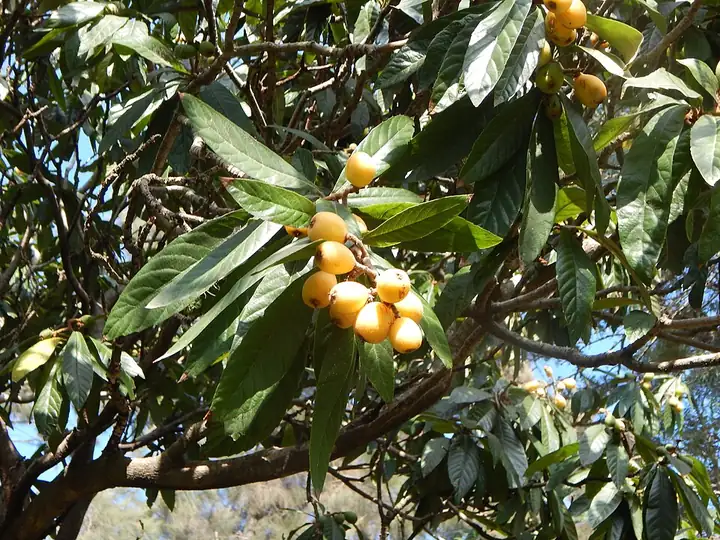
Loquat
Eriobotrya japonica · Rose family (Rosaceae)
| Hardiness zones | 8 to 11 |
|---|---|
| Sun | full sun to part shade |
| Water | moderate |
| Life cycle | perennial |
| Frost | Half-hardy: takes a light frost |
| Soil pH | 5.5–6.5 |
| Spacing | 300 to 360 inches |
About Loquat
Loquat is an evergreen tree with big, crinkled leaves and fragrant fall flowers that turn into clusters of sweet-tart yellow to orange fruit in late winter and spring. The tree itself is fairly cold hardy, but frost kills the flowers and young fruit. Heads-up: the South Carolina Invasive Pest Council lists loquat as invasive, and UF/IFAS says to manage it so it doesn't escape in central and south Florida.
NC State and UF/IFAS list zones 8-11 (Clemson 8b-10); trees take about 8-12 F, but flowers and fruit die below about 27 F (UF/IFAS; Texas A&M). It is on the South Carolina Invasive Pest Council list, and UF/IFAS rates it 'caution' in central and south Florida; USDA PLANTS lists no noxious status.
When to plant
Timing is counted from your average last spring frost (and first fall frost). Sow & Tell works out the actual dates for your ZIP code.
In the ground, give an unpruned tree 25-30 ft from buildings and other trees, and in cold areas plant on the south or southeast side (UF/IFAS; Texas A&M). Potted trees go back outside once frost danger has passed (no source gives a set number of weeks, so the window is left blank). Grafted trees bear 1-2 years after planting; seedlings take 6-8 years (UF/IFAS).
Soil
Almost any well-drained soil, acid or alkaline; it will not stand flooded or salty ground (UF/IFAS; Texas A&M).
Fertilize based on a soil test (Clemson); loquats grow in acid or alkaline soil as long as it drains (Texas A&M). Compost or topsoil can be mixed in up to half and half (UF/IFAS).
Feeding
- First-year in-ground trees, 2-3 times a year once new growth starts: balanced fertilizer such as 6-6-6 or 8-3-9. UF/IFAS uses 1/4 to 1/2 lb per feeding in year one, rising each year to about 3-3.5 lb per feeding by year seven; spread it under the canopy and water in.
- Bearing trees: just before or at bloom in late fall, again in March, and once in summer: balanced fertilizer such as 6-6-6 or 8-3-9. Follow the UF/IFAS table for tree age; Texas A&M gives mature trees about 1 lb of 21-0-0 per inch of trunk width per year, split into 2-3 feedings.
- Potted trees, from the start of new growth in spring through summer: complete liquid fertilizer with micronutrients, or a timed-release fertilizer. Feed liquid fertilizer at least monthly, or timed-release about every 12 weeks, because nutrients wash out of pots quickly (UF/IFAS St. Lucie County; NC State). Stop in winter and start again when new growth appears (Maryland Extension).
Heavy nitrogen makes loquats more prone to fire blight (UF/IFAS; Clemson).
Harvest
Fruit ripens February to May, depending on variety; color deepens and fruit softens over the last 4-5 weeks, and it does not ripen after picking, so taste a few first (UF/IFAS; Clemson). Clip whole clusters, then snip off single fruit.
Loquat blooms in fall and early winter and gives one crop, ripening in late winter and spring (February-May in Florida). Pick at nearly full to full color by cutting whole clusters and then clipping off single fruits.
Varieties (15)
| Variety | Type | Days | Notes |
|---|---|---|---|
| Premier | Dwarf | Dwarf tree about 6 ft tall with yellow-orange fruit; suits containers. | |
| Advance | Named cultivar | Sweet-tart; white flesh under thin yellow skin. Medium-large, pear-shaped fruit with 1-2 seeds. | |
| Champagne | Named cultivar | Sweet and a little spicy; white to light yellow flesh. Medium-large, pear-shaped fruit with thin, pale yellow-orange skin. | |
| Emanuel | Named cultivar | Mildly sweet; orange flesh. Medium-large, pear-shaped fruit with dark yellow-orange skin. | |
| Gold Nugget | Named cultivar | Mildly sweet (UF/IFAS rates it fair); orange flesh. NC State calls it sweet. Round orange fruit with thick skin and 3-6 seeds. | |
| Golitch | Named cultivar | Mildly sweet; orange flesh. Round, medium-large orange fruit with thick skin. | |
| Juda | Named cultivar | Sweet and mildly tart. Medium-large, pear-shaped pale orange fruit with thin skin. | |
| Judith | Named cultivar | Mild and sweet; dark yellow-orange flesh. Small to medium pear-shaped fruit with thick skin. | |
| Macbeth | Named cultivar | Large yellow fruit (NC State). | |
| Oliver | Named cultivar | Very sweet; pale orange flesh. Medium-large fruit with thick, leathery orange skin and 1-2 seeds. | |
| Sherry | Named cultivar | Mildly sweet; white to pale yellow flesh. The largest fruit in UF/IFAS trials, with thick yellow skin. | |
| Thales | Named cultivar | Sweet; yellow-orange flesh. Small to medium pear-shaped fruit with thin skin. | |
| Thursby | Named cultivar | Mildly sweet-tart; dark yellow flesh. Small to medium fruit with thick, dark yellow-orange skin. | |
| Wolfe | Named cultivar | Sweet-tart and spicy; white to pale orange flesh. Large, pear-shaped fruit with thin yellow skin and 1-2 seeds. | |
| Variegata | Ornamental | Leaves are variegated white and light green; grown mainly for looks. UF/IFAS rates it for zones 8A-11. |
Pests to watch for
Aphids, Scale insects
Diseases and problems
Fire blight, Crown rot, Canker, Scab, Anthracnose
In the kitchen
Eaten fresh or used in fruit salads, pies, sauces, jams, jellies and syrup; it also cans, dries and freezes (UF/IFAS).
Keeping it: Ripe loquats bruise easily: handle them gently, refrigerate them in a plastic bag, and use them soon.
Safety: The seeds (and young leaves) are mildly poisonous; eating large amounts of cracked seeds can cause vomiting, weakness, breathing trouble and seizures (NC State; Missouri Botanical Garden). We found no research-based guidance on pregnancy or drug interactions.
Pets: Not listed as toxic by the ASPCA
Sources
- ask.ifas.ufl.edu
- ask.ifas.ufl.edu
- aggie-hort.tamu.edu
- hgic.clemson.edu
- plants.ces.ncsu.edu
- missouribotanicalgarden.org
- fieldreport.caes.uga.edu
- invasiveplantatlas.org
- invasiveplantatlas.org
- plantsservices.sc.egov.usda.gov
- yardandgarden.extension.iastate.edu
- aspca.org
- aspca.org
- aspca.org
- blogs.ifas.ufl.edu
- content.ces.ncsu.edu
- extension.umd.edu
Photo: Photo: Adriel anv00, CC BY-SA 4.0, via Wikimedia Commons (CC BY-SA 4.0). Photo resized for the web.

Planting dates and advice are general guidance; check with your local Cooperative Extension office for your area.