
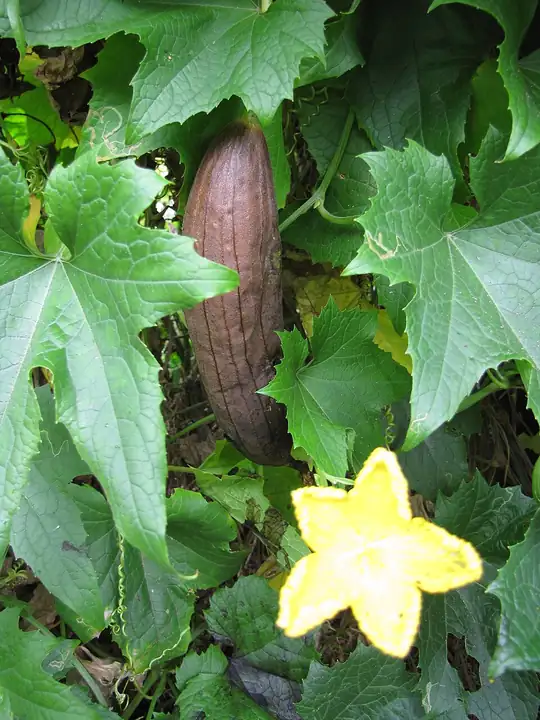
Luffa (loofah gourd)
Luffa aegyptiaca and Luffa acutangula · Gourd family (Cucurbitaceae)
| Hardiness zones | 8 to 11 |
|---|---|
| Sun | full sun |
| Water | moderate |
| Life cycle | annual |
| Frost | Tender: killed by frost |
| Soil pH | 6.0–6.5 |
| Spacing | 12 to 36 inches |
About Luffa (loofah gourd)
Luffa is a fast, tropical climbing vine in the cucumber family. Its young fruits are eaten like summer squash, and fruits left to mature dry into the fibrous sponges sold as loofahs. Smooth luffa (L. aegyptiaca) has round, smooth fruit, while angled luffa (L. acutangula), sometimes called Chinese okra, has 8 to 10 sharp ridges. Vines can run 30 feet or more, so they need a long hot season and a very sturdy trellis.
Grown as a summer annual; NC State lists zones 8-11, and Florida plants it from March through July (UF/IFAS). It needs a long, warm season, so in cooler areas start transplants indoors and use black plastic mulch on raised beds to warm the soil (NC State).
When to plant
Timing is counted from your average last spring frost (and first fall frost). Sow & Tell works out the actual dates for your ZIP code.
- Start seeds indoors: 4 to 8 weeks before the last frost
Soak seed in warm water for 24 hours; sprouting is slow and uneven, so transplants are best: sow 2-3 seeds per cell 4 to 8 weeks before the last frost and set plants out after all danger of frost, at the 2-3 true-leaf stage (NC State; UF/IFAS). In warm areas seed can go straight in the ground after frost. Young fruit for eating needs about two to three months of hot weather (UF/IFAS). Space plants 12-18 inches apart on a trellis (NC State) or 3 feet apart with 6 feet between rows (UF/IFAS).
Soil
Well-drained, evenly moist, rich loam with good air flow; UF/IFAS says it prefers neutral to slightly alkaline soil and, until luffa-specific advice exists, to follow cucumber guidance (pH 6.0-6.5).
Follow a soil test and use the lime and fertilizer advice for cucumbers (pH about 6.0-6.5); a balanced slow-release fertilizer works when the test calls for it.
Feeding
- two or three times through the growing season: nitrogen fertilizer such as 21-0-0, or a balanced fertilizer. Give small side-dressings beside the vines (or through drip irrigation) and water them in; NC State's commercial rate is 20-25 lb of nitrogen per acre each time.
Too much water slows growth and invites root disease, and fruit lying on the ground rots, so mulch and keep vines on the trellis.
Harvest
For eating, pick fruit while young and tender, under about 6 inches long; it quickly turns fibrous and bitter (UF/IFAS). For sponges, leave fruit on the vine until it turns brown, feels light and dry and the seeds rattle, or pick it green just as the skin yellows and 'pops' when squeezed (NC State).
Each vine sets about 6 to 7 fruits over the summer. Pick young fruit under about 6 inches for eating, and let later ones ripen on the vine for sponges.
Varieties (7)
UF/IFAS documents 7 luffa cultivars, mostly by name only; NC State names none.
| Variety | Type | Days | Notes |
|---|---|---|---|
| Hybrid Asian Pride | Angled luffa (L. acutangula) | Dark green, ridged fruit; a hybrid. | |
| Hybrid Green Glory | Angled luffa (L. acutangula) | Dark green, ridged fruit; a hybrid. | |
| Lucky Boy | Angled luffa (L. acutangula) | Dark green fruit with 8 to 10 raised ridges; angled types keep longer after picking. | |
| Summer Long | Angled luffa (L. acutangula) | Dark green, ridged fruit. | |
| Smooth Beauty | Smooth luffa (L. aegyptiaca) | Smooth, green, squash-like fruit. | |
| Smooth Boy | Smooth luffa (L. aegyptiaca) | Smooth, green, squash-like fruit. | |
| South Winner | Smooth luffa (L. aegyptiaca) | Smooth, green, squash-like fruit. |
Pests to watch for
Cucumber beetles, Squash bug, Aphids, Thrips, Twospotted spider mite, Leafminers
Diseases and problems
Powdery mildew, Downy mildew, Leaf spots, Mosaic viruses, Fruit rot, Damping-off
In the kitchen
Young fruit is eaten raw like cucumber or cooked like zucchini in stir-fries and soups (UF/IFAS).
Keeping it: Angled luffa keeps longer after picking than smooth luffa; dried sponges keep for a long time in a dry, airy place.
Safety: Don't eat fruit that tastes bitter: UF/IFAS notes bitter types have reported poisonous properties. Only young fruit is eaten; mature fruit is tough and fibrous.
Pets: Not listed by the ASPCA
Sources
- plants.ces.ncsu.edu
- content.ces.ncsu.edu
- gardeningsolutions.ifas.ufl.edu
- ask.ifas.ufl.edu
- edis.ifas.ufl.edu
- blogs.ifas.ufl.edu
- aspca.org
- aspca.org
Photo: Photo: Forest and Kim Starr / Wikimedia Commons, CC BY 3.0 US (CC BY 3.0 US). Photo resized for the web.

Planting dates and advice are general guidance; check with your local Cooperative Extension office for your area.