
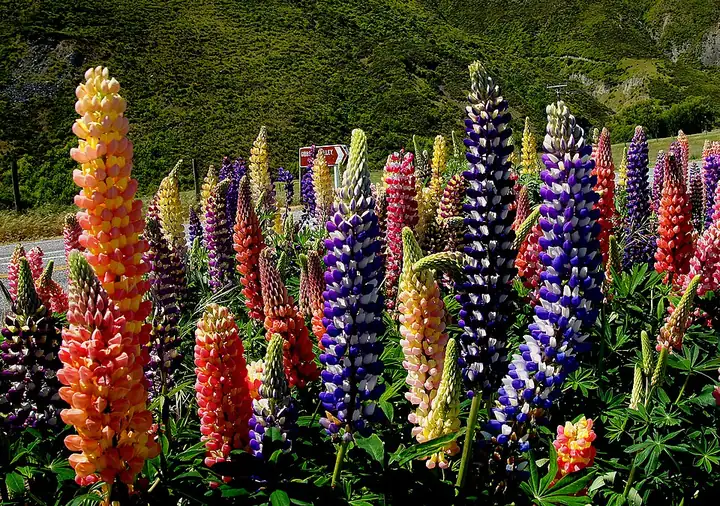
Lupine (and Texas bluebonnet)
Lupinus polyphyllus hybrids (Russell lupines), L. texensis (Texas bluebonnet), L. perennis (sundial lupine) and others · Pea family (Fabaceae)
| Hardiness zones | 4 to 9 |
|---|---|
| Sun | full sun to part shade |
| Water | moderate |
| Life cycle | perennial |
| Frost | Hardy: takes frost |
About Lupine (and Texas bluebonnet)
Lupines send up tall, dense spikes of pea flowers in late spring and fix their own nitrogen. Garden Russell lupines like cool summers and are short-lived (2-5 years); in the South they struggle, and there the native Texas bluebonnet, an annual sown in fall, is the lupine to grow. All lupines are toxic if eaten, especially the seeds. Heads-up: bigleaf lupine, the parent of Russell hybrids, spreads by seed outside its western home, and in the Northeast and Midwest it crosses with native sundial lupine, making plants that endangered Karner blue caterpillars can't eat.
NC State lists zones 4-9 but notes lupines need cool summers and are grown as annuals in zones 7-8. Bigleaf lupine is called potentially invasive in New Hampshire (UNH); Wisconsin does not regulate it but warns it hybridizes with native sundial lupine.
When to plant
Timing is counted from your average last spring frost (and first fall frost). Sow & Tell works out the actual dates for your ZIP code.
Grow from seed; nick or scarify the hard seed coat and soak it before sowing (UW Miller Library). Sow in fall (NC State) or spring; plants from seed won't bloom until the next year (SDSU). Texas bluebonnets are sown in fall, lightly raked in, often with the right Rhizobium bacteria for the roots (Wildflower Center; Texas A&M).
Soil
Well-drained soil kept evenly moist; Texas bluebonnets need very good drainage and do well in limy soils (NC State, SDSU, Wildflower Center).
Follow a soil test; lupines fix their own nitrogen, so rich soil isn't needed, but it must drain well (SDSU; NC State).
Feeding
- after bloom, when you cut plants back: complete slow-release organic fertilizer. Use a light hand; high-nitrogen fertilizers are too strong for lupines (UW Miller Library).
High-nitrogen fertilizer (UW Miller Library).
Harvest
Russell lupines bloom in June in South Dakota; bluebonnets peak in late March and early April in Texas and bloom about six weeks. Cut garden lupines to the ground after flowering and they may send up new growth (UW Miller Library).
Varieties (8)
Extension sources document only a few lupine and bluebonnet selections.
| Variety | Type | Days | Notes |
|---|---|---|---|
| Blushing Bride | Garden lupine | Pure white flowers. | |
| Red Flame | Garden lupine | Carmine red flowers on 40 in plants. | |
| The Governor | Garden lupine | Marine-blue flowers marked with white; 30 in tall. | |
| Tutti Frutti series | Garden lupine | White, pink, red, burgundy, lavender, blue, purple and yellow. | |
| Russell Hybrids | Garden lupine (L. polyphyllus hybrids) | Mixed colors on plants about 30 in tall. | |
| Minarett series | Garden lupine, dwarf | Dwarf plants about 20 in tall. | |
| Barbara Bush Lavender | Texas bluebonnet (L. texensis) | Lavender bluebonnet picked from natural variation in a wild stand. | |
| Maroon (Aggie) bluebonnet | Texas bluebonnet (L. texensis) | A true maroon-colored bluebonnet line. |
Pests to watch for
Aphids, Slugs, Brown garden snail, Four-lined plant bug
Diseases and problems
Powdery mildew
In the kitchen
Safety: Lupine seeds contain bitter alkaloids that can slow the heart and breathing and cause sleepiness or seizures if a lot is eaten (NC State); only low-alkaloid 'sweet' crop lupines are eaten as food (SDSU). Don't eat garden lupine seeds.
Pets: Toxic to dogs, cats and horses (ASPCA). NC State and the Lady Bird Johnson Wildflower Center warn that the seeds hold alkaloids that can poison people and animals, and SDSU warns that some lupines can kill grazing livestock. Keep pets away from the seed pods.
Sources
- plants.ces.ncsu.edu
- extension.sdstate.edu
- depts.washington.edu
- dnr.wisconsin.gov
- extension.unh.edu
- wildflower.org
- aggie-hort.tamu.edu
- agrilifetoday.tamu.edu
- aspca.org
- aspca.org
- aspca.org
Photo: Photo: Bernard Spragg, CC0, via Wikimedia Commons (CC0). Photo resized for the web.

Planting dates and advice are general guidance; check with your local Cooperative Extension office for your area.