
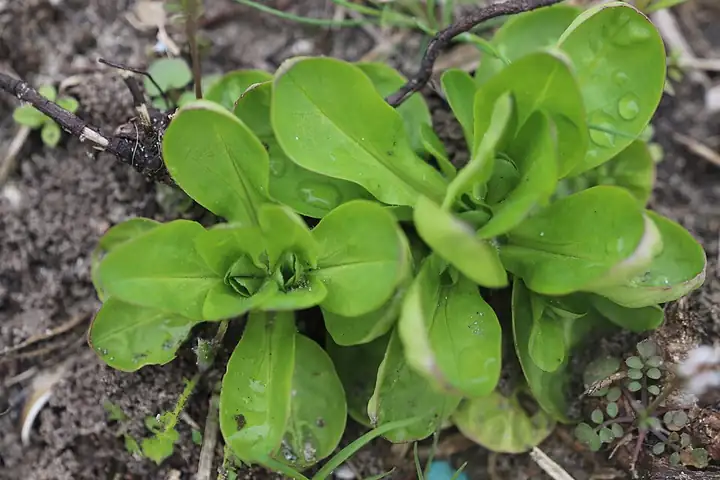
Mâche (corn salad)
Valerianella locusta · Honeysuckle family (Caprifoliaceae; formerly the valerian family)
| Hardiness zones | 2 to 11 |
|---|---|
| Sun | full sun to part shade |
| Water | moderate |
| Life cycle | annual |
| Frost | Hardy: takes frost |
| Soil pH | 6.0–7.0 |
| Spacing | 3 to 4 inches |
| Days to harvest | 50 days |
| Soil temperature to plant | at least 41°F |
About Mâche (corn salad)
Mache, also called corn salad or lamb's lettuce, makes small rosettes of soft, mild, slightly nutty leaves. It is one of the hardiest winter greens, so it is grown in fall, winter under cover, and early spring. It bolts quickly once the weather warms.
Grown as a cool-season annual in every zone; plants with 4 to 5 true leaves can overwinter under mulch or a cold frame for an early spring crop.
When to plant
Timing is counted from your average last spring frost (and first fall frost). Sow & Tell works out the actual dates for your ZIP code.
- Start seeds indoors: 5 to 6 weeks before the last frost
- Set out plants: around the last frost
- Sow seeds outdoors: 3 to 4 weeks before the last frost
- Fall planting: 4 weeks before the first fall frost
Days count from seeding, though small leaves can be picked 2 to 3 weeks after plants come up. Sow when soil is 41 to 68F; seed goes dormant above about 70F. Sow every two weeks for a steady supply, and about 4 weeks before the first fall frost for a fall crop.
Soil
Fertile, well-drained soil rich in organic matter, kept evenly moist; the roots are shallow.
Use fertile, well-drained soil with pH 6.0 to 7.0; follow a soil test, work fertilizer into the top 6 inches, and add no more than 1 inch of compost.
Feeding
- 4 weeks after transplanting, or when you thin seedlings: nitrogen fertilizer such as 21-0-0. Scatter 1/4 cup per 10 feet of row beside the plants and water it in; go easy, it needs little feeding.
Uneven watering makes leaves tough and off-flavored.
Harvest
Snip single leaves once they are usable, or cut whole rosettes at or just below the soil line. Pick before warm spring weather makes it flower.
Snip leaves once they are about 4 inches across and new ones form in the center; or cut whole small rosettes. Fall plantings can be picked through winter under cover.
Varieties (8)
Extension sources name about 8 mache varieties, mostly without details.
| Variety | Type | Days | Notes |
|---|---|---|---|
| Big-Seeded | Large-seeded | Recommended for Santa Clara County; large-seeded types make bigger 4-8 in rosettes and take more heat. | |
| Bistro | Large-seeded | Very uniform, open-pollinated, large-seeded type. | |
| Burpee Green | Listed in North American cultivar descriptions (2003). | ||
| D'Etampes | Recommended for Santa Clara County and listed by Utah State. | ||
| Dutch Broad Leaved | Listed by Utah State Extension. | ||
| French | Listed by Utah State Extension. | ||
| Gala | Recommended for Santa Clara County. | ||
| Vit | Recommended for Santa Clara County and listed by Utah State. |
Pests to watch for
Aphids, Cabbage looper, Flea beetles, Leafminers, Slugs, Brown garden snail
Diseases and problems
Alternaria leaf spot, Damping-off
In the kitchen
Mostly eaten raw in salads with a light dressing; it can also be added to stir-fries and soups at the end.
Keeping it: Refrigerate in the crisper drawer and use within about 5 to 7 days; wash just before eating.
Safety: If you take the blood thinner warfarin, keep the amount of leafy greens you eat about the same from day to day, because they are rich in vitamin K (NIH Office of Dietary Supplements).
Pets: Not listed by the ASPCA
Sources
- extension.usu.edu
- sonomamg.ucanr.edu
- innovate.ucanr.edu
- extension.oregonstate.edu
- rvpadmin.cce.cornell.edu
- agrilifeextension.tamu.edu
- hort.extension.wisc.edu
- extension.umd.edu
- ods.od.nih.gov
- aspca.org
- aspca.org
Photo: Photo: Michel Langeveld / Wikimedia Commons, CC BY-SA 4.0 (CC BY-SA 4.0). Photo resized for the web.

Planting dates and advice are general guidance; check with your local Cooperative Extension office for your area.