
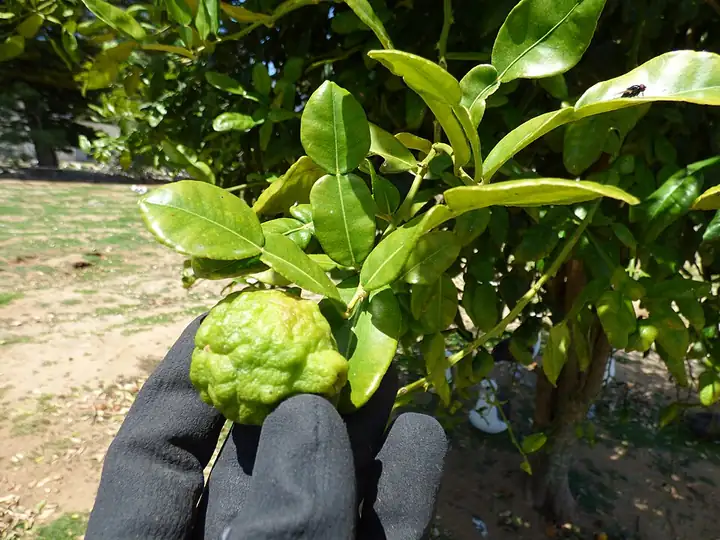
Makrut lime
Citrus hystrix · Citrus family (Rutaceae)
| Hardiness zones | 10 to 12 |
|---|---|
| Sun | full sun to part shade |
| Water | moderate |
| Life cycle | perennial |
| Frost | Tender: killed by frost |
About Makrut lime
Makrut lime is a thorny Southeast Asian citrus grown mostly for its glossy, fragrant 'double' leaves, which flavor Thai, Lao and Indonesian soups and curries. The bumpy green fruit has little juice, but its rind is grated into food. It was long sold as 'kaffir lime', but that word is an offensive term in some cultures, so 'makrut' is now the preferred name (Smithsonian Asian Pacific American Center).
Missouri Botanical Garden rates it for zones 10-12: it takes an occasional 32 F but seldom survives much colder, so north of zone 10 it is grown in a pot.
When to plant
Timing is counted from your average last spring frost (and first fall frost). Sow & Tell works out the actual dates for your ZIP code.
North of zone 10, keep it in a pot and set it outside in late spring (Missouri Botanical Garden). Grafted trees are best; seedlings tend to be very thorny (UH CTAHR). It grows slowly.
Soil
Well-drained, fertile soil; it adapts to many soil types but gets root rot in soggy ground (UH CTAHR; Missouri Botanical Garden).
Use a loam-based, peat-free potting mix with added grit in a pot with drainage (RHS); in the ground, well-drained fertile soil (UH CTAHR).
Feeding
- Potted trees: spring through late summer, while it is growing: citrus fertilizer with micronutrients. Feed as for other potted citrus, only while it is actively growing (UMD), following the label. RHS, writing for greenhouse growers, feeds citrus fertilizer year-round, but US extension advice for potted citrus is to stop by early fall (UMD).
- Any time new leaves come out yellow with green veins: chelated micronutrient spray (zinc, iron, manganese). Spray the new growth with a chelated micronutrient product (UC IPM); follow the label.
Don't let the pot stay soggy; makrut lime gets root rot in wet soil (Missouri Botanical Garden).
Harvest
Cut young to newly mature leaves whenever you need them; they keep well frozen or dried (UH CTAHR). Fruit turns yellow and drops when ripe, in late winter to early spring in California (UC Riverside).
The leaves are the main harvest: cut young to newly mature leaves whenever you need them, and freeze or dry extras.
Pests to watch for
Aphids, Twospotted spider mite, Mealybugs, Scale insects, Whiteflies, Citrus leafminer, Asian citrus psyllid
Diseases and problems
Root rot
In the kitchen
Whole or shredded leaves go into soups, curries, stir-fries, fish cakes, salads and marinades, and the rind is grated or diced for flavor; the sour, slightly bitter juice is seldom used (Missouri Botanical Garden; UC Riverside).
Keeping it: The leaves keep well: freeze them flat in a bag, or air-dry them for a week or two in an airy spot.
Safety: The leaves and rind are common foods. The branches carry sharp spines (UC Riverside), and RHS warns that lime fruit can irritate skin exposed to sunlight, so wear gloves when handling it.
Pets: Makrut lime is not listed separately by the ASPCA, but the ASPCA lists lemon and lime as toxic to dogs, cats and horses because their peel and plant parts contain essential oils and psoralens.
Sources
- citrusvariety.ucr.edu
- missouribotanicalgarden.org
- rhs.org.uk
- ctahr.hawaii.edu
- apa.si.edu
- plantpono.org
- aphis.usda.gov
- usda.gov
- aspca.org
- aspca.org
- extension.umd.edu
- ipm.ucanr.edu
Photo: Photo: Forest and Kim Starr, CC BY 3.0 us, via Wikimedia Commons (CC BY 3.0 us). Photo resized for the web.

Planting dates and advice are general guidance; check with your local Cooperative Extension office for your area.