
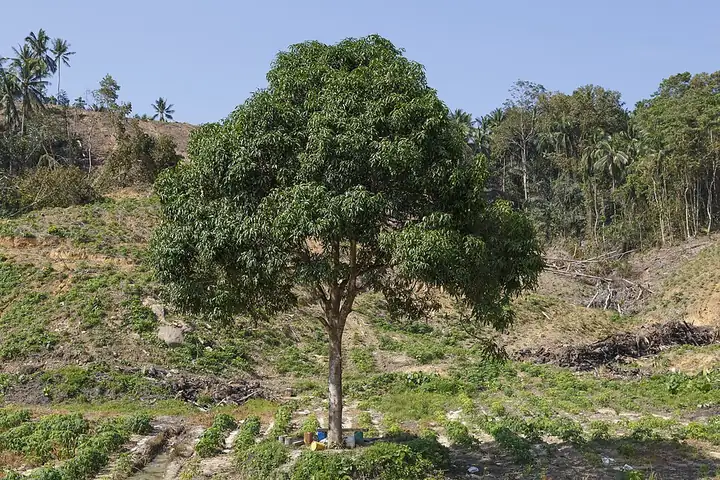
Mango
Mangifera indica · Cashew family (Anacardiaceae)
| Hardiness zones | 10 to 11 |
|---|---|
| Sun | full sun |
| Water | moderate |
| Life cycle | perennial |
| Frost | Tender: killed by frost |
| Spacing | 144 to 360 inches |
About Mango
Mango is a big evergreen tree from southern Asia, grown for its sweet fruit that can be green, yellow, red or purple outside with pale yellow to deep orange flesh. In the U.S. it grows outdoors only where winters stay almost frost-free, mainly the warm coasts of south Florida and in Hawaii. Heads-up: mango peel, leaves and stems hold compounds much like those in poison ivy, and they can give sensitive people an itchy rash.
UF/IFAS lists zones 10A-11; in Florida it does best along the warm southeast and southwest coasts, with sheltered trees as far north as Merritt Island, and Hawaii and Puerto Rico have small mango industries. Mature trees are hurt after a few hours at 25 F, young trees can die at 29-30 F, and flowers and small fruit are damaged below 40 F (UF/IFAS). UF/IFAS rates mango 'caution' in central and south Florida (manage to prevent escape); it is not on the Florida Invasive Species Council list or any state noxious list we checked.
When to plant
Timing is counted from your average last spring frost (and first fall frost). Sow & Tell works out the actual dates for your ZIP code.
No source ties planting to a frost date. Plant in full sun 25-30 ft or more from buildings, power lines and other trees, or 12-15 ft for low-vigor varieties kept small by yearly pruning (UF/IFAS). Grafted trees start bearing 3-5 years after planting, while seedlings can take about 10 years and often give stringy, bland fruit (UF/IFAS).
Soil
Grows in many soils, including Florida sands and limestone, as long as the spot doesn't stay wet; plant on a mound where flooding is possible (UF/IFAS).
Don't put fertilizer, topsoil or compost in the planting hole; if you amend, mix no more than half and half with the native soil, and plant on a 2-3 ft mound where the ground floods (UF/IFAS).
Feeding
- First year, every 2-3 months (about 6 times): young-tree fertilizer with 2-6% nitrogen, 6-10% phosphate, 6-12% potash and 4-6% magnesium, such as 6-6-6-2. UF/IFAS gives 1/4-1/2 lb per tree each time in year one, rising to 1/2-1 lb in year two and 1-1.5 lb in year three; spread it under the canopy and water in. Use much less for a small tree and follow the label.
- Bearing trees (about year 4 on), 3-4 times a year from March through August: low-nitrogen, high-potash fertilizer such as 6-3-16 or 0-0-22. UF/IFAS says healthy mature trees need little or no nitrogen; focus on potash and minor elements and follow a soil test.
- Spring through summer, 2-4 times (March-September): micronutrient sprays (magnesium, manganese, zinc, boron) and iron. Spray minor elements on the leaves; on alkaline limestone soils use chelated iron (EDDHA) as a soil drench 2-3 times a year, since iron sprays on the leaves don't work well (UF/IFAS).
Too much nitrogen makes internal breakdown (soft, jelly-like flesh by the seed) worse, and heavy lawn fertilizer or a timed sprinkler under the tree can hurt fruit and roots (UF/IFAS).
Harvest
Most Florida mangoes ripen May through September, peaking in June and July; fruit is usually picked firm and mature, when the shoulders and tip fill out and the skin starts to change color, and ripens on the counter in 3-8 days (UF/IFAS). Refrigerate only after it ripens: chilling unripe mangoes damages them.
Mango blooms in winter and ripens one crop a year, mostly May through September in Florida, with a peak in June and July. Fruit can hang on the tree and be picked as needed, and growing varieties that ripen at different times stretches the season over months.
Varieties (39)
| Variety | Type | Days | Notes |
|---|---|---|---|
| Angie | Monoembryonic | Low-vigor tree; 13-14 oz fruit with yellow, orange, pink skin. Anthracnose: moderately resistant; yield good in UF/IFAS ratings. | |
| Carrie | Monoembryonic | High-vigor tree; 10-12 oz fruit with green, yellow skin. Anthracnose: moderately resistant; yield good to poor in UF/IFAS ratings. | |
| Cogshall | Monoembryonic | Low to moderate-vigor tree; 10-16 oz fruit with yellow, red skin. Anthracnose: susceptible; yield good in UF/IFAS ratings. | |
| Dot | Monoembryonic | Moderate-vigor tree; 9-16 oz fruit with yellow, pink skin. Anthracnose: susceptible; yield good in UF/IFAS ratings. | |
| Duncan | Monoembryonic | Moderate to high-vigor tree; 16-24 oz fruit with yellow skin. Anthracnose: moderately resistant; yield good in UF/IFAS ratings. | |
| Edward | Monoembryonic | Moderate to high-vigor tree; 16-20 oz fruit with yellow, pink, red skin. Anthracnose: moderately resistant; yield poor in UF/IFAS ratings. | |
| Fairchild | Monoembryonic | Low-vigor tree; 8-10 oz fruit with green, yellow skin. Anthracnose: moderately resistant; yield good in UF/IFAS ratings. | |
| Glenn | Monoembryonic | Moderate-vigor tree; 12-18 oz fruit with yellow, pink, red skin. Anthracnose: moderately susceptible; yield good to poor in UF/IFAS ratings. | |
| Graham | Monoembryonic | Moderate-vigor tree; 20-29 oz fruit with yellow, pink skin. Anthracnose: susceptible; yield fair to good in UF/IFAS ratings. | |
| Haden | Monoembryonic | High-vigor tree; 16-24 oz fruit with red, yellow skin. Anthracnose: susceptible; yield fair in UF/IFAS ratings. | |
| Ice Cream | Monoembryonic | Low-vigor tree; 8-9 oz fruit with green, yellow skin. Anthracnose: susceptible; yield fair in UF/IFAS ratings. | |
| Irwin | Monoembryonic | Moderate-vigor tree; 12-16 oz fruit with red skin. Anthracnose: very susceptible; yield good in UF/IFAS ratings. | |
| Julie | Monoembryonic | Low-vigor tree; 9-16 oz fruit with green, pink, yellow skin. Anthracnose: susceptible; yield poor in UF/IFAS ratings. | |
| Keitt | Monoembryonic | Moderate to high-vigor tree; 20-40 oz fruit with green, pink, yellow skin. Anthracnose: moderately resistant; yield good in UF/IFAS ratings. | |
| Kent | Monoembryonic | High-vigor tree; 16-30 oz fruit with green, red, yellow skin. Anthracnose: very susceptible; yield good in UF/IFAS ratings. | |
| Lippens | Monoembryonic | Moderate to high-vigor tree; 14-20 oz fruit with pink, yellow skin. Anthracnose: susceptible; yield good in UF/IFAS ratings. | |
| Mallika | Monoembryonic | Moderate to low-vigor tree; 10-16 oz fruit with yellow, pink skin. Anthracnose: susceptible; yield fair to good in UF/IFAS ratings. | |
| Neelum | Monoembryonic | Low to moderate-vigor tree; 8-11 oz fruit with yellow skin. Anthracnose: moderately susceptible; yield fair to good in UF/IFAS ratings. | |
| Palmer | Monoembryonic | High-vigor tree; 20-30 oz fruit with red, yellow skin. Anthracnose: susceptible; yield good in UF/IFAS ratings. | |
| Parvin | Monoembryonic | High-vigor tree; 16-25 oz fruit with red, green skin. Anthracnose: moderately resistant; yield good in UF/IFAS ratings. | |
| Rapoza | Monoembryonic | Moderate-vigor tree; 14-28 oz fruit with yellow, red skin. Anthracnose: moderately resistant; yield good in UF/IFAS ratings. | |
| Ruby | Monoembryonic | Moderate-vigor tree; 6-8 oz fruit with red skin. Anthracnose: susceptible; yield good in UF/IFAS ratings. | |
| Sensation | Monoembryonic | High-vigor tree; 10-12 oz fruit with purple, red skin. Anthracnose: susceptible; yield good in UF/IFAS ratings. | |
| Tommy Atkins | Monoembryonic | High-vigor tree; 16-24 oz fruit with red, yellow skin. Anthracnose: moderately resistant; yield good in UF/IFAS ratings. | |
| Valencia Pride | Monoembryonic | High-vigor tree; 21-32 oz fruit with yellow, pink, red skin. Anthracnose: susceptible; yield good in UF/IFAS ratings. | |
| Van Dyke | Monoembryonic | Moderate-vigor tree; 10-16 oz fruit with red and yellow skin. Anthracnose: moderately resistant; yield good in UF/IFAS ratings. | |
| Zill | Monoembryonic | High-vigor tree; 8-12 oz fruit with red, yellow skin. Anthracnose: susceptible; yield good in UF/IFAS ratings. | |
| Carabao | Polyembryonic | High-vigor tree; 10-15 oz fruit with green, yellow skin. Anthracnose: moderately susceptible; yield good in UF/IFAS ratings. | |
| Florigon | Polyembryonic | High-vigor tree; 10-16 oz fruit with yellow skin. Anthracnose: moderately resistant; yield good in UF/IFAS ratings. | |
| Kyo Savoy | Polyembryonic | High-vigor tree; 8-12 oz fruit with green, yellow skin. Anthracnose: moderately resistant; yield good in UF/IFAS ratings. | |
| Nam Doc Mai | Polyembryonic | Moderate to high-vigor tree; 12-20 oz fruit with yellow, pink skin. Anthracnose: moderately susceptible; yield good in UF/IFAS ratings. | |
| Phimsen Mun | Polyembryonic | Low to moderate-vigor tree; 14-15 oz fruit with yellow skin. Anthracnose: moderately susceptible; yield fair to good in UF/IFAS ratings. | |
| Rosigold | Polyembryonic | Low-vigor tree; 9-11 oz fruit with yellow, red skin. Anthracnose: susceptible; yield fair in UF/IFAS ratings. | |
| Saigon | Polyembryonic | Moderate to high-vigor tree; 6-12 oz fruit with green, yellow skin. Anthracnose: resistant; yield good in UF/IFAS ratings. | |
| Coconut Cream | UF/IFAS Gardening Solutions names it among popular Florida mango varieties but gives no size or season details. | ||
| Maha Chanok | UF/IFAS Gardening Solutions names it among popular Florida mango varieties but gives no size or season details. | ||
| Orange Sherbert | UF/IFAS Gardening Solutions names it among popular Florida mango varieties but gives no size or season details. | ||
| Pickering | UF/IFAS Gardening Solutions names it among popular Florida mango varieties but gives no size or season details. | ||
| Sugarloaf | UF/IFAS Gardening Solutions names it among popular Florida mango varieties but gives no size or season details. |
Pests to watch for
Scale insects, Thrips, Twospotted spider mite, Eriophyid mites (rust, bud, blister and gall mites), Mealybugs
Diseases and problems
Anthracnose, Powdery mildew, Mango scab, Verticillium wilt, Algal leaf spot, Mango malformation, Internal breakdown (jelly seed, soft nose)
In the kitchen
Most often eaten fresh; also frozen, dried, canned, or made into jam, jelly, pie, chutney and ice cream, and some varieties are eaten while still green and firm (UF/IFAS).
Keeping it: Ripen firm mangoes at room temperature, ideally 70-75 F, for 3-8 days, then refrigerate; don't chill them before they ripen, or the skin can discolor and the fruit won't ripen evenly (UF/IFAS).
Safety: The peel, leaves and stems hold compounds similar to poison ivy's urushiol that can cause a delayed, itchy rash in people sensitized to poison ivy or poison oak, while the flesh carries very little of them, so sensitive people can let someone else peel the fruit (Western Journal of Emergency Medicine case report). We found no research-based guidance on pregnancy or drug interactions for the fruit.
Pets: Not listed by the ASPCA
Sources
- ask.ifas.ufl.edu
- gardeningsolutions.ifas.ufl.edu
- westjem.com
- www3.ctahr.hawaii.edu
- aspca.org
- assessment.ifas.ufl.edu
- ask.ifas.ufl.edu
Photo: Photo: CEphoto, Uwe Aranas / Wikimedia Commons, CC BY-SA 3.0 (CC BY-SA 3.0). Photo resized for the web.

Planting dates and advice are general guidance; check with your local Cooperative Extension office for your area.