
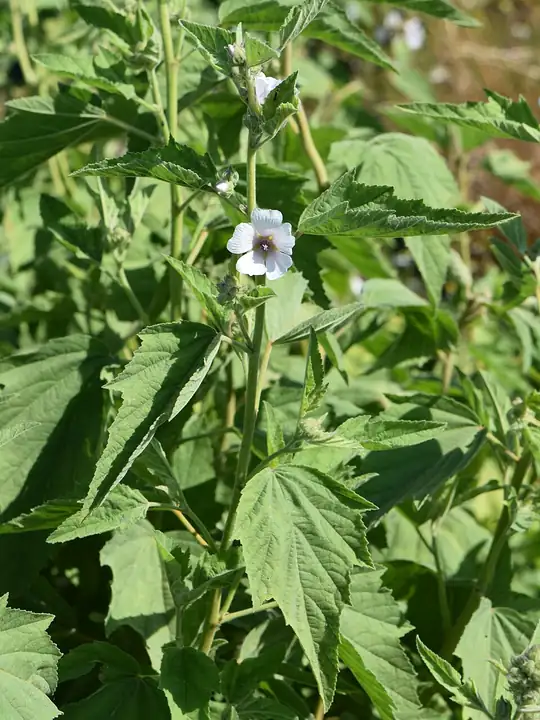
Marsh mallow
Althaea officinalis · Mallow family (Malvaceae)
| Hardiness zones | 3 to 9 |
|---|---|
| Sun | full sun |
| Water | high |
| Life cycle | perennial |
| Frost | Hardy: takes frost |
About Marsh mallow
Marsh mallow is a tall, soft-leaved perennial from wet ditches and stream banks in Europe and North Africa. It carries pale pink flowers from July to September, and every part of the plant is slippery with mucilage, which is why it was once used to make the first marshmallow candy.
Missouri Botanical Garden lists marsh mallow as hardy in zones 3-9.
When to plant
Timing is counted from your average last spring frost (and first fall frost). Sow & Tell works out the actual dates for your ZIP code.
Plants grow 3-6 feet tall and 2.5-4 feet wide, so give them room at the back of a bed, in a rain garden or in another damp spot (Missouri Botanical Garden).
Soil
Moist, fertile soil suits it best; it tolerates many soil types and short dry spells once established (Missouri Botanical Garden).
Plant in moist, fertile soil in full sun; marsh mallow tolerates many soil types. Follow a soil test.
Feeding
Don't let it sit in dry soil for long; it is a plant of damp ditches and stream banks, though it handles brief dry spells once established.
Harvest
Pick young leaves and flowers in summer for the kitchen; flowers open from July to September.
Pests to watch for
Flea beetles
Diseases and problems
Rust
In the kitchen
All parts contain mucilage and can be used to thicken soups and stews (Missouri Botanical Garden).
Safety: Europe's medicines agency (EMA) knows of no side effects, but it does not recommend marsh mallow root products during pregnancy or breastfeeding because safety has not been studied. It may slow the uptake of other medicines, so the EMA advises taking it 30-60 minutes apart from them.
Pets: Not listed by the ASPCA
Sources
- missouribotanicalgarden.org
- ema.europa.eu
- ema.europa.eu
- aspca.org
- aspca.org
- plantsservices.sc.egov.usda.gov
Photo: Photo: Krzysztof Ziarnek, Kenraiz / Wikimedia Commons, CC BY-SA 4.0 (CC BY-SA 4.0). Photo resized for the web.

Planting dates and advice are general guidance; check with your local Cooperative Extension office for your area.