
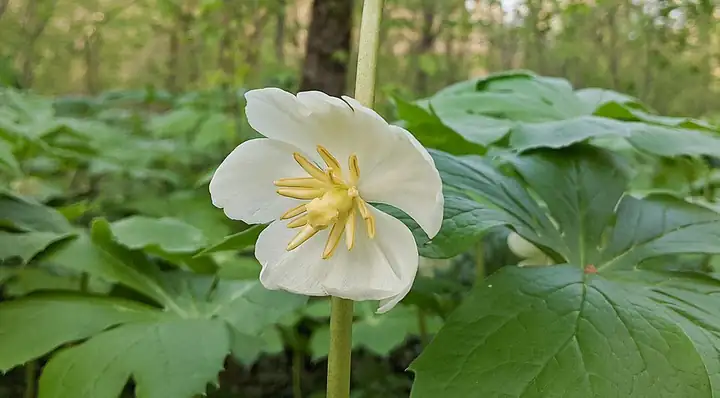
Mayapple
Podophyllum peltatum · Barberry family (Berberidaceae)
| Hardiness zones | 3 to 8 |
|---|---|
| Sun | part shade |
| Water | moderate |
| Life cycle | perennial |
| Frost | Hardy: takes frost |
| Spacing | 12 to 36 inches |
About Mayapple
Mayapple carpets shady ground with big umbrella-like leaves; stems with two leaves carry one waxy white flower, often hidden under the leaves, that ripens into a lemon-shaped golden fruit in late summer (Wisconsin Extension, NC State). It is native across most of the eastern U.S. and Canada, west to Minnesota, eastern Nebraska, Kansas and eastern Texas (wildflower.org). It spreads by creeping rhizomes into dense colonies and goes dormant by midsummer. Every part except the fully ripe fruit is poisonous, including the unripe fruit and the seeds (NC State, wildflower.org).
Hardy in zones 3-8 (Wisconsin Extension, NC State). Native and not invasive, but it spreads into large patches by rhizomes.
When to plant
Timing is counted from your average last spring frost (and first fall frost). Sow & Tell works out the actual dates for your ZIP code.
Dividing the rhizomes while dormant (late summer, fall or very early spring), with at least one bud per piece, is the easiest way to start it (Wisconsin Extension, wildflower.org). Seed must be sown fresh or given three months of cold, moist chilling, and seedlings take 4-5 years to mature. Don't mow the patch. We found no sourced day count to first bloom.
Soil
Rich, moist, acidic soil high in organic matter, under deciduous trees (not pines); it tolerates black walnut but not crowding from other plants (Wisconsin Extension, NC State, wildflower.org).
Plant in rich, moist, acidic soil with plenty of organic matter, under deciduous trees (Wisconsin Extension, wildflower.org).
Feeding
Don't mow it, and don't crowd it with other plants; it doesn't tolerate competition (wildflower.org, Wisconsin Extension). Wear gloves when dividing.
Harvest
Flowers in April-May for 2-3 weeks; only stems with two leaves bloom (NC State, Wisconsin Extension). The fruit turns golden and soft in late summer (August-September), when only its flesh is edible; wear gloves when handling the rest of the plant (NC State).
Varieties (3)
NC State names one cultivar without details, and Wisconsin Extension describes two natural forms; we found no other documented selections.
| Variety | Type | Days | Notes |
|---|---|---|---|
| Many-fruited mayapple (P. peltatum f. polycarpum) | Natural form | A rare form that bears a cluster of fruits instead of one. | |
| Pink mayapple (P. peltatum f. deamii) | Natural form | Pink, rose or purple flowers followed by maroon or red fruit. | |
| Wagon Wheels | Listed as a mayapple cultivar by NC State; no details are given. |
Diseases and problems
Rust
In the kitchen
Only the flesh of the fully ripe, soft, golden fruit is edible: bland or lemony, eaten raw in small amounts or made into jelly or preserves (NC State, Wisconsin Extension). Never eat the seeds, unripe fruit or any other part.
Safety: Highly poisonous: roots, leaves, stems, seeds and unripe fruit contain podophyllotoxin, which can cause vomiting, diarrhea, fever and, rarely, coma, and wildflower.org warns it may be fatal (NC State, wildflower.org). Leaves and roots can redden and ulcer the skin, especially near the eyes, so wear gloves (NC State).
Pets: Toxic to dogs, cats and horses (ASPCA): podophyllin can cause vomiting, diarrhea, lethargy, panting and rarely coma, plus skin redness and ulcers.
Sources
- plants.ces.ncsu.edu
- hort.extension.wisc.edu
- wildflower.org
- extension.missouri.edu
- aspca.org
- aspca.org
- aspca.org
- aspca.org
Photo: Photo: Willthomas / Wikimedia Commons, CC BY 4.0 (CC BY 4.0). Photo resized for the web.

Planting dates and advice are general guidance; check with your local Cooperative Extension office for your area.