
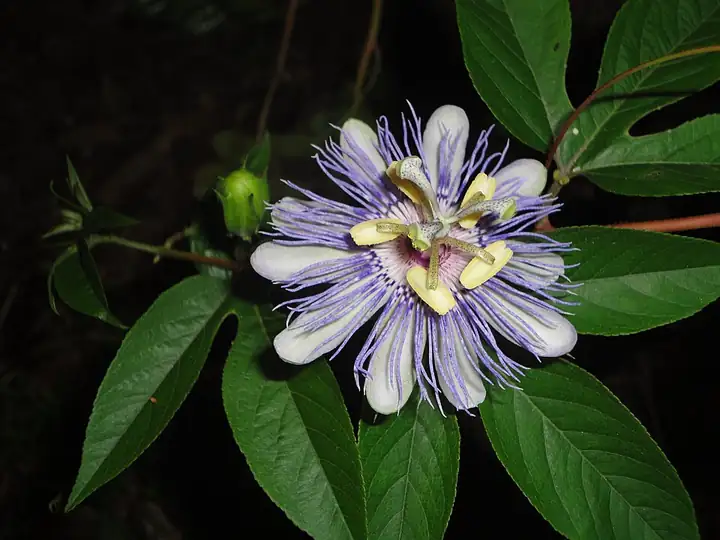
Maypop (purple passionflower)
Passiflora incarnata · Passionflower family (Passifloraceae)
| Hardiness zones | 5 to 9 |
|---|---|
| Sun | full sun to part shade |
| Water | low |
| Life cycle | perennial |
| Frost | Hardy: takes frost |
About Maypop (purple passionflower)
Maypop is a native passionflower vine with showy lavender flowers and egg-sized yellowish fruit full of edible, sweet-tart pulp. It dies to the ground in cold winters and comes back from spreading roots that send up suckers, sometimes far from the plant. It also feeds Gulf fritillary and variegated fritillary caterpillars.
NC State lists zones 5-9. In cold areas the vine dies to the ground each winter and regrows from the roots, coming up late in spring (NC State; University of Tennessee).
When to plant
Timing is counted from your average last spring frost (and first fall frost). Sow & Tell works out the actual dates for your ZIP code.
Set out plants or rooted suckers in spring; the vines climb by tendrils and can reach 25 feet (USDA NRCS; University of Tennessee). Maypop spreads by its roots: suckers can pop up as far as 20 feet away, so pull extras regularly (Mississippi State; USDA NRCS).
Soil
Prefers fertile, well-drained soil but grows in clay, sand and poor soils (USDA NRCS; Mississippi State); soggy soil in winter can cause root rot (NC State).
Pick a well-drained spot with sun at least half the day; maypop grows well even in poor soil.
Feeding
Avoid soggy soil, especially in winter, which can rot the roots; pull root suckers regularly so the vine doesn't take over.
Harvest
Flowers open from about June to September, and fruit ripens 2-3 months later, from July to October, as it turns yellowish (USDA NRCS). Ripe or nearly ripe fruit drops to the ground, so check under the vines often (Mississippi State).
Maypop keeps blooming from June to September, and each flower's fruit ripens 2-3 months later, so fruit keeps coming from July to October as it turns yellowish.
Diseases and problems
Root rot
In the kitchen
Ripe fruit is eaten fresh or made into juice, syrup or jelly (USDA NRCS; NC State).
Safety: Eat only the ripe fruit: NC State notes the leaves and stems contain cyanogenic glycosides that can cause nausea, vomiting, drowsiness and irregular heartbeat. As an herbal supplement, passionflower can cause drowsiness and dizziness, should be avoided in pregnancy, and may add to the effects of anesthesia and other sedating medicines (NCCIH).
Pets: Not listed by the ASPCA; NC State flags the leaves and stems (cyanogenic glycosides) as a concern for cats, dogs and horses
Sources
- plants.sc.egov.usda.gov
- plants.sc.egov.usda.gov
- plants.ces.ncsu.edu
- tnyards.utk.edu
- msfruitextension.wordpress.com
- nccih.nih.gov
- plantsservices.sc.egov.usda.gov
- aspca.org
- aspca.org
Photo: Photo: E.nielsen / Wikimedia Commons, CC BY-SA 3.0 (CC BY-SA 3.0). Photo resized for the web.

Planting dates and advice are general guidance; check with your local Cooperative Extension office for your area.