
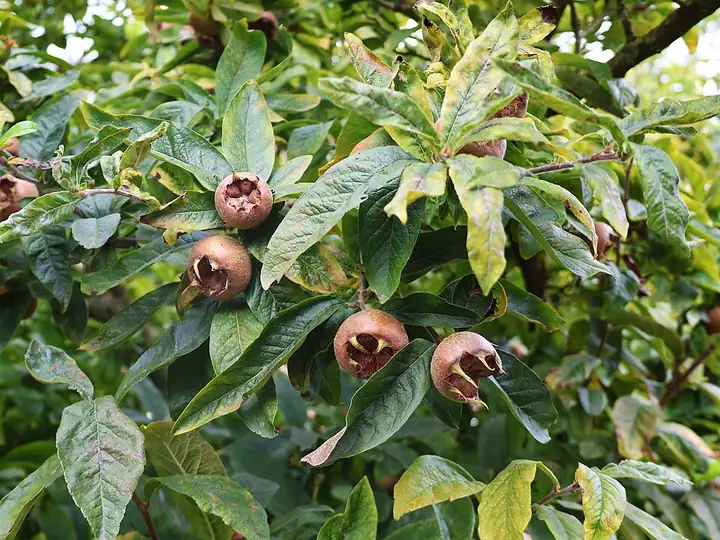
Medlar
Mespilus germanica (syn. Crataegus germanica) · Rose family (Rosaceae)
| Hardiness zones | 5 to 9 |
|---|---|
| Sun | full sun |
| Water | moderate |
| Life cycle | perennial |
| Frost | Hardy: takes frost |
| Spacing | 198 inches |
About Medlar
Medlar is a small, hardy, spreading tree related to pears and hawthorns, with large white flowers in late spring and russet-brown fruit shaped like a little open-ended apple. The fruit is hard and astringent when picked and must be 'bletted' (softened in storage) until the flesh turns brown and tastes like spiced baked apple or dates. It was a favorite of medieval and 1600s European gardens and is grown today as an unusual backyard fruit.
The University of Wisconsin uncommon-fruit trials list zones 5-9 and call its winter hardiness marginal at the cold end; Oregon State lists zone (4)5. Late bloom means spring frosts seldom harm the flowers. It is not native or naturalized in the U.S., and we found no invasive or noxious listing.
When to plant
Timing is counted from your average last spring frost (and first fall frost). Sow & Tell works out the actual dates for your ZIP code.
Plant bare-root trees while dormant, from late fall to early spring; potted trees can go in at other times if it isn't hot and dry (RHS). Keep it about 16 ft from other trees and buildings, set the graft about 2 inches above the soil and stake it (RHS; University of Missouri). Grafted trees usually fruit in the third or fourth growing season.
Soil
Deep, fertile, well-drained soil; it tolerates most soils except very chalky or waterlogged ground (RHS; University of Wisconsin).
Most soils need no preparation; in poor soil mix a bucket of compost into the backfill (RHS).
Feeding
- Late winter or early spring, each year: Compost mulch, 2-3 inches deep. Spread it over the root area, leaving a gap around the trunk (RHS).
- Early spring, only if crops are poor or leaves show deficiency: General-purpose organic granular fertilizer. Follow the package directions (RHS).
Water during dry spells for the first few years so young fruit doesn't drop; when pruning in winter, spare the short side shoots, because fruit forms at their tips (RHS).
Harvest
Pick in late October or November, after a frost, on a dry day when the stalk comes away easily (RHS; University of Missouri). Set fruit stalk-up in one layer in a cool, dark, frost-free spot for 2-3 weeks until it is soft, darker brown and slightly wrinkled; that is bletted and ready.
One crop each fall, picked in late October or November and then bletted indoors for 2-3 weeks before eating.
Varieties (9)
Extension and RHS sources document 9 medlar varieties; most are European and only a few are described in detail.
| Variety | Type | Days | Notes |
|---|---|---|---|
| Macrocarpa | European selection | Named by University of Missouri Extension among medlars grown in the U.S. | |
| Marron | European selection | Smaller fruit and a smaller tree than 'Breda Giant' in the Wisconsin trials (listed there as 'Marion'). | |
| Monstrueuse d'Evreinoff | European selection | Named by University of Missouri Extension (spelled there 'Monstruesue de Evrenoff') among medlars grown in the U.S. | |
| Pucia Super Mol | European selection | Named by University of Missouri Extension among medlars grown in the U.S. | |
| Sultan | European selection | Named by University of Missouri Extension among medlars grown in the U.S. | |
| Breda Giant | Large-fruited | Grown in the University of Wisconsin uncommon-fruit trials; very similar to 'Marron'. | |
| Iranian | Large-fruited | Good flavor. Heavy crops of early-ripening fruit. RHS Award of Garden Merit. | |
| Large Russian | Large-fruited | Large russet-brown fruit, about 2.75 inches across, on a small, spreading tree. | |
| Nottingham | Small-fruited | Small fruit, about 1.5 inches, with very good flavor. Prolific; a fairly compact tree, more upright than most medlars. RHS Award of Garden Merit. |
Pests to watch for
Leafhoppers, Aphids
Diseases and problems
Brown rot, Powdery mildew, Quince leaf blight
In the kitchen
Scoop the bletted pulp from the skin and seeds and eat it fresh, with cheese, or in desserts; it also makes amber jelly and has been baked, roasted and made into brandy or cider (RHS; University of Missouri; University of Wisconsin).
Keeping it: Blet hard fruit stalk-up in a single layer in a cool, dark, frost-free spot for 2-3 weeks, checking often; use bletted fruit soon.
Safety: Eat only bletted pulp; discard the leathery skin and large seeds (RHS). Before bletting the fruit is hard, bitter and astringent. Some trees have thorny branches (Oregon State). We found no research-based guidance on pregnancy, drug interactions or allergies.
Pets: Not listed by the ASPCA
Sources
Photo: Photo: Renée Kools, CC BY 4.0, via Wikimedia Commons (CC BY 4.0). Photo resized for the web.

Planting dates and advice are general guidance; check with your local Cooperative Extension office for your area.