
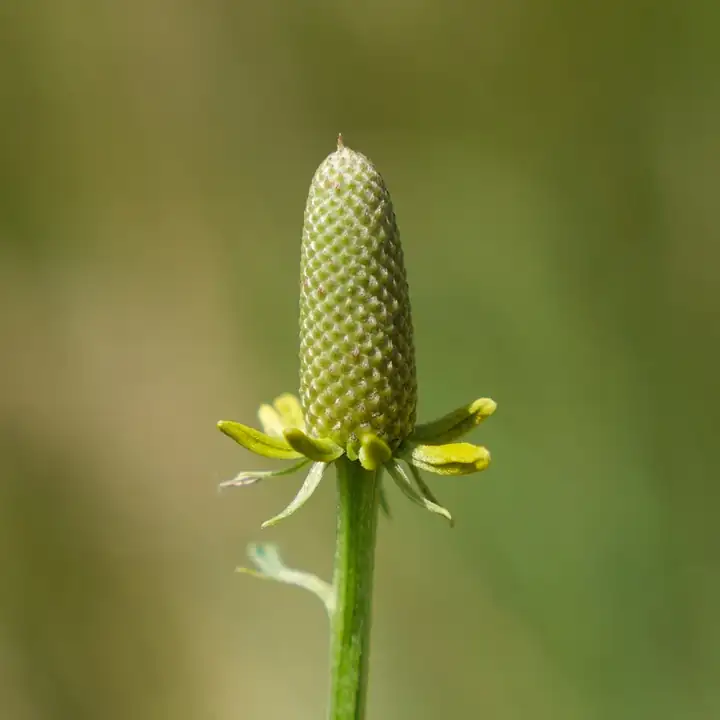
Mexican hat (prairie coneflower)
Ratibida columnifera (upright prairie coneflower), including the brown-purple form f. pulcherrima · Aster family (Asteraceae)
| Hardiness zones | 4 to 9 |
|---|---|
| Sun | full sun |
| Water | low |
| Life cycle | perennial |
| Frost | Hardy: takes frost |
| Soil pH | 6.8–7.2 |
About Mexican hat (prairie coneflower)
Mexican hat is a tough prairie wildflower whose drooping red-brown and yellow petals hang below a tall, thimble-like center, like a sombrero (Wildflower Center). It is native across the Great Plains and much of the West: from southeastern British Columbia to Arizona, east to Wisconsin, Illinois, Missouri, Arkansas, Oklahoma and Texas, and it has spread farther east (Wildflower Center, NRCS). It blooms all summer, feeds native bees and butterflies, and its seeds feed songbirds (Wildflower Center, SDSU). It is short-lived in gardens and can crowd out weaker plants, and the Wildflower Center rates its deer resistance high but notes deer will eat the flowers.
NC State lists zones 4a-9b. It's native, not listed as invasive anywhere we checked, though it reseeds and can be aggressive in a small bed (Wildflower Center).
When to plant
Timing is counted from your average last spring frost (and first fall frost). Sow & Tell works out the actual dates for your ZIP code.
Fall sowing is easiest: rake the seed lightly into loose soil so it touches the ground (Wildflower Center, SDSU). For spring sowing, chill the seed first (about 30 days cold, or 9 weeks at 40 F); it sprouts best at 68-86 F (SDSU, Wildflower Center, NRCS). Plants from seed usually bloom the second year, so days_to_harvest is empty; it can also be divided (NC State, Texas Tech).
Soil
Well-drained soil, usually limy (calcareous): sand, loam, clay loam, caliche or rocky ground; it handles poor soil but not heavy clay (Wildflower Center, NC State, SDSU).
Just make sure the spot drains well; it tolerates poor, limy soil and doesn't need compost or fertilizer (NC State, Wildflower Center).
Feeding
Don't fertilize or overwater: it generally needs neither, and heavy clay or soggy soil shortens its already short life (NC State, Arkansas Extension).
Harvest
Blooms from early summer into early fall, longer if you water during dry spells (Wildflower Center, Arkansas Extension). Cut for the vase; the flowers last well (NC State). Shear leggy plants now and then, and let the cones dry brown before mowing or cutting back if you want seedlings (Texas Tech, Wildflower Center).
Varieties (1)
Extension and Wildflower Center pages name no cultivars; most plants are sold as the wild species from seed. We list the one named color form.
| Variety | Type | Days | Notes |
|---|---|---|---|
| f. pulcherrima (red Mexican hat) | Natural color form | Rich brown-purple to red petals instead of yellow-tipped ones. |
In the kitchen
Safety: NC State and the Wildflower Center give no poisoning warnings for it. Old Plains teas and washes made from it are history, not advice, and it isn't a food plant.
Pets: Not listed by the ASPCA (no Mexican hat entry on its toxic and non-toxic plant lists).
Sources
- plants.ces.ncsu.edu
- wildflower.org
- plants.sc.egov.usda.gov
- uaex.uada.edu
- depts.ttu.edu
- extension.okstate.edu
- openprairie.sdstate.edu
- yavapaiplants.extension.arizona.edu
- aspca.org
- aspca.org
Photo: Photo: Jasper Shide, CC0, via Wikimedia Commons (CC0). Photo resized for the web.

Planting dates and advice are general guidance; check with your local Cooperative Extension office for your area.