
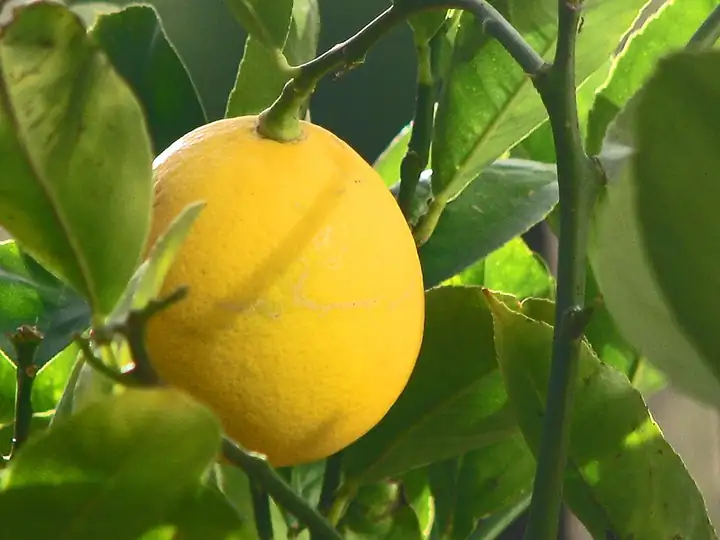
Meyer lemon
Citrus × meyeri · Citrus family (Rutaceae)
| Hardiness zones | 9 to 11 |
|---|---|
| Sun | full sun |
| Water | moderate |
| Life cycle | perennial |
| Frost | Half-hardy: takes a light frost |
| Soil pH | 5.5–6.5 |
About Meyer lemon
The Meyer lemon is a natural cross between a lemon and a mandarin or orange. USDA plant explorer Frank Meyer brought it from near Beijing, China, in 1908. Its fruit is rounder, thinner-skinned and more orange-yellow than a store lemon, with a milder, less sour taste. The small, nearly thornless tree is one of the easiest citrus to keep in a pot, and the trees sold today are 'Improved Meyer', a virus-free selection.
NC State lists lemons, including Meyer, for zones 9-11; Meyer is the most cold-hardy lemon, about 22 F in Clemson's list, and UF/IFAS says to protect it below 20 F. Everywhere colder, grow it in a pot and bring it in for winter.
When to plant
Timing is counted from your average last spring frost (and first fall frost). Sow & Tell works out the actual dates for your ZIP code.
Move potted trees outdoors in spring once the danger of frost has passed (UMD); Oregon State's rule of thumb in the Northwest is out around mid-April and back in around Halloween. In zones 9-11 a container-grown tree can go in the ground any time of year (UF/IFAS). Lemons often start bearing 1 to 3 years after planting (Clemson).
Soil
Loose, well-drained soil that stays moist but never soggy (UF/IFAS); in pots, a well-drained citrus, cactus or general potting mix (UMD).
Pot in a light, well-drained citrus, cactus or general potting mix in a container with a drainage hole (UMD); Clemson also suggests 4 parts aged pine bark to 1 part peat or coir. In the ground aim for pH 5.5-6.5 (UF/IFAS).
Feeding
- Potted trees: early spring, as new growth starts: citrus fertilizer with micronutrients, with an N-P-K ratio near 2-1-1 or 3-1-1. Feed only while the tree is actively growing (UMD). Either mix slow-release fertilizer into the pot, or use a liquid citrus fertilizer once or twice a month (UC Master Gardeners); follow the label, since trees in pots need less than trees in the ground (UC IPM).
- Potted trees: early summer: citrus fertilizer with micronutrients. Give the second of at least three growing-season feedings (UMD), or keep up the liquid feeding. Potted citrus outdoors may need watering daily in summer (UMD), so check the pot often.
- Potted trees: late summer (last feeding of the year): citrus fertilizer with micronutrients. Give the last feeding in late summer and stop by early fall; don't feed through winter (UMD).
- Any time new leaves come out yellow with green veins (zinc, iron or manganese shortage): chelated micronutrient spray (zinc, iron, manganese). Spray the new spring growth with a chelated micronutrient product, or add zinc or iron sulfate to the soil (UC IPM); follow the label.
- In-ground trees (zones 9-11), first year, spread through the growing season: citrus fertilizer such as 6-6-6-2 with minor elements. UF/IFAS suggests a 6-6-6-2 mix after planting; for young lemon trees it gives about 1/4 to 1/2 pound per feeding, 3 to 4 times the first year, with more each year after. Follow a soil test.
Don't feed in fall or winter (UMD; UC IPM advises against late-season feeding). Too much nitrogen gives leafy growth at the expense of fruit (UF/IFAS), and late-season flushes attract citrus leafminer (UC Master Gardeners).
Harvest
Fruit ripens mainly in winter, with a few lemons at other times of year (UC Riverside; UF/IFAS says fall and winter). Pick when the rind has turned fully yellow-orange; citrus fruit can take six to nine months to ripen after bloom (UMD).
Meyer lemon flowers off and on all year (the main bloom is in spring), so lemons come at scattered times with the biggest crop in winter. Pick each one as it colors fully.
Varieties (1)
Only one Meyer lemon is sold today. 'Improved Meyer', a virus-free selection, has been the only commercial Meyer since the 1970s (UF/IFAS); the original Meyer lemons carried tristeza virus without showing it and were banned in some citrus areas (Citrus ID).
| Variety | Type | Days | Notes |
|---|---|---|---|
| Improved Meyer | Meyer lemon (lemon × mandarin or orange hybrid) | Juicy and acidic but sweeter and less sour than a Eureka lemon, with a distinctive aroma. Small, shrubby, nearly thornless tree that flowers on and off all year; medium, rounded fruit with a smooth, thin, yellow-orange rind and some seeds. A good container tree, frost-hardy into the low 20s F. |
Pests to watch for
Asian citrus psyllid, Citrus leafminer, Scale insects, Mealybugs, Aphids, Twospotted spider mite, Whiteflies
Diseases and problems
Citrus greening (HLB), Citrus canker, Tristeza virus, Root rot, Sooty mold
In the kitchen
Use the juice, zest and slices like any lemon in drinks, desserts, dressings and cooking. It is sweeter and less acidic than a Eureka lemon (UC Master Gardeners, Solano).
Keeping it: Keep Meyer lemons in a sealed plastic bag in the fridge for a few weeks; on the counter they last only days. Squeezed juice tastes best used within a day.
Safety: The fruit is a common food. Lemon peel and plant sap may cause a skin rash in some people (NC State), and juice or peel oil left on skin in sunlight can cause a burn-like reaction (RHS). NC State also notes that heavy use of lemon juice can wear down tooth enamel.
Pets: Toxic to dogs, cats and horses (ASPCA, listed under lemon): the peel and plant contain essential oils and psoralens that can cause vomiting, diarrhea, depression and skin irritation; the fruit flesh itself is edible.
Sources
- citrusvariety.ucr.edu
- gardeningsolutions.ifas.ufl.edu
- idtools.net
- hgic.clemson.edu
- hgic.clemson.edu
- plants.ces.ncsu.edu
- extension.umd.edu
- extension.oregonstate.edu
- ucanr.edu
- ucanr.edu
- rhs.org.uk
- aphis.usda.gov
- usda.gov
- aspca.org
- ipm.ucanr.edu
- ask.ifas.ufl.edu
Photo: Photo: Debra Roby, CC BY 2.0, via Wikimedia Commons (CC BY 2.0). Photo resized for the web.

Planting dates and advice are general guidance; check with your local Cooperative Extension office for your area.