
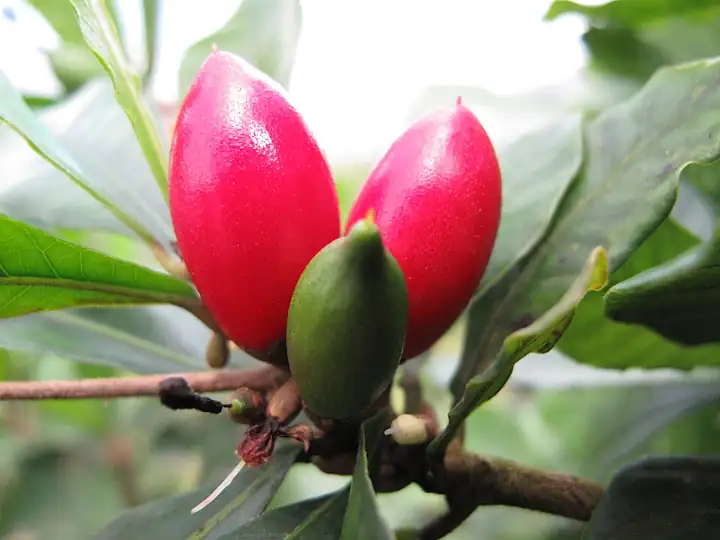
Miracle fruit
Synsepalum dulcificum · Sapodilla family (Sapotaceae)
| Hardiness zones | 10 to 11 |
|---|---|
| Sun | full sun to part shade |
| Water | moderate |
| Life cycle | perennial |
| Frost | Tender: killed by frost |
| Spacing | 98 inches |
About Miracle fruit
Miracle fruit is a slow-growing evergreen shrub from West Africa with small, bright red berries. A protein in the pulp, miraculin, makes sour foods taste sweet for about 15 minutes to an hour after you eat a berry. It needs acidic soil, so most U.S. gardeners grow it in a pot that can come indoors in cold weather.
UF/IFAS says it is not frost tolerant and recommends pots in Florida so plants can come inside before a freeze; a Palm Beach County Extension agent notes older plants can live through the mid-20s F with leaf and twig loss. No source gives zones, so the range is our estimate. The Hawaii-Pacific Weed Risk Assessment rates it low risk, and UF/IFAS expects little invasive potential.
When to plant
Timing is counted from your average last spring frost (and first fall frost). Sow & Tell works out the actual dates for your ZIP code.
Plants start fruiting in their third or fourth year and peak around year five (UF/IFAS; Palm Beach County Extension). Fresh seed sprouts in about 8-10 weeks and must never dry out; cuttings root slowly. In-ground plantings in south Florida are spaced about 8 ft apart (UF/IFAS). No source ties planting to a frost date.
Soil
Rich, well-drained, acidic soil, ideally around pH 5; in alkaline areas grow it in a pot of pine-bark or peat-rich mix (UF/IFAS; Palm Beach County Extension).
Use an acidic mix, such as a pine-based potting mix or one with plenty of peat moss; avoid alkaline soil (UF/IFAS; Palm Beach County Extension).
Feeding
- Regularly through the warm months: Slow-release fertilizer such as 18-6-8, or a balanced fertilizer. Follow the label; a Palm Beach County Extension agent suggests a balanced feeding every two to three months (UF/IFAS; Palm Beach County Extension).
Don't let it dry out in the dry season, and don't grow it in alkaline soil (UF/IFAS).
Harvest
Berries come all year in flushes, about every two months. Pick weekly when the whole berry, including the shoulder, is fully red (UF/IFAS).
Potted plants in south Florida gave about six flushes of berries a year, roughly every two months; pick weekly and prune once a year to keep fruit within reach.
Varieties (9)
There are no released cultivars; UF/IFAS describes 9 plant forms (morphotypes) from its south Florida yield trial.
| Variety | Type | Days | Notes |
|---|---|---|---|
| Cardinal | Plant form (morphotype) | Christmas-tree shape; one of the heaviest bearers, with about 1,800-1,900 berries per plant a season. | |
| Cherry | Plant form (morphotype) | Wavy leaves; about 2.2 kg per plant a year. | |
| Flame | Plant form (morphotype) | Narrow, columnar plant; one Flame tree had the highest miraculin level in the study. | |
| Holly | Plant form (morphotype) | Dark green leaves; the lightest bearer in the trial (about 0.7 kg per plant a year). | |
| Imperial | Plant form (morphotype) | Common tree shape; one of the two heaviest bearers in the UF/IFAS trial (about 2.8 kg of fruit per plant a year). | |
| Sangria | Plant form (morphotype) | Wavy, curly leaves; about 1.7 kg per plant a year. | |
| Scarlet | Plant form (morphotype) | Curly leaves; about 1.9 kg per plant a year. | |
| Vermilion | Plant form (morphotype) | Flat, horizontal branches; good yields (about 2.25 kg per plant a year). | |
| Wine | Plant form (morphotype) | Weeping branches that bend downward; about 1.8 kg per plant a year. |
Pests to watch for
Mealybugs, Twospotted spider mite
In the kitchen
Eat a berry, let the pulp coat your tongue, then try lemons, limes, sour berries or other tart foods; they'll taste sweet for a while. The effect fades with cooking, so extra fruit is frozen or freeze-dried (UF/IFAS).
Keeping it: Fresh berries don't keep long; freeze or freeze-dry extras, which keeps the sour-to-sweet effect.
Safety: The fruit is sold in the U.S. as a natural product, but the FDA has not accepted miraculin as a food additive; early GRAS requests in the 1970s were denied for lack of safety data (UF/IFAS). Claims about blood sugar or chemotherapy taste changes come from small or non-human studies, so don't use it as a treatment. We found no research-based guidance on pregnancy, drug interactions or allergies.
Pets: Not listed by the ASPCA
Sources
Photo: Photo: MiracleFruitFarm, CC BY-SA 3.0, via Wikimedia Commons (CC BY-SA 3.0). Photo resized for the web.

Planting dates and advice are general guidance; check with your local Cooperative Extension office for your area.