
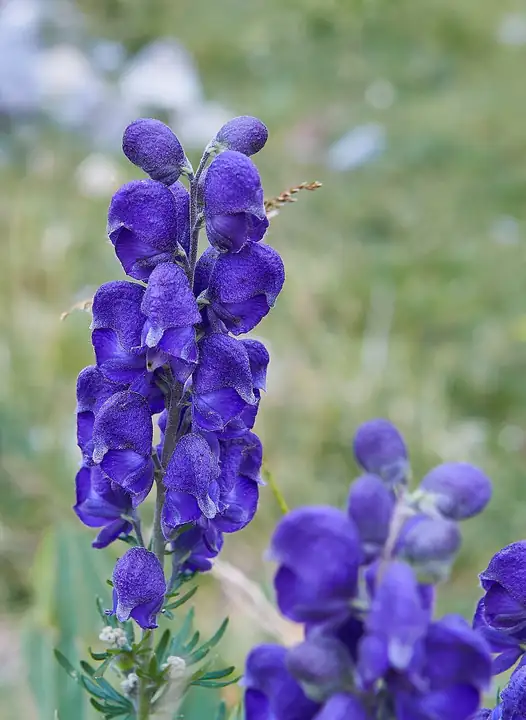
Monkshood
Aconitum napellus (common monkshood, aconite, wolfsbane) and other garden Aconitum species and hybrids, such as azure monkshood (A. carmichaelii) · Buttercup family (Ranunculaceae)
| Hardiness zones | 3 to 8 |
|---|---|
| Sun | full sun to part shade |
| Water | moderate |
| Life cycle | perennial |
| Frost | Hardy: takes frost |
| Spacing | 12 to 36 inches |
About Monkshood
Monkshood sends up stiff 3-5 ft spikes of hooded, helmet-shaped flowers in deep blue or purple from late summer into fall, a time when few perennials bloom blue (Cornell, Illinois Extension). It is also one of the most poisonous plants in the garden: every part, especially the root, holds aconitine, which can stop the heart, and deaths have followed eating it by mistake (NC State, Poison Control). Garden monkshood comes from the mountains of Europe and Asia; the U.S. has its own native kinds, such as southern blue monkshood (A. uncinatum) from Missouri to Pennsylvania and south to Georgia, and New York monkshood (A. noveboracense) (Wildflower Center).
Hardy in zones 3-8 (Illinois Extension; Cornell says 4-8, reportedly to zone 3). It grows best where summers are cool and needs afternoon shade in the South (NC State).
When to plant
Timing is counted from your average last spring frost (and first fall frost). Sow & Tell works out the actual dates for your ZIP code.
Plant the tuberous roots in fall with the crowns just below the soil surface, or set out nursery plants in spring or fall (Illinois Extension, Cornell). Pick the spot carefully: the brittle roots resent being moved, and it can be slow to settle in. Seed sown outdoors in fall, early winter or early spring may take 1-2 years to sprout (Cornell). Wear gloves when handling roots and plants, and never plant it in or next to the vegetable garden. We found no sourced day count to first bloom.
Soil
Rich, humus-filled soil that stays evenly moist but never soggy; work in plenty of organic matter before planting (Cornell, Illinois Extension).
Work plenty of compost or other organic matter into the bed before planting so the soil stays evenly moist but drains well (Cornell).
Feeding
- Early spring, just before shoots come up: complete slow-release fertilizer such as 12-6-6. Without a soil test, about 1-2 lb per 100 sq ft, kept off the new leaves and watered in (Clemson). Follow a soil test.
Don't let it dry out or sit in soggy soil, and don't move or divide it more than you must; the brittle roots are slow to recover (Cornell, Illinois Extension).
Harvest
Blooms late summer to fall (Cornell; Illinois says September-October). Cutting plants back after flowering can bring more bloom (NC State). For the vase, cut spikes when about half the florets are open; monkshood is sensitive to ethylene, so keep it away from ripening fruit (Kansas State). Wear gloves whenever you cut it.
Varieties (4)
Cornell documents these 4 cultivars under common monkshood; we couldn't open a trustworthy source for azure monkshood (A. carmichaelii) cultivars such as 'Arendsii'.
| Variety | Type | Days | Notes |
|---|---|---|---|
| Albus | Common monkshood (A. napellus) | Pure white flowers on 3-4 ft plants. | |
| Blue Sceptre | Monkshood, listed under A. napellus | Two-tone blue and white flowers. | |
| Newry Blue | Monkshood, listed under A. napellus | Very deep blue flowers. | |
| Rubellum | Monkshood, listed under A. napellus | Pink flowers over very finely cut leaves. |
Pests to watch for
Four-lined plant bug, Leafminers
Diseases and problems
Verticillium wilt, Bacterial leaf spot, Crown rot, Powdery mildew
In the kitchen
Safety: Deadly poisonous. Every part, roots most of all, contains aconitine and related alkaloids; symptoms start within minutes to hours and include burning and numbness of the mouth, tingling, vomiting, diarrhea, muscle weakness, a slow or racing irregular heartbeat and breathing paralysis (NC State, Poison Control). There is no antidote. Roots have been mistaken for horseradish or Jerusalem artichokes, and leaves for salad greens, so keep it away from food gardens and children, wear gloves when handling it, and never use it as an herbal remedy; if any is swallowed, call Poison Help at 1-800-222-1222.
Pets: Not listed by the ASPCA (no monkshood, aconite or wolfsbane entry on its plant lists), but don't take that as safe: NC State rates it high-severity, lists it as a problem for cats and dogs, and says it may be fatal to people and pets. Keep pets from chewing any part.
Sources
- plants.ces.ncsu.edu
- extension.illinois.edu
- gardening.cornell.edu
- archive.lib.msu.edu
- poison.org
- pmc.ncbi.nlm.nih.gov
- wildflower.org
- bookstore.ksre.ksu.edu
- aspca.org
- aspca.org
- aspca.org
- aspca.org
- aspca.org
- extension.rutgers.edu
- hgic.clemson.edu
Photo: Photo: Axel Tschentscher, CC BY-SA 4.0, via Wikimedia Commons (CC BY-SA 4.0). Photo resized for the web.

Planting dates and advice are general guidance; check with your local Cooperative Extension office for your area.