
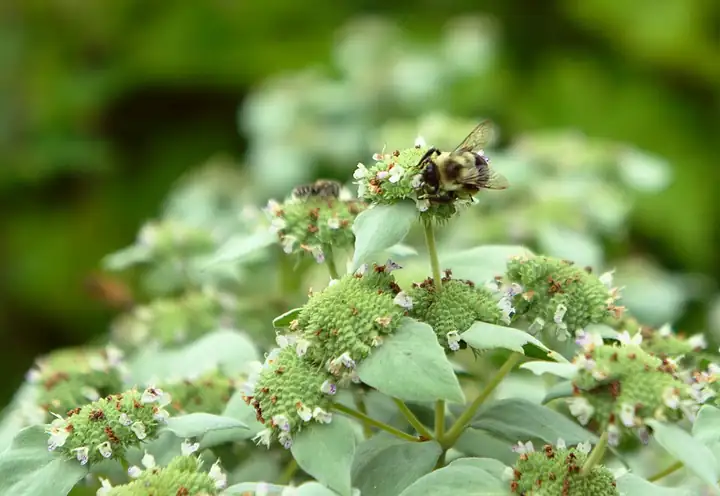
Mountain mint
Pycnanthemum muticum (clustered or short-toothed mountain mint), P. tenuifolium (narrowleaf), P. virginianum (Virginia) and relatives · Mint family (Lamiaceae)
| Hardiness zones | 3 to 8 |
|---|---|
| Sun | full sun to part shade |
| Water | moderate |
| Life cycle | perennial |
| Frost | Hardy: takes frost |
| Spacing | 12 to 36 inches |
About Mountain mint
Mountain mints are native wildflowers with strongly minty leaves and flat clusters of tiny white to pale lavender flowers, often framed by silvery bracts. Through the summer they draw an enormous range of bees, wasps, flies, beetles and butterflies. They spread by underground stems, so give them room or a border; clustered mountain mint is the 2025 Perennial Plant of the Year.
NC State lists P. virginianum for zones 3-7 and P. muticum and P. tenuifolium for 4-8. Clemson warns the spreading kinds may become invasive in a garden; they are native, and we found no legal invasive listing.
When to plant
Timing is counted from your average last spring frost (and first fall frost). Sow & Tell works out the actual dates for your ZIP code.
Mountain mint is easy from seed and divides readily (UT Gardens); NC State also lists stem cuttings. To keep a clump in bounds, slice around it with a spade in spring (NC State), or pull or mow the extra shoots (UT Gardens; Maryland DNR).
Soil
Moist, well-drained soil is best, but plants handle clay, rocky or sandy ground and are very drought tolerant once established; drier soil slows their spread (Clemson; NC State; UT Gardens).
Moist, well-drained soil is ideal, but mountain mint grows in clay, rocky or sandy soil; no special preparation is needed (NC State; UT Gardens).
Feeding
Rich, moist soil speeds its spread; keeping the soil on the dry side slows it (Clemson). No fertilizer is normally needed.
Harvest
Flowers from June or July into September, often for about three months. No deadheading is needed; the dried heads stay attractive. Leaves and flowers for tea can be picked in summer (NC State).
Varieties (4)
Mountain mints have almost no named cultivars in extension sources (Mt. Cuba's 2025-2027 trial is still underway), so the main garden species are listed instead.
| Variety | Type | Days | Notes |
|---|---|---|---|
| Hoary mountain mint | Species (P. incanum) | Frosty, whitened leaves near the flowers; suits sunny, dry, acidic soil and tolerates drought. | |
| Clustered mountain mint | Species (P. muticum) | 3-4 ft tall with broad leaves, a strong spearmint scent and pink-white flowers above silvery bracts. | |
| Narrowleaf mountain mint | Species (P. tenuifolium) | 2-4 ft tall with fine, needle-like leaves and white to lavender flowers. | |
| Virginia mountain mint | Species (P. virginianum) | 2-3 ft tall with flat heads of purple-dotted white flowers. |
Diseases and problems
Rust
In the kitchen
NC State notes the leaves and flowers are used for tea and flavoring. UT Gardens cautions that the leaves contain pulegone, which makes them a poor choice for cooking.
Safety: The leaves contain pulegone, a natural insecticide compound (Clemson; UT Gardens); don't use them as a regular cooking herb, and keep strong teas away from pregnancy and children, since we found no research-based safety guidance.
Pets: Not listed by the ASPCA. Its 'Mint' entry covers garden mints (Mentha species), a different plant group, which the ASPCA lists as toxic to dogs, cats and horses (vomiting and diarrhea if a lot is eaten).
Sources
- plants.ces.ncsu.edu
- plants.ces.ncsu.edu
- plants.ces.ncsu.edu
- hgic.clemson.edu
- utgardens.tennessee.edu
- news.maryland.gov
- mtcubacenter.org
- extension.psu.edu
- aspca.org
- aspca.org
- homesoiltest.msu.edu
Photo: Photo: Kelvinsong, CC BY 3.0, via Wikimedia Commons (CC BY 3.0). Photo resized for the web.

Planting dates and advice are general guidance; check with your local Cooperative Extension office for your area.