
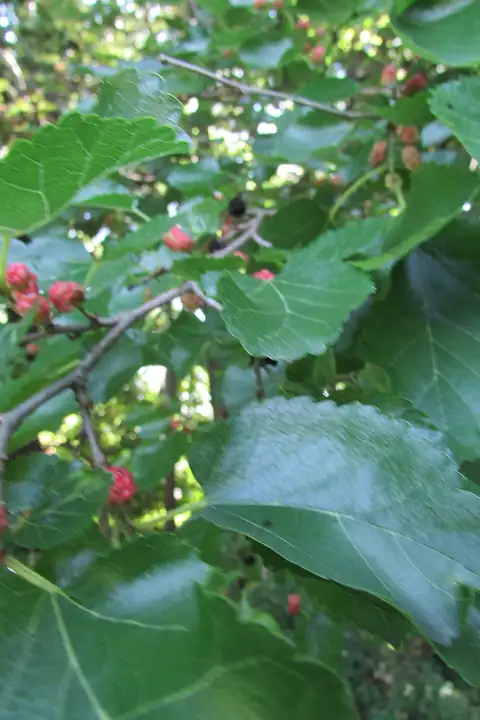
Mulberry (red and black)
Morus rubra (red mulberry) and Morus nigra (black mulberry) · Mulberry family (Moraceae)
| Hardiness zones | 4 to 9 |
|---|---|
| Sun | full sun |
| Water | moderate |
| Life cycle | perennial |
| Frost | Hardy: takes frost |
About Mulberry (red and black)
Mulberries are fast-growing trees with sweet, blackberry-like fruit that ripens in early summer. Red mulberry is a native eastern tree; black mulberry is an Asian species that is less cold-hardy. Skip white mulberry (Morus alba): USDA PLANTS flags it as invasive, Wisconsin restricts it as an invasive plant, and it crosses readily with native red mulberry, so many 'mulberry' cultivars sold are white mulberry or white-red hybrids; check the species before you buy.
Red mulberry is listed for zones 4-9 (NC State); black mulberry is hardy only to about zone 7 (UW-Madison CIAS).
When to plant
Timing is counted from your average last spring frost (and first fall frost). Sow & Tell works out the actual dates for your ZIP code.
Transplants usually start bearing in 3 to 4 years (UW-Madison CIAS). Red mulberry trees are usually either male or female, so a tree that never fruits may be a male (NC State; USDA Forest Service). Unpruned trees can grow very tall (up to 80 feet), so prune to keep the fruit within reach (UW-Madison CIAS).
Soil
Deep, rich, well-drained loam; red mulberry grows on clay, sand or loam over a wide pH range and does best on moist, well-drained sites (NC State; UW-Madison CIAS; USDA Forest Service).
Plant in deep, well-drained loam in full sun (UW-Madison CIAS; NC State).
Feeding
Poor soil gives weak growth (NC State); prune to keep the tree a manageable size for picking (UW-Madison CIAS).
Harvest
Fruits turn from red to dark purple and drop when fully ripe, from late spring into summer (NC State; USDA Forest Service). Ripe fruit can be gathered by shaking the branches over a sheet (UW-Madison CIAS).
Mulberries give one crop a year, maturing in late spring to summer (about May-June in North Carolina). Red mulberry trees are usually male or female, so only female trees fruit.
Varieties (7)
Only 7 named mulberries could be sourced, and details are thin. Sources rate the red mulberry species, not cultivars (NC State: Zones 4a-9b). No black mulberry (Morus nigra) cultivars were documented in the sources that could be opened. White mulberry hybridizes with red mulberry and the two are often confused (US Forest Service), so many named 'red' mulberries likely carry white mulberry genes; pure white mulberry cultivars are left out because white mulberry is invasive in several states (Wisconsin lists it as noxious and invasive).
| Variety | Type | Days | Notes |
|---|---|---|---|
| Gerardi Dwarf | Hybrid (Morus hybrid; USDA GRIN) | Dwarf selection. | |
| Illinois Everbearing | Hybrid (Morus hybrid; USDA GRIN) | Dark fruit that looks like a blackberry. | |
| Collier | Hybrid (red × white mulberry) | ||
| Hicks Everbearing | Named under red mulberry (Morus rubra) by NC State; may carry white mulberry genes | ||
| Silk Hope | Named under red mulberry (Morus rubra) by NC State; may carry white mulberry genes | Fruit larger than Illinois Everbearing. | |
| Townsend | Named under red mulberry (Morus rubra) by NC State; may carry white mulberry genes | Large fruit. | |
| Travis | Named under red mulberry (Morus rubra) by NC State; may carry white mulberry genes | More cold hardy than black mulberry. |
Pests to watch for
Birds, Scale insects, Whiteflies, Twospotted spider mite
Diseases and problems
Bacterial leaf scorch, Leaf spot, Powdery mildew, Root rot
In the kitchen
Eaten fresh or frozen, dried, juiced, baked into pies and tarts, or made into wine (UW-Madison CIAS).
Keeping it: Ripe mulberries are fragile and don't keep: refrigerate them unwashed and eat them within 2 to 3 days, or freeze them.
Safety: Eat only ripe fruit: unripe berries and the milky sap can cause stomach upset and, rarely, hallucinations, and the sap can irritate skin (NC State). We found no research-based guidance on pregnancy or drug interactions for the fruit.
Pets: Not toxic to dogs, cats or horses (ASPCA lists mulberry tree, Morus sp., as non-toxic)
Sources
- uncommonfruit.cias.wisc.edu
- plants.ces.ncsu.edu
- plants.ces.ncsu.edu
- fs.usda.gov
- plantsservices.sc.egov.usda.gov
- plantsservices.sc.egov.usda.gov
- plantsservices.sc.egov.usda.gov
- aspca.org
Photo: Photo: Chris Light / Wikimedia Commons, CC BY-SA 4.0 (CC BY-SA 4.0). Photo resized for the web.

Planting dates and advice are general guidance; check with your local Cooperative Extension office for your area.