
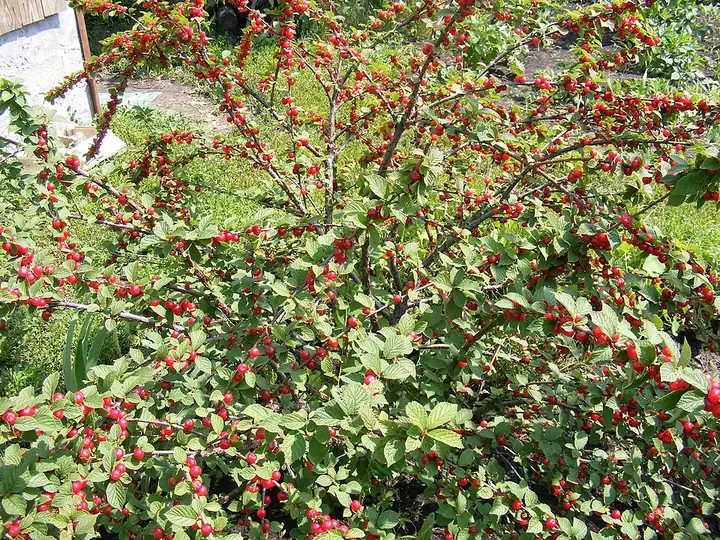
Nanking cherry
Prunus tomentosa · Rose family (Rosaceae)
| Hardiness zones | 2 to 7 |
|---|---|
| Sun | full sun |
| Water | moderate |
| Life cycle | perennial |
| Frost | Hardy: takes frost |
| Spacing | 96 to 180 inches |
About Nanking cherry
Nanking cherry is a tough, very cold-hardy bush cherry from China, Japan and the Himalayas, grown in North America since the late 1800s. In early spring it is covered in white to pale pink flowers, and by early summer it bears small, bright red, tart cherries for fresh eating, jelly and pies. It can seed into nearby wild areas, and Maryland's Invasive Species Council lists it as an invasive species of concern (advisory, not a ban).
NC State lists zones 2-7 and does not recommend it south of zone 7, where heat and humidity hold it back; NDSU rates it hardy to zone 2.
When to plant
Timing is counted from your average last spring frost (and first fall frost). Sow & Tell works out the actual dates for your ZIP code.
Fall is the best time to plant; spring and summer plantings work too but need steady watering the first summer (Utah State). Space single bushes 8 to 15 feet apart, or 6 to 10 feet for a hedge, and plant at least two, since it needs a partner for pollination (Utah State). Bushes usually start bearing in their third or fourth year (Utah State).
Soil
Adapts to most soils, including alkaline ones, as long as they drain well; sandy, well-drained soil is ideal, and established bushes are very drought tolerant (Utah State; University of Wisconsin; NDSU).
Test the soil and work in compost or manure before planting (Utah State).
Feeding
- Once a year in spring, only as a soil test calls for: Balanced fertilizer or compost. Utah State gives no set rate for Nanking cherry; add nutrients at the rates your soil test recommends.
Keep sprinkler water off the leaves to help prevent coryneum blight, and once established don't overwater, since bushes are very drought tolerant (Utah State).
Harvest
Fruit ripens in June to July (Utah State; NC State). Pick when the cherries are bright red and very soft; they bruise easily and keep only a short time, so use or freeze them soon (Utah State).
One crop each early summer (June to July), starting about the third or fourth year. Ripe fruit is very soft and doesn't keep, so pick every few days and freeze what you can't use.
Varieties (1)
Nanking cherry is mostly sold as unnamed seedlings; Utah State says there are no standard cultivars in production. Extension sources name only one form, the white-fruited 'Leucocarpa'.
| Variety | Type | Days | Notes |
|---|---|---|---|
| Leucocarpa | White-fruited form | White-fruited Nanking cherry sold in the North (NDSU). |
Pests to watch for
Twospotted spider mite, Aphids, Cherry fruit fly, Plum curculio, Birds, Deer, Rabbits, Mice (house mice and deer mice)
Diseases and problems
Coryneum blight (shot hole), Brown rot, Branch cankers
In the kitchen
Eaten fresh (some bushes are quite tart), or made into jam, jelly, juice, pies and tarts; NDSU also mentions wine (Utah State; NC State; NDSU). The fruit is small with a big pit, so pitting takes time (University of Wisconsin).
Keeping it: Ripe Nanking cherries are very soft and keep only a short time, so most growers freeze them soon after picking (Utah State).
Safety: The ripe fruit flesh is eaten like other cherries. As in other cherries, the stems, leaves and seeds hold cyanide-forming compounds (ASPCA, for Prunus species), so don't chew or crush the pits.
Pets: Toxic to dogs, cats and horses (ASPCA, listed as cherry, Prunus species): stems, leaves and seeds contain cyanide, worst when leaves are wilting; signs include brick-red gums, dilated pupils, trouble breathing, panting and shock.
Sources
- plants.ces.ncsu.edu
- extension.usu.edu
- uncommonfruit.cias.wisc.edu
- ndsu.edu
- extension-store.montana.edu
- aspca.org
- mdinvasives.org
- marylandbiodiversity.com
Photo: Photo: A. Kabanov / Wikimedia Commons, CC0 (CC0). Photo resized for the web.

Planting dates and advice are general guidance; check with your local Cooperative Extension office for your area.