
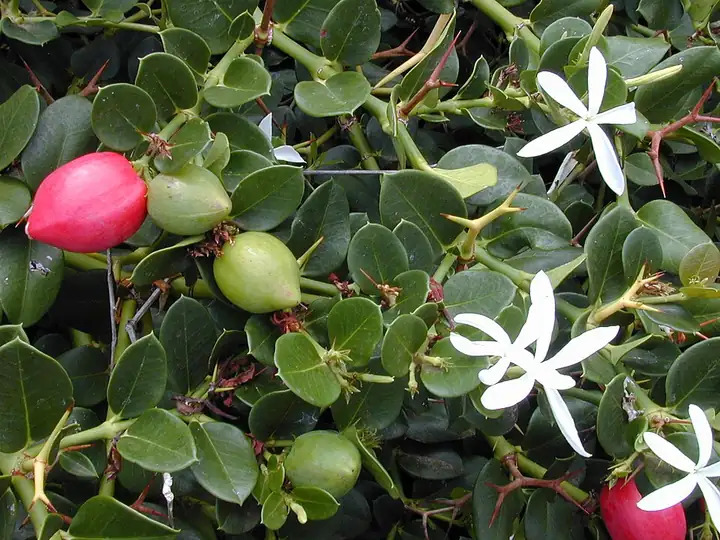
Natal plum (carissa)
Carissa macrocarpa (syn. C. grandiflora) · Dogbane family (Apocynaceae)
| Hardiness zones | 9 to 11 |
|---|---|
| Sun | full sun to part shade |
| Water | low |
| Life cycle | perennial |
| Frost | Half-hardy: takes a light frost |
| Spacing | 48 to 60 inches |
About Natal plum (carissa)
Natal plum is a thorny, evergreen shrub from southern Africa with glossy leaves, star-shaped white flowers that smell like orange blossom, and bright red, plum-shaped fruit that tastes like cranberry or raspberry. It shrugs off salt spray and drought, so it is a favorite hedge in coastal Florida and California. Only the fully ripe fruit is eaten; the rest of the plant bleeds a milky latex sap.
UF/IFAS lists zones 9B-11B and NC State 9a-10b; established plants survive about 25 F, but young ones need protection below 29 F (Morton). NC State notes it has naturalized in Florida and Texas, but the UF/IFAS Assessment rates it not a problem species in all parts of Florida, and we found no state invasive or noxious listing.
When to plant
Timing is counted from your average last spring frost (and first fall frost). Sow & Tell works out the actual dates for your ZIP code.
Set plants 4-5 ft apart for a hedge (UF/IFAS Extension, Charlotte County); keep thorny types away from walkways (UF/IFAS). Layered or budded plants are preferred because seedlings vary; seedlings may fruit in about 2 years and cuttings sooner (Morton; NC State). No source ties planting to a frost date.
Soil
Sandy, well-drained soil is best, though it grows in clay, loam, acid or alkaline soil; it tolerates salt spray and drought but rots in soggy soil (UF/IFAS; NC State).
Plant in sandy, well-drained soil in full sun or light shade; no special preparation is given (UF/IFAS Extension, Charlotte County; NC State).
Feeding
Don't overwater once it is established; soggy soil causes root rot (UF/IFAS). Prune after the spring bloom, taking off no more than the top third (UF/IFAS).
Harvest
Flowers and fruit come all year, with the most from late spring through summer. Pick fruit when it is fully ripe: deep red and slightly soft (Morton; NC State).
Flowers and fruit come all year in frost-free areas, with the biggest crop from about May through September; pick fruit as it turns deep red and soft.
Varieties (13)
Extension sources document 13 varieties; most are landscape forms chosen for size or thornlessness, and fruit flavor isn't rated by variety.
| Variety | Type | Days | Notes |
|---|---|---|---|
| Boxwood Beauty | Compact, thornless | Compact plant with no thorns, good near walks. | |
| Bonsai | Dwarf | Dwarf form about 2 ft tall, suited to containers. | |
| Tomlinson | Dwarf | Dwarf with thorns hidden in the foliage and wine-red fruit. | |
| Nana | Dwarf, thornless | Dwarf, thornless form up to about 1.5 ft tall. | |
| Frank | Fruiting | Light bearer but a good pollen source for other plants. | |
| Gifford | Fruiting | One of Florida's best fruit bearers. | |
| Torrey Pines | Fruiting | Gives good crops of fruit and plenty of pollen. | |
| Fancy | Fruiting, upright | Upright California selection from the 1950s with many large fruits and few seeds. | |
| Emerald Blanket | Low groundcover | Low, spreading form for groundcover. | |
| Green Carpet | Low groundcover | Low-growing groundcover form. | |
| Horizontalis | Low groundcover | Low, spreading groundcover form. | |
| Prostrata | Low groundcover | Low-growing groundcover form. | |
| Variegata | Variegated | Leaves edged or marked with cream or yellow. |
Pests to watch for
Scale insects, Twospotted spider mite, Thrips, Whiteflies
Diseases and problems
Root rot, Bacterial leaf spot, Algal leaf spot, Anthracnose
In the kitchen
Ripe fruit is eaten fresh, skin, seeds and all, and used like cranberries in sauces, pies, jams and jellies; it is a good source of vitamin C (Morton; UF/IFAS Extension, Charlotte County; UF/IFAS).
Safety: Eat only fully ripe fruit. Unripe fruit is full of latex, and unripe fruit and other plant parts are a minor toxicity concern (UF/IFAS Extension, Charlotte County). The milky sap is rated low-severity poison: large amounts may cause vomiting or diarrhea (NC State), and it can irritate the eyes. The stems have sharp, forked thorns up to 2 inches long, so wear gloves and protective clothing when pruning.
Pets: Non-toxic to dogs, cats and horses (ASPCA, listed as natal plum, Carissa grandiflora)
Sources
- ask.ifas.ufl.edu
- edis.ifas.ufl.edu
- plants.ces.ncsu.edu
- blogs.ifas.ufl.edu
- growables.org
- assessment.ifas.ufl.edu
- aspca.org
Photo: Photo: Forest & Kim Starr, CC BY 3.0, via Wikimedia Commons (CC BY 3.0). Photo resized for the web.

Planting dates and advice are general guidance; check with your local Cooperative Extension office for your area.