
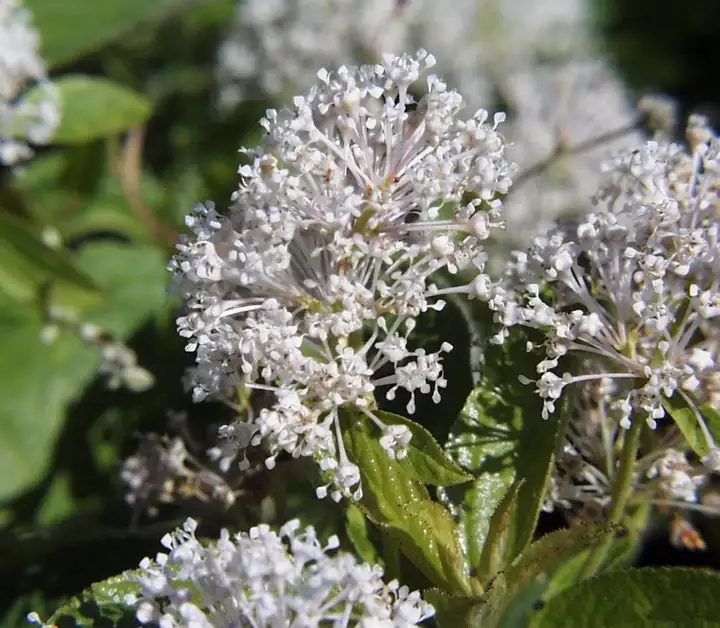
New Jersey tea
Ceanothus americanus · Buckthorn family (Rhamnaceae)
| Hardiness zones | 4 to 8 |
|---|---|
| Sun | full sun to part shade |
| Water | low |
| Life cycle | perennial |
| Frost | Hardy: takes frost |
| Spacing | 36 to 72 inches |
About New Jersey tea
New Jersey tea is a small, tough native shrub, usually 2-3 ft tall, with fluffy clusters of fragrant white flowers in late spring and early summer. It grows wild in prairies, glades and open woods from Maine and southern Canada to Minnesota, Nebraska, Texas and Florida (wildflower.org, Missouri Botanical Garden). Its deep red roots make it very drought tolerant and good on dry, rocky slopes, but hard to move once settled. Its leaves were brewed as a tea substitute around the Revolutionary War, which gave it its name (MBG).
Hardy in zones 4-8 (NC State, Missouri Botanical Garden, Morton Arboretum).
When to plant
Timing is counted from your average last spring frost (and first fall frost). Sow & Tell works out the actual dates for your ZIP code.
Start with small container plants or seed, since the deep roots make older plants hard to transplant (NC State, NRCS). Plant in spring or fall, 3-6 ft apart, and water until established (UMN); after that it needs little water.
Soil
Well-drained sandy, loamy or rocky soil, neutral to alkaline; it tolerates poor, dry soil, road salt and black walnut but gets root rot in wet soil (NC State, Morton Arboretum, MBG).
Test the soil before planting; established shrubs in decent soil need little or no fertilizer (Clemson).
Feeding
- Spring to early summer after new growth starts, only if a soil test shows a need: slow-release complete fertilizer in a 3:1:2 ratio, or what the soil test calls for. Spread evenly from the trunk out to the drip line and water it in; a typical soil-test rate for shrubs is about 2 lb of 12-6-6 per 100 sq ft (Clemson). Follow a soil test.
Water is what new shrubs need most: daily for the first 2 weeks, every 2-3 days through week 12, then weekly until the roots spread (at least two growing seasons), using about a quarter to a third of the nursery pot's volume each time (UMN). Once established it is drought tolerant and does well in poor, dry soil, so it rarely needs feeding; soggy soil causes root rot (NC State, Morton Arboretum).
Harvest
Blooms May to July (Missouri Botanical Garden). Prune only in summer; in cold areas it may die back to the ground in winter and regrow in spring (Morton Arboretum).
Diseases and problems
Leaf spot, Powdery mildew, Root rot in wet soil, Canker
In the kitchen
The dried leaves make a caffeine-free tea (NC State, Missouri Botanical Garden).
Safety: No toxicity is listed in the sources we used.
Pets: Not listed by the ASPCA.
Sources
- plants.ces.ncsu.edu
- wildflower.org
- mortonarb.org
- missouribotanicalgarden.org
- plants.sc.egov.usda.gov
- extension.umn.edu
- aspca.org
- hgic.clemson.edu
Photo: Photo: U.S. Fish and Wildlife Service, Public domain, via Wikimedia Commons. Photo resized for the web.

Planting dates and advice are general guidance; check with your local Cooperative Extension office for your area.