
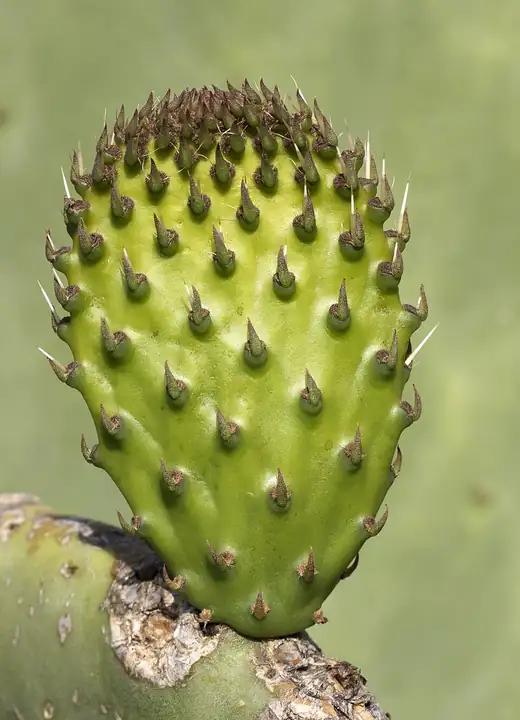
Nopal and prickly pear (Opuntia)
Opuntia ficus-indica (Indian fig, the spineless crop type) and native Opuntia species such as O. engelmannii and O. humifusa · Cactus family (Cactaceae)
| Hardiness zones | 4 to 10 |
|---|---|
| Sun | full sun |
| Water | low |
| Life cycle | perennial |
| Frost | Half-hardy: takes a light frost |
About Nopal and prickly pear (Opuntia)
Prickly pear cacti grow flat, jointed pads that are eaten as a vegetable (nopales or nopalitos) and juicy fruit called tunas. Nopales are a staple of Mexican cooking, and the spineless Indian fig is the main crop type in Mexico and California, while native prickly pears grow wild from the eastern states to the desert Southwest. USDA PLANTS lists Indian fig as introduced in the lower 48 states and Hawaii, but no U.S. state lists it as noxious or invasive.
Hardiness depends on the species: native eastern prickly pear (O. humifusa) is hardy in zones 4-9 (NC State), but spineless Indian fig is mostly limited to zones 9-10 (ISHS paper by Felker and others). In a Kansas City trial, Indian fig died in winter while hardier native types mostly survived (SARE).
When to plant
Timing is counted from your average last spring frost (and first fall frost). Sow & Tell works out the actual dates for your ZIP code.
Start from pads in early spring: let a cut pad dry in shade about a week until the cut end calluses, then set it upright about an inch deep (UC Master Gardeners; UC ANR). Upright pads rooted faster than pads laid flat in a SARE trial, and plants grown from seed take 3 to 4 years to flower and fruit.
Soil
Sandy or rocky, very well-drained soil; in pots or planting holes, UC suggests equal parts soil and sand or rough pumice, since wet soil rots the roots.
Plant in sandy, rocky or gritty soil with sharp drainage; in a pot or planting hole UC ANR suggests equal parts soil and sand or rough pumice.
Feeding
- During the growing season, if you are harvesting pads: high-nitrogen fertilizer. UC ANR recommends a high-nitrogen fertilizer for plants grown for pads; a diluted complete fertilizer in the water is optional for other cacti (UC Master Gardeners).
Overwatering is the main killer: wet soil causes root rot, so let the soil dry between waterings (UC ANR; UC Master Gardeners).
Harvest
Cut young pads in spring while they are thin, tender and bright green, before the spines harden; mid-morning harvest gives the least sour pads (UA; UC ANR). Fruit ripens in the hottest months, often September in the Southwest: pick when deep red or purple, firm but slightly soft, by twisting it off with tongs, because it does not ripen after picking (UA; NMSU).
New pads keep coming: in warm climates well-tended plants can give pads up to six times a year, about 20 to 40 half-pound pads per harvest once established. The fruit is a once-a-year crop in late summer.
Varieties (5)
UC ANR names three spineless Indian fig cultivars, and NC State and a SARE trial add two cold-hardy types; no source documents more for home gardens.
| Variety | Type | Days | Notes |
|---|---|---|---|
| Ohio | Eastern prickly pear (O. humifusa) | Cold-hardy, low-growing native type with orange to peach flowers with red centers and red fruit. | |
| Oklahoma Pancake | O. gilvescens | Died back but mostly survived a Kansas City winter in a high-tunnel trial where Indian fig was killed. | |
| Burbank Spineless | Spineless Indian fig (O. ficus-indica) | A spineless type for pads and fruit; like all 'spineless' prickly pears it still has tiny glochids. | |
| Hemet | Spineless Indian fig (O. ficus-indica) | Spineless pad and fruit type grown in California. | |
| Melrose | Spineless Indian fig (O. ficus-indica) | Spineless pad and fruit type grown in California. |
Pests to watch for
Scale insects, Mealybugs
Diseases and problems
Root and crown rot
In the kitchen
Cleaned pads are eaten raw or cooked: sauteed with eggs, in tacos, soups, stews and salads, often compared to green beans or okra. The fruit is eaten fresh or made into juice, syrup and jelly, and the dried seeds can be ground into flour (UA; NMSU; UC ANR).
Keeping it: Keep cleaned raw pads in the refrigerator and use them within about a week; cook diced nopalitos soon after cutting (UA). Ripe whole fruit keeps about a week somewhere cool; freeze it for longer storage.
Safety: Even 'spineless' types carry glochids, tiny barbed bristles that lodge in skin and can cause a rash; wear thick gloves, use tongs and scrape or singe off every bristle before eating (UA; NC State). Prickly pear juice is a low-acid food, so it can't be canned plain (NMSU).
Pets: Not listed by the ASPCA. NC State tags eastern prickly pear as non-toxic to cats, dogs and horses, but its bristles still stick in skin.
Sources
- ccfruitandnuts.ucanr.edu
- extension.arizona.edu
- extension.arizona.edu
- pubs.nmsu.edu
- plants.ces.ncsu.edu
- ishs.org
- projects.sare.org
- ucanr.edu
- plantsservices.sc.egov.usda.gov
- aspca.org
Photo: Photo: Zeynel Cebeci, CC BY-SA 4.0, via Wikimedia Commons (CC BY-SA 4.0). Photo resized for the web.

Planting dates and advice are general guidance; check with your local Cooperative Extension office for your area.