
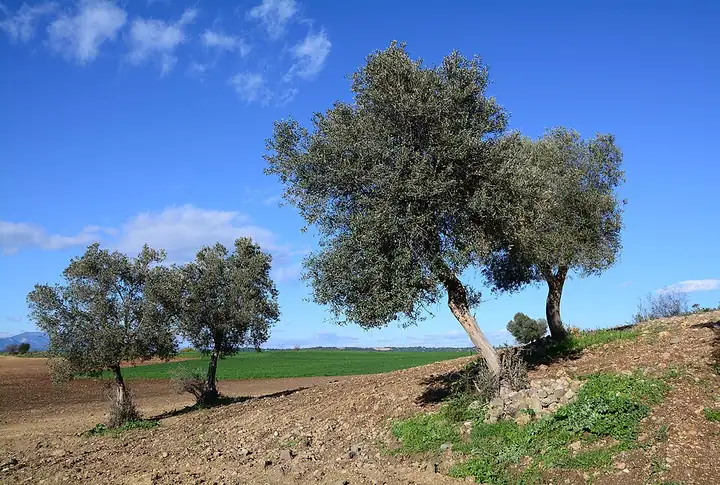
Olive
Olea europaea · Olive family (Oleaceae)
| Hardiness zones | 8 to 10 |
|---|---|
| Sun | full sun |
| Water | low |
| Life cycle | perennial |
| Frost | Half-hardy: takes a light frost |
| Spacing | 240 to 300 inches |
About Olive
The olive is a slow, long-lived evergreen tree with silvery leaves that handles heat, drought and poor soil. Most varieties crop better with a second variety nearby, and the fruit is too bitter to eat until it is cured. In a pot it makes a handsome porch tree that fruits best after hot summers. Heads-up: the California Invasive Plant Council rates olive as a 'Limited' invasive because birds spread seedlings into wild areas there.
NC State lists zones 8-10 (some cultivars 7); UF/IFAS says olives grow where winters stay above about 12 F. Cal-IPC rates olive 'Limited' (escaping in southern California and the Central Valley) and suggests fruitless types near open space; USDA PLANTS lists no noxious status.
When to plant
Timing is counted from your average last spring frost (and first fall frost). Sow & Tell works out the actual dates for your ZIP code.
In the ground, plant in spring after frost or in fall, 20-25 ft apart, with the root crown slightly high (UC Marin Master Gardeners). Potted trees go back outside once frost danger has passed (no source gives a set number of weeks, so the window is left blank). Grafted or cutting-grown trees start bearing in about four years (UF/IFAS).
Soil
Any well-drained soil, including poor soil, up to about pH 8.5; sandy soils are best because olives get root rot in wet ground (UF/IFAS; UC Marin Master Gardeners).
No rich soil needed: olives grow in almost any well-drained soil up to about pH 8.5 and bear poorly on very fertile ground (UF/IFAS).
Feeding
- Young in-ground trees, monthly in the growing season: nitrogen fertilizer such as urea or blood meal. UC Marin Master Gardeners use about 1 oz under each drip emitter each month; mature in-ground trees usually need no fertilizer.
- Potted trees, monthly during spring and summer growth: balanced liquid fertilizer. Feed once a month to support a crop (RHS); stop over winter.
Too much nitrogen gives lots of leafy shoots but fewer olives and poorer oil (UF/IFAS). Overwatering invites root rot.
Harvest
Fruit ripens in late fall, turning from green to black-purple (some stay green or turn copper-brown), and olives often bear heavily only every other year (UF/IFAS; UC Marin). Raw olives are bitter and must be cured before eating.
Olives ripen once a year in late fall, turning from green to black, and trees tend to crop heavily only in alternate years. The fruit must be cured before eating.
Varieties (18)
| Variety | Type | Days | Notes |
|---|---|---|---|
| Little Ollie | Compact ornamental | Compact, rounded shrub form (NC State). | |
| Swan Hill | Fruitless ornamental | Sterile: makes no pollen and no fruit (UF/IFAS; NC State). | |
| Wilsoni | Fruitless ornamental | Sterile: no pollen and no fruit (UF/IFAS; NC State). | |
| Arbequina | Oil | From Spain. Small fruit. Cold hardiness: hardy (UF/IFAS). Oil content about 22-27%, low in polyphenols (UC ANR); resistant to verticillium wilt (UC Marin). | |
| Carolea | Oil | From Italy. Large fruit. Cold hardiness: hardy (UF/IFAS). | |
| Frantoio | Oil | From Italy. Medium fruit. Cold hardiness: cold-sensitive (UF/IFAS). Oil content about 23-26%, medium-high polyphenols (UC ANR). | |
| Koroneiki | Oil | From Greece. Very small fruit. Cold hardiness: cold-sensitive (UF/IFAS). Oil content about 24-28%, very high polyphenols (UC ANR). | |
| Leccino | Oil | From Italy. Medium fruit. Cold hardiness: hardy (UF/IFAS). Oil content about 22-27% (UC ANR). | |
| Maurino | Oil | From Italy. Medium fruit. Cold hardiness: hardy (UF/IFAS). | |
| Moraiolo | Oil | From Italy. Small fruit. Cold hardiness: cold-sensitive (UF/IFAS). | |
| Picual | Oil | From Spain. Medium fruit. Cold hardiness: hardy (UF/IFAS). Very high in polyphenols (UC ANR). | |
| Pendolino | Oil (often a pollinizer) | From Italy. Medium fruit. Cold hardiness: hardy (UF/IFAS). | |
| Kalamata | Table | From Greece. Large fruit. Cold hardiness: medium (UF/IFAS). | |
| Sevillano | Table | From Spain. Very large fruit. Cold hardiness: hardy (UF/IFAS). Oil content only about 12-17% (UC ANR). | |
| Manzanillo | Table (and oil) | From Spain. Large fruit. Cold hardiness: cold-sensitive (UF/IFAS). High in polyphenols (UC ANR). | |
| Ascolano | Table and oil | From Italy. Large fruit. Cold hardiness: hardy (UF/IFAS). Oil content about 15-22% (UC ANR). | |
| Mission | Table and oil | From the United States (California). Medium fruit. Cold hardiness: hardy (UF/IFAS). High oil content (UC Marin), about 19-24% (UC ANR). | |
| Picholine | Table and oil | From France. Medium fruit. Cold hardiness: medium (UF/IFAS). |
Pests to watch for
Scale insects, Thrips, Grasshoppers
Diseases and problems
Olive knot, Verticillium wilt, Peacock spot, Root rot, Anthracnose
In the kitchen
Cured olives for the table and pressed olive oil (UF/IFAS; UC Marin).
Keeping it: Fresh olives are too bitter to eat and must be cured first; start curing soon after picking. How long cured olives keep, and whether they need the fridge, depends on the curing method.
Safety: Olive pollen is a common allergen; UF/IFAS notes some cities ban fruiting olives for that reason and sell pollen-free types like 'Swan Hill'. MSKCC says olive leaf extract may add to the effect of blood pressure and diabetes medicines.
Pets: Not listed as toxic by the ASPCA
Sources
- ask.ifas.ufl.edu
- ucanr.edu
- plants.ces.ncsu.edu
- ucanr.edu
- rhs.org.uk
- cal-ipc.org
- calinvasives.ucdavis.edu
- plantsservices.sc.egov.usda.gov
- mskcc.org
- yardandgarden.extension.iastate.edu
- aspca.org
- aspca.org
- aspca.org
Photo: Photo: Zeynel Cebeci, CC BY-SA 4.0, via Wikimedia Commons (CC BY-SA 4.0). Photo resized for the web.

Planting dates and advice are general guidance; check with your local Cooperative Extension office for your area.