
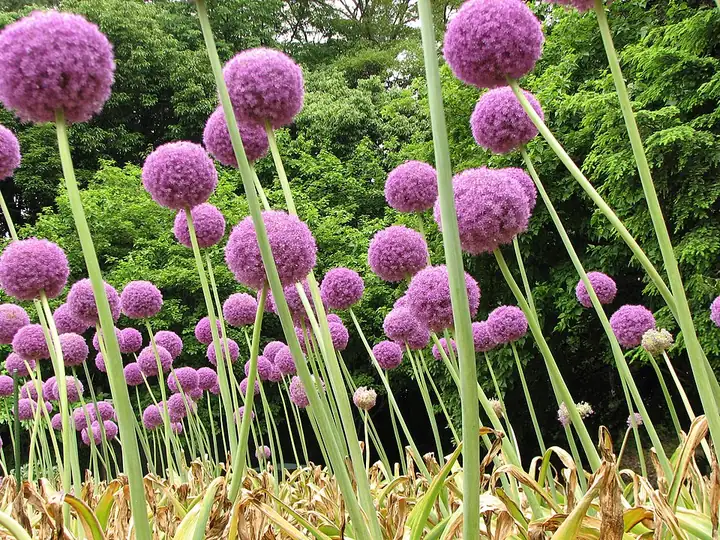
Ornamental onion (allium)
Allium giganteum, A. hollandicum (A. aflatunense), A. cristophii and hybrids such as 'Globemaster' · Amaryllis family (Amaryllidaceae)
| Hardiness zones | 4 to 8 |
|---|---|
| Sun | full sun |
| Water | low |
| Life cycle | perennial |
| Frost | Hardy: takes frost |
| Spacing | 4 to 12 inches |
About Ornamental onion (allium)
Ornamental onions are fall-planted bulbs that send up bare stems topped with round balls of tiny star-shaped flowers, mostly purple, in late spring and early summer. Favorites include giant allium, 'Globemaster', 'Purple Sensation' and Star of Persia. Bees and butterflies crowd the nectar-rich flowers, and the oniony sulfur compounds keep deer, rabbits and rodents away (Missouri Extension, NC State, Chicago Botanic Garden).
NC State lists giant allium for zones 4-8 and ornamental onions in general for 4-9; 'Globemaster' is sterile and won't self-sow, but drumstick allium should be deadheaded to limit seedlings (Missouri Botanical Garden, Chicago Botanic Garden).
When to plant
Timing is counted from your average last spring frost (and first fall frost). Sow & Tell works out the actual dates for your ZIP code.
Plant bulbs in fall, at the same time as tulips and daffodils (Chicago Botanic Garden). Giant allium goes about 8 inches deep and 12 inches apart; smaller kinds such as 'Purple Sensation' 4-6 inches deep and 4-6 inches apart (NC State).
Soil
Well-drained soil of almost any texture or pH; bulbs rot in wet soil, especially over winter, so mix compost into clay (NC State, Missouri Extension).
Plant in well-drained soil; mix decomposed organic matter into clay, since poor drainage causes winter losses (Missouri Extension).
Feeding
- Early spring, when shoots come up: balanced fertilizer such as 10-10-10. A light feeding like other spring bulbs: Clemson gives 1-2 lb per 100 sq ft for bulbs kept in place. Follow a soil test.
Avoid soggy soil, which rots the bulbs, and let the leaves die back on their own even though they yellow as the flowers open (Missouri Extension, NC State).
Harvest
Big-ball alliums bloom from May to July, each for 2-3 weeks, and their leaves start to yellow as the flowers open, so plant them behind other perennials (NC State). Cut heads for fresh or dried bouquets, or leave the dry seed heads standing for summer interest.
Varieties (17)
| Variety | Type | Days | Notes |
|---|---|---|---|
| Blue Drumstick | Allium caeruleum | Darker blue form of blue globe onion. | |
| Purple Sensation | Allium hollandicum (often sold as A. aflatunense) | Deep violet balls 4-5 inches across on 2-3 foot stems; honeybees love the nectar. | |
| Ivory Queen | Allium karataviense | Compact, with creamy white flowers over broad blue-gray leaves; about 10-12 inches. | |
| Balloon Bouquet | Allium tanguticum 'Noneuq' | Purple-pink clusters on plants about a foot tall; spreads by rhizomes and handles clay. | |
| Globemaster | Hybrid (A. cristophii x A. macleanii) | Deep lavender to silvery purple balls 6-10 inches across on stalks about 20-30 inches tall (Chicago Botanic Garden reports up to 4-5 feet); sterile, so it doesn't self-sow; no fragrance. | |
| Gladiator | Hybrid ornamental onion | Purple, softball-size balls on 4-5 foot stems; place at the back of a border. | |
| Lavender Bubbles | Hybrid ornamental onion | Darker purple flowers over twisted leaves. | |
| Blue globe onion | Species (Allium caeruleum) | True-blue, 1-inch clusters on 20-24 inch stems; bees and butterflies visit. | |
| Star of Persia | Species (Allium cristophii) | Airy, silvery-lavender heads 8-12 inches wide on short 1-2 foot stems; can self-sow in sandy soil. | |
| Giant allium | Species (Allium giganteum) | Dense purple-pink balls on stems up to about 6 feet; fragrant and good for cutting or drying. | |
| Litvinov onion | Species (Allium litvinovii) | Dense globes of deep violet-blue flowers; needs sun and good drainage. | |
| Lily leek | Species (Allium moly) | Small yellow star flowers on 4-6 inch stems; butterflies are strongly drawn to the nectar; deer and rabbits avoid it. | |
| Schubert onion | Species (Allium schubertii) | Big, explosive-looking heads similar to Star of Persia. | |
| Drumstick allium | Species (Allium sphaerocephalon) | Egg-shaped heads open green and turn rose-purple, on stems to about 3 feet; deadhead to limit self-sowing. | |
| Millenium | Summer-blooming hybrid (A. nutans x unknown) | Clumps of glossy leaves with 2-inch rosy purple balls on about 20-inch stems; nearly sterile and handles clay soil. | |
| Summer Beauty | Summer-blooming ornamental onion | Lilac-pink 2-inch globes held 8-12 inches above glossy dark green leaves; sterile. | |
| Windy City | Summer-blooming ornamental onion | Dark rose-purple 2-inch heads with sparkly white anthers; about 21 inches tall in bloom and flowers about 6 weeks. |
Pests to watch for
Thrips
Diseases and problems
Bulb rot, Rust, Leaf spot
In the kitchen
Safety: All parts contain sulfur compounds and can cause nausea, vomiting and diarrhea if eaten in quantity (NC State). These are grown for looks, not for the kitchen.
Pets: The ASPCA has no entry for ornamental alliums, but it lists their close relatives onion, garlic, leek and chives as toxic to dogs and cats. Keep pets from chewing the bulbs and leaves.
Sources
- plants.ces.ncsu.edu
- plants.ces.ncsu.edu
- plants.ces.ncsu.edu
- plants.ces.ncsu.edu
- extension.missouri.edu
- chicagobotanic.org
- missouribotanicalgarden.org
- chicagobotanic.org
- extension.sdstate.edu
- aspca.org
- aspca.org
- njaes.rutgers.edu
- hgic.clemson.edu
Photo: Photo: Chris Gladis, CC BY 2.0, via Wikimedia Commons (CC BY 2.0). Photo resized for the web.

Planting dates and advice are general guidance; check with your local Cooperative Extension office for your area.