
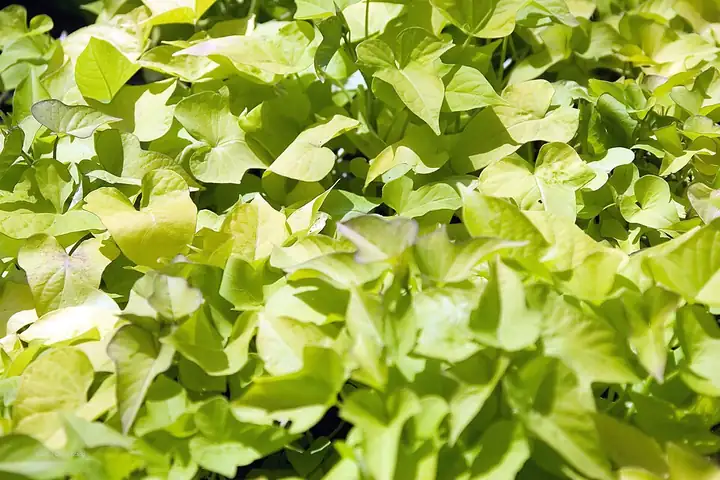
Ornamental sweet potato vine
Ipomoea batatas, ornamental cultivars (such as 'Marguerite', 'Blackie' and the Sweet Caroline and Illusion series) · Morning glory family (Convolvulaceae)
| Hardiness zones | 9 to 11 |
|---|---|
| Sun | full sun to part shade |
| Water | moderate |
| Life cycle | tender perennial (grown as an annual) |
| Frost | Tender: killed by frost |
About Ornamental sweet potato vine
Ornamental sweet potato vines are the same species as the food sweet potato, but bred for colorful leaves and a trailing or mounding habit rather than for their roots (Clemson, Iowa State). Leaves come in chartreuse, near-black purple, bronze, burgundy-red and pink-and-white variegation, shaped like hearts, lobes or deeply cut maple leaves, and the plants spill over the edges of pots and baskets or cover the ground in beds (Clemson, NC State, UF/IFAS). The species comes from Mexico, Central America and northern South America and is killed by frost, so most gardeners grow it as a summer annual and keep it over winter as stored tubers or rooted cuttings (NC State, Clemson). The tubers are edible but not bred for flavor; for eating, see the Sweet potato record.
Perennial only in zones 9-11 (NC State) and grown as a perennial in Florida (UF/IFAS); everywhere else it is a summer annual killed by frost. UF/IFAS rates Ipomoea batatas 'not a problem species' with low invasion risk in Florida.
When to plant
Timing is counted from your average last spring frost (and first fall frost). Sow & Tell works out the actual dates for your ZIP code.
Set out plants or stored tubers after the danger of frost has passed and the soil has begun to warm (Clemson, NC State). Cuttings root easily: take a trailing stem piece with several leaf nodes, strip the lower two-thirds of the leaves and set it in water; roots form in about 10 days and the cutting can be planted in 2-3 weeks (Clemson). The big older kinds such as 'Marguerite' and 'Blackie' are too vigorous for mixed pots; the compact Sweet Caroline types were bred for containers (NC State patents).
Soil
Potting mix in containers; in beds, loamy, well-drained soil with plenty of organic matter (Clemson, NC State).
Fill containers with potting mix; in beds, use loamy, well-drained soil with plenty of organic matter (Clemson, NC State).
Feeding
- After setting out overwintered plants in spring: general garden fertilizer. Illinois Extension feeds plants brought through winter indoors once they are moved to their summer containers. Clemson notes extra feeding is usually unnecessary because the vines are so vigorous.
Don't overfeed: it is vigorous and usually needs no fertilizer (Clemson). Let it tell you when to water; it wilts when dry (UF/IFAS, Clemson).
Harvest
Grown for its leaves, which color up all season until frost. Trim it back whenever it gets too wild, and use the trimmings as cuttings (UF/IFAS). In fall, either dig the tubers after the first frost and store them in a paper bag or box somewhere cool that won't freeze, such as a garage, or pot up a cut-back plant and keep it in a sunny window as a houseplant (Clemson, Illinois).
Varieties (19)
| Variety | Type | Days | Notes |
|---|---|---|---|
| Illusion Emerald Lace ('NCORNSP-012EMLC') | Illusion series (NC State) | Chartreuse-green leaves cut into fine, deep lobes. | |
| Illusion Garnet Lace ('NCORNSP-013GNLC') | Illusion series (NC State) | Bronzy-red leaves cut into fine, deep lobes. | |
| Illusion Midnight Lace ('NCORNSP-011MDNTLC') | Illusion series (NC State) | Nearly black leaves cut into fine, deep lobes. | |
| Blackie | Older trailing type | Deep purple, almost black leaves, deeply cut into lobes; a vigorous trailer with lavender flowers and purple-skinned roots. | |
| Marguerite ('Margarita') | Older trailing type | Bright lime-green to chartreuse, heart-shaped to slightly lobed leaves; a very vigorous, fast trailer that fills beds and keeps its color until frost. | |
| Tricolor ('Pink Frost') | Older trailing type | Broadly lobed leaves marbled light green, creamy white and pink; moderate to fast growth. | |
| Bright Ideas series | Series | Heart-shaped leaves in several colors; resistant to Phytophthora root rot. | |
| Sidekick series (Sidekick Black, Sidekick Lime) | Series | Broadly lobed leaves in several colors, including black and lime. | |
| Spotlight series | Series | Deeply divided leaves in several colors. | |
| Sweet Caroline Bewitched After Midnight ('NCORNSP-023BWAM') | Sweet Caroline series (NC State) | Shallowly lobed, reddish-black leaves. | |
| Sweet Caroline Bronze | Sweet Caroline series (NC State) | New growth chartreuse, aging to coppery bronze or purple-bronze with purple veins; redder in cool weather. Compact and mounded, about 5 in tall and 1 ft across. | |
| Sweet Caroline Light Green | Sweet Caroline series (NC State) | Chartreuse leaves cut into 3-5 lobes with a purple band at the leaf base; compact, densely mounding, about 6 in tall and 15 in across. | |
| Sweet Caroline Purple | Sweet Caroline series (NC State) | Leaves open green and turn purple, deeply cut into 3-5 lobes; a compact, well-branched mound that spreads wider than it is tall. | |
| Sweet Caroline Red | Sweet Caroline series (NC State) | New shoots yellow-green, turning bronze and then deep burgundy-red; large lobed leaves on a low, moderately compact, mounding-to-trailing plant about 8 in tall. | |
| Sweet Caroline Sweetheart Jet Black ('NCORNSP-021SHJB') | Sweet Caroline series (NC State) | Dark purple foliage; spreads wide enough to use as a groundcover, including in part shade. | |
| Sweet Caroline Sweetheart Purple | Sweet Caroline series (NC State) | Dark purple, heart- to spade-shaped leaves; a compact, round, freely branching mound about 10 in tall and 1.5 ft across that forms few storage roots. | |
| Sweet Caroline Sweetheart Red | Sweet Caroline series (NC State) | A red-leaved member of the Sweet Caroline group, which comes in green, red or dark purple with divided or heart-shaped leaves. | |
| Ace of Spades | Heart-shaped, near-black leaves; resistant to Phytophthora root rot. | ||
| Goldfinger | Chartreuse leaves cut deeply into narrow fingers. |
Pests to watch for
Flea beetles, Thrips, Japanese beetle, Twospotted spider mite, Aphids, Whiteflies, Sweetpotato weevil, Root-knot nematodes
Diseases and problems
Root rot (Phytophthora), Black rot, Fusarium root rot, Southern blight, Sweet potato feathery mottle virus
In the kitchen
The tubers are edible, and NC State notes the leaves and stems are too, but ornamental kinds were chosen for leaf color, so they are usually less tasty than food sweet potatoes (Clemson, Iowa State, Purdue, NC State). For eating, grow a food variety (see the Sweet potato record).
Keeping it: To replant next year, dig the tubers after the first frost and keep them in a paper bag or box in a cool place that won't freeze, such as a garage; they often sprout before spring (Clemson). Stored tubers can dry out and shrivel, so Illinois Extension suggests potting up a cut-back plant as a sunny-window houseplant instead.
Safety: Cut stems ooze a sticky, milky sap that can irritate skin (dermatitis), though Clemson says it isn't considered harmful. Before eating tubers from bought plants, check that they weren't treated with pesticides not labeled for edible sweet potatoes (Purdue).
Pets: Not toxic to dogs, cats or horses (ASPCA, 'Sweet Potato Vine', Ipomoea batatas).
Sources
- hgic.clemson.edu
- plants.ces.ncsu.edu
- extensiongardener.ces.ncsu.edu
- gardeningsolutions.ifas.ufl.edu
- umass.edu
- extension.illinois.edu
- purdue.edu
- yardandgarden.extension.iastate.edu
- ask.ifas.ufl.edu
- assessment.ifas.ufl.edu
- aspca.org
- patents.google.com
- patents.google.com
- patents.google.com
Photo: Photo: David J. Stang, CC BY-SA 4.0, via Wikimedia Commons (CC BY-SA 4.0). Photo resized for the web.

Planting dates and advice are general guidance; check with your local Cooperative Extension office for your area.