
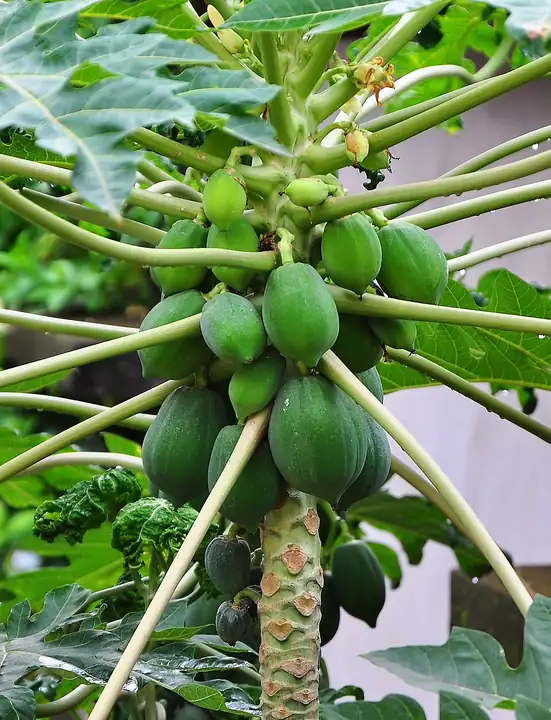
Papaya
Carica papaya · Papaya family (Caricaceae)
| Hardiness zones | 9 to 11 |
|---|---|
| Sun | full sun |
| Water | high |
| Life cycle | perennial |
| Frost | Tender: killed by frost |
| Soil pH | 4.5–8.0 |
| Spacing | 84 to 144 inches |
About Papaya
Papaya is a fast, soft-stemmed tropical plant from Central America that looks like a small tree and can fruit within a year from seed. Plants are male, female or bisexual: males rarely bear, females need pollen from a nearby male or bisexual plant, and bisexual plants fruit on their own, so plant two or three. It is short-lived, usually replaced every few years.
UF/IFAS lists zones 9B-11 and says plants in 9A and colder live only a short time; papaya is damaged below 31 F and struggles to flower below 59 F, so some gardeners grow it as an annual or in a pot. University of Hawaii notes papaya has a low-risk weed rating in Hawaii, and we found no U.S. invasive or noxious listing in the sources we checked.
When to plant
Timing is counted from your average last spring frost (and first fall frost). Sow & Tell works out the actual dates for your ZIP code.
No source ties planting to a frost date. Sow 2-4 seeds in a 1-gallon pot; they sprout in 2-3 weeks, and seedlings go into the ground at 6-12 inches tall (UF/IFAS). Plants flower about 4 months after planting and fruit 7-11 months after planting; set out 2-3 plants 7-12 ft apart so at least one bears (UF/IFAS).
Soil
Sand, loam or rocky soil all work if they drain well; papaya rots in wet ground, so plant on a mound of native soil where it floods (UF/IFAS).
Plant in a well-drained spot; don't add fertilizer, topsoil or compost to the hole (mix any amendment no more than 1:1 with native soil), and build a mound where water stands (UF/IFAS).
Feeding
- Every 2 weeks for the first 3 months: complete fertilizer with nitrogen, phosphate, potash and magnesium. 1/4-1/2 lb per plant each time, scattered around the plant and watered in; add a chelated iron drench of about 1/4 oz (UF/IFAS).
- Months 4-7, every 2 weeks: the same complete fertilizer. 1/2-3/4 lb per plant each time (UF/IFAS).
- Months 8-10, once a month: the same complete fertilizer. 3/4-1 lb per plant each time (UF/IFAS).
- From about a year on, once a month: the same complete fertilizer. 1-2 lb per plant each time; add manganese, zinc and boron up to monthly (on the soil if pH is 7 or lower, as a leaf spray above 7) and iron about twice a year (UF/IFAS).
Don't let papaya dry out: drought makes it drop flowers, leaves and young fruit and gives small, bland fruit; but timed sprinklers that overwater cause root rot (UF/IFAS).
Harvest
Pick when the skin is about one-tenth to one-third yellow, then let it ripen on the counter; more color on the plant means sweeter fruit (UF/IFAS). Green fruit can be picked anytime to cook as a vegetable. Ripe papaya keeps 4-7 days in the refrigerator.
Once it starts bearing about 7-11 months after planting, a healthy papaya keeps flowering and fruiting up the trunk, giving roughly 60-80 lb over a year with steady water and frequent small feedings. Where ringspot virus is around, UF/IFAS suggests replanting every 18-24 months.
Varieties (6)
UF/IFAS and University of Hawaii sources name only these 6 papayas, with few details; UF/IFAS notes that seed of named varieties is hard for home gardeners to find in small amounts.
| Variety | Type | Days | Notes |
|---|---|---|---|
| Kapoho | Solo | A Hawaii papaya whose plants stay short-jointed in well-drained lava soils but grow longer between leaves in acidic soils (University of Hawaii). | |
| Solo types | Solo | Small, pear-shaped fruit; Solo varieties don't produce male plants, so seedlings are female or bisexual (University of Hawaii). | |
| UH Rainbow | Solo | A virus-resistant hybrid from the University of Hawaii; seed from its female plants gives female and bisexual seedlings in equal numbers. | |
| Maradol | One of the common papaya varieties grown in Florida (UF/IFAS). | ||
| Red Lady | One of the common papaya varieties grown in Florida (UF/IFAS). | ||
| Tainung No. 1 | One of the common papaya varieties grown in Florida (UF/IFAS). |
Pests to watch for
Whiteflies, Twospotted spider mite, Root-knot nematodes
Diseases and problems
Papaya ringspot virus, Anthracnose, Powdery mildew, Phytophthora blight (root, stem and fruit rot), Corynespora leaf spot, Damping-off
In the kitchen
Ripe papaya is eaten fresh or in fruit salads, drinks and desserts; green papaya is cooked as a vegetable or shredded into salads, and the fruit can also be dried, candied, or made into paste, jelly and jam (UF/IFAS).
Keeping it: Let papayas ripen on the counter, then refrigerate; ripe fruit keeps about 4-7 days (UF/IFAS).
Safety: Papaya is one of the foods linked to latex-fruit allergy, so people allergic to latex may react to it (MedlinePlus). Papaya leaf supplements may not be safe in pregnancy or for people with liver problems, and lab studies hint they could affect diabetes medicines (MSKCC).
Pets: Not listed by the ASPCA
Sources
- ask.ifas.ufl.edu
- gardeningsolutions.ifas.ufl.edu
- www3.ctahr.hawaii.edu
- www3.ctahr.hawaii.edu
- www3.ctahr.hawaii.edu
- medlineplus.gov
- mskcc.org
- aspca.org
Photo: Photo: Joydeep / Wikimedia Commons, CC BY-SA 3.0 (CC BY-SA 3.0). Photo resized for the web.

Planting dates and advice are general guidance; check with your local Cooperative Extension office for your area.