
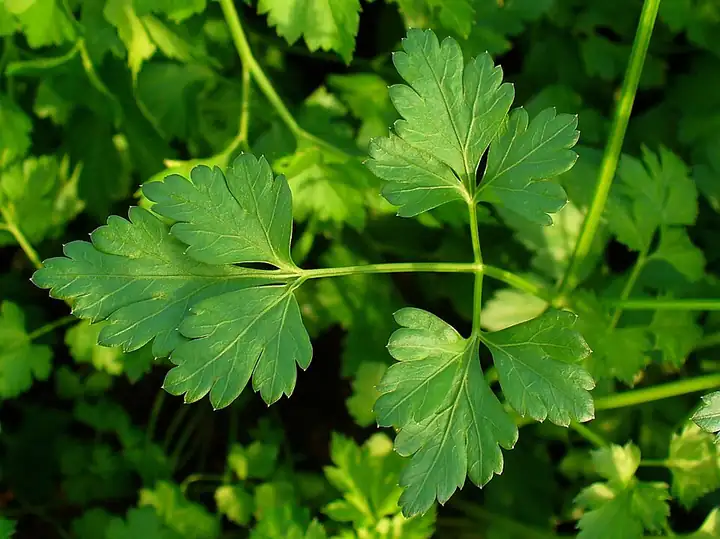
Parsley
Petroselinum crispum · Carrot family (Apiaceae)
| Hardiness zones | 2 to 11 |
|---|---|
| Sun | full sun to part shade |
| Water | moderate |
| Life cycle | biennial |
| Frost | Half-hardy: takes a light frost |
| Soil pH | 6.0–7.0 |
| Spacing | 10 to 12 inches |
About Parsley
Parsley is a hardy biennial grown like an annual for its curly or flat leaves. It is slow to sprout but then produces for months, and it feeds the caterpillars of swallowtail butterflies.
Grown as an annual everywhere; it is a hardy biennial, so plants may resprout in their second spring, but second-year leaves are more bitter and the plant soon flowers.
When to plant
Timing is counted from your average last spring frost (and first fall frost). Sow & Tell works out the actual dates for your ZIP code.
- Start seeds indoors: 6 to 8 weeks before the last frost
- Set out plants: 2 to 3 weeks before the last frost
- Sow seeds outdoors: up to 2 weeks after the last frost
Seed takes two to five weeks to sprout; soaking it in warm water for up to 24 hours speeds that up. Many gardeners find transplants easier because germination is so slow.
Soil
Moist, well-drained soil rich in organic matter; water deeply at least once a week and do not let it dry out completely.
Follow a soil test; work compost into well-drained soil rich in organic matter, and lime if the pH is below 6.0 (aim for 6.0 to 7.0).
Feeding
- once or twice during the growing season: complete fertilizer such as 5-10-5. Scatter about 3 oz per 10 ft of row beside the plants and water it in; potted parsley outdoors can get half-strength liquid fertilizer every 3-4 weeks.
Harvest
Start cutting when plants are about 8 inches tall. Snip whole stalks close to the ground, beginning with the outside stalks, instead of cutting the tops.
Snip whole stalks near the ground, starting with the outside ones, and new growth keeps coming all season. In its second year the plant turns bitter, sends up a seed stalk and dies, so replant each year.
Varieties (16)
| Variety | Type | Days | Notes |
|---|---|---|---|
| Banquet | Curly-leaf | Finely curled leaves; Illinois Extension calls it the standard of its class. | |
| Darki | Curly-leaf | Curly type on the Rutgers-led Mid-Atlantic recommended list. | |
| Deep Green | Curly-leaf | Curly type recommended by Oregon State. | |
| Emerald | Curly-leaf | Curly type Oregon State suggests for trial. | |
| Forest Green | Curly-leaf | Semi-curled leaves. | |
| Moss Curled | Curly-leaf | Strong parsley flavor. Tightly curled, dark green leaves. | |
| Wega | Curly-leaf | Curly type on the Rutgers-led Mid-Atlantic recommended list. | |
| Curly parsley | Curly-leaf (var. crispum) | Slightly peppery. Tightly curled leaves in a dense clump 8-14 inches tall; the most popular type for garnish, borders and pots. | |
| Argon | Flat-leaf | Improved flat-leaf type with an upright habit. | |
| Deep Green Italian | Flat-leaf | Flat-leaf type recommended by Oregon State. | |
| Giant of Italy (Gigante d'Italia) | Flat-leaf | Large flat-leaf type. | |
| Peione | Flat-leaf | Flat-leaf type on the Rutgers-led Mid-Atlantic recommended list. | |
| Pinocchio | Flat-leaf | Flat-leaf type on the Rutgers-led Mid-Atlantic recommended list. | |
| Plain Italian Dark Green | Flat-leaf | Excellent flavor; the standard flat-leaf parsley for cooking. Bright green flat leaves. | |
| Italian flat-leaf parsley | Flat-leaf (var. neapolitanum) | Stronger and sweeter than curly parsley, so cooks prefer it. Flat, deeply toothed leaves on a taller, looser plant that can reach 2-3 feet. | |
| Hamburg (root) parsley | Root parsley (var. tuberosum) | Roots are used to flavor soups; the leaves can be used like other parsley. Forms a white, fleshy, parsnip-like root under tall, ferny leaves. |
Pests to watch for
Carrot rust fly, Carrot weevil
In the kitchen
The leaves are used fresh or dried as a flavoring and garnish.
Keeping it: Wash, let dry, and refrigerate parsley in a plastic bag, or stand the stems in a jar of water; use it within a few days.
Safety: Parsley contains furanocoumarins; eating very large amounts can make skin sunburn-prone (photosensitization) (NC State).
Pets: Toxic to dogs, cats and horses (ASPCA): furanocoumarins can cause sunburn-like skin reactions (photosensitization), though large amounts are needed
Sources
- plants.ces.ncsu.edu
- extension.umn.edu
- extension.umn.edu
- extension.illinois.edu
- aspca.org
- extension.unh.edu
- riley.k-state.edu
- horticulture.oregonstate.edu
- blogs.ifas.ufl.edu
Photo: Photo: H. Zell, CC BY-SA 3.0, via Wikimedia Commons (CC BY-SA 3.0). Photo resized for the web.

Planting dates and advice are general guidance; check with your local Cooperative Extension office for your area.