
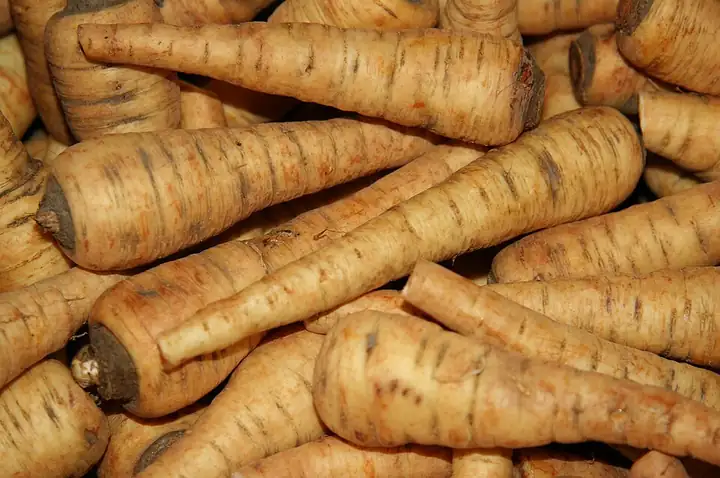
Parsnip
Pastinaca sativa · Carrot family (Apiaceae)
| Hardiness zones | 2 to 11 |
|---|---|
| Sun | full sun |
| Water | moderate |
| Life cycle | biennial |
| Frost | Hardy: takes frost |
| Soil pH | 6.0–6.5 |
| Spacing | 2 to 4 inches |
| Soil temperature to plant | at least 35°F |
About Parsnip
Parsnips are a pale, carrot-like root with a nutty sweetness. They take the whole season to grow, and cold weather makes them much sweeter, so many gardeners leave them in the ground into winter.
Grown as an annual root crop; roots can stay in the ground over winter under soil or straw mulch and be dug in early spring.
When to plant
Timing is counted from your average last spring frost (and first fall frost). Sow & Tell works out the actual dates for your ZIP code.
- Sow seeds outdoors: from 2 weeks before to 2 weeks after the last frost
Sow seed thickly, since it is slow to sprout and can take up to 3 weeks. Parsnips grow all season; dig them after 2 to 4 weeks of near-freezing fall weather rather than counting days.
Soil
Deep, loose, sandy or loamy soil free of rocks; heavy clay or fresh clumps of organic matter cause forked, misshapen roots.
Have the soil tested and keep pH about 6 to 7 in loose, sandy loam; work in well-rotted compost or manure in spring or fall, not fresh clumps.
Feeding
- midseason (late June), only if plants look pale or stunted: complete fertilizer such as 10-10-10. Side-dress lightly beside the row and water it in; skip this if the soil was fertilized well before planting.
Too much nitrogen gives leaves instead of roots, and fresh manure or clumps of organic matter cause forked roots.
Harvest
Dig roots in late fall after several weeks of near-freezing weather, or leave them mulched and dig in early spring before new growth starts. Roots that start to send up a flower stalk lose quality.
Dig roots once, in late fall or early spring; cold weather makes them sweeter. Dig overwintered roots before they start a flower stalk, when quality drops.
Varieties (8)
Extension sources name only a handful of parsnip varieties and give little detail about most of them. Parsnips take about 100 to 120 days (Wisconsin Extension planting guide).
| Variety | Type | Days | Notes |
|---|---|---|---|
| Albion | Hybrid | A hybrid on Kansas State's recommended list. | |
| Javelin | Hybrid | A hybrid on Kansas State's recommended list. | |
| All American | Listed for home gardens by Kansas State, Oregon State and Wisconsin. | ||
| Andover | Bred at the University of Minnesota, with resistance to brown canker. | ||
| Harris Model | On Kansas State and Wisconsin Extension variety lists. | ||
| Hollow Crown | Kansas State lists Hollow Crown, and Oregon State lists Improved Hollow Crown for home gardens. | ||
| Jarelin | 110 days | On Kentucky's list at about 110 days. | |
| Lancer | On Wisconsin Extension's parsnip list. |
Pests to watch for
Carrot weevil, Mice (house mice and deer mice)
Diseases and problems
Powdery mildew, Common scab
In the kitchen
Roasted, mashed, pureed into soups or added to stews; the roots can also be eaten raw.
Keeping it: Refrigerate unwashed roots in a perforated bag for 2 to 3 weeks. Or leave them mulched in the garden and dig as needed; frost makes them sweeter.
Safety: The leaves, stems and sap contain furanocoumarins that can make skin burn and blister in sunlight. Wear gloves, long sleeves and long pants when working among the foliage, especially on sunny days (NC State, UMN).
Pets: Not listed as toxic by the ASPCA (its 'Cow parsnip' and 'Poison parsnip' entries are different, wild plants).
Sources
- extension.umn.edu
- extension.illinois.edu
- plants.ces.ncsu.edu
- extension.unh.edu
- extension.colostate.edu
- riley.k-state.edu
- extension.umd.edu
- aspca.org
- aspca.org
- riley.k-state.edu
- extension.oregonstate.edu
Photo: Photo: Jonathunder, CC BY-SA 3.0, via Wikimedia Commons (CC BY-SA 3.0). Photo resized for the web.

Planting dates and advice are general guidance; check with your local Cooperative Extension office for your area.