
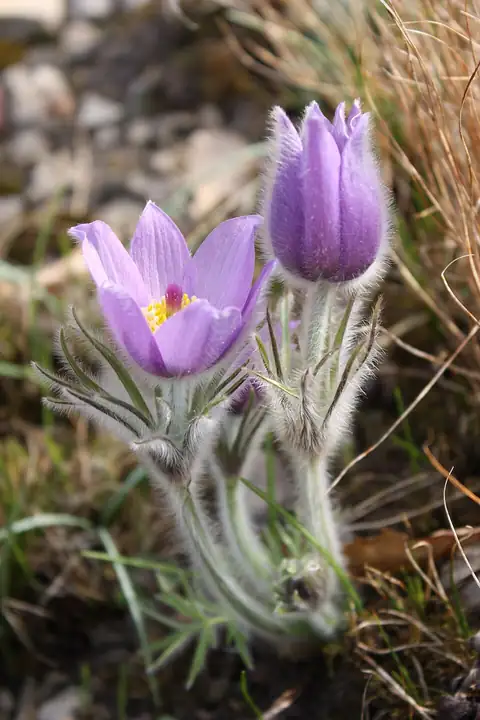
Pasqueflower
Pulsatilla vulgaris (European pasqueflower; formerly Anemone pulsatilla) and P. patens (eastern or American pasqueflower) · Buttercup family (Ranunculaceae)
| Hardiness zones | 3 to 8 |
|---|---|
| Sun | full sun |
| Water | low |
| Life cycle | perennial |
| Frost | Hardy: takes frost |
| Soil pH | 6.8–7.2 |
About Pasqueflower
Pasqueflower is one of the very first perennials to bloom in spring, opening silky, cup-shaped purple flowers around a burst of golden stamens, often before its ferny, silver-haired leaves have unfolded (Wisconsin Extension). The flowers turn into round, shimmering, feathery seed heads that stay for weeks. The common garden kind, P. vulgaris, comes from Europe; the American pasqueflower, P. patens, is native to grasslands from Wisconsin, Michigan and Illinois south to Texas and west through the Plains and Rockies to Washington and Alaska (Wildflower Center). All parts are poisonous, and the fresh sap can blister skin (NC State, Wisconsin Extension).
P. vulgaris is hardy in zones 4-8 and P. patens in zones 3-8 (Wisconsin Extension). It does best where summers are cool.
When to plant
Timing is counted from your average last spring frost (and first fall frost). Sow & Tell works out the actual dates for your ZIP code.
Set out small plants in spring or fall and then leave them alone; the thick, woody rootstock dislikes disturbance (Wisconsin Extension, NC State). Sow ripe seed outdoors right away or in small pots and transplant while small; P. patens seed is best sown outdoors in fall, since stored seed can be hard to wake (Wisconsin Extension). Divide or take root cuttings in spring or late fall (Wildflower Center). We found no sourced day count to first bloom.
Soil
Well-drained soil is a must; it handles dry soil once settled, though NC State notes it likes some moisture in hot summers (Wisconsin Extension, Wildflower Center, NC State).
Choose a sunny spot with sharp drainage, such as a rock garden or the front of a raised border (Wisconsin Extension).
Feeding
Wisconsin Extension says not to fertilize heavily. Don't disturb the roots once it is settled, and wear gloves, since fresh sap can blister skin.
Harvest
Blooms in early spring, March-April (Colorado State), and P. patens into June in the wild (Wildflower Center). Cutting it back after the first flush may bring more flowers in about four weeks (Wisconsin Extension). Many gardeners leave the flowers to form the silky seed heads, which are as showy as the blooms.
Varieties (7)
Wisconsin Extension documents these 7 pasqueflower cultivars and strains, all of the European P. vulgaris.
| Variety | Type | Days | Notes |
|---|---|---|---|
| Alba | European pasqueflower (P. vulgaris) | Creamy white flowers; grows more slowly and blooms a little later than the species. | |
| Rubra | European pasqueflower (P. vulgaris) | Wine-red flowers. | |
| Blau Glocke (Violet Bells) | European pasqueflower (P. vulgaris), Glocke (Bells) series | Violet flowers. | |
| Perlen Glocke (Pearl Bells) | European pasqueflower (P. vulgaris), Glocke (Bells) series | Very pale pink flowers. | |
| Rosen Glocke (Rose Bells) | European pasqueflower (P. vulgaris), Glocke (Bells) series | Rose-pink flowers. | |
| Rote Glocke (Red Bells) | European pasqueflower (P. vulgaris), Glocke (Bells) series | Red flowers. | |
| Prima Papagena | European pasqueflower (P. vulgaris), seed strain | Fringed to semi-double flowers in a mix of cream, bright pink, dark red, violet and light blue. |
In the kitchen
Safety: Poisonous. All fresh parts contain protoanemonin; NC State rates it high severity, and eating it causes severe mouth pain, vomiting and diarrhea. Fresh sap can redden and blister skin, so wear gloves when handling it (NC State, Wisconsin Extension). Keep it away from children.
Pets: Not listed by the ASPCA (no pasqueflower or Pulsatilla entry on its plant lists). NC State says all fresh parts contain protoanemonin, which irritates the mouth and gut, so keep pets from chewing it.
Sources
- hort.extension.wisc.edu
- wildflower.org
- plants.ces.ncsu.edu
- extension.colostate.edu
- extension.okstate.edu
- aspca.org
- aspca.org
- aspca.org
Photo: Photo: Marco Schmidt, CC BY-SA 3.0, via Wikimedia Commons (CC BY-SA 3.0). Photo resized for the web.

Planting dates and advice are general guidance; check with your local Cooperative Extension office for your area.