
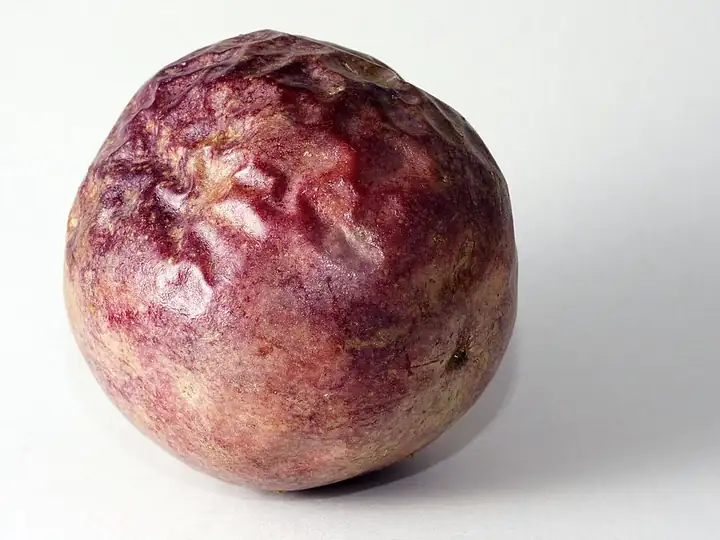
Passion fruit
Passiflora edulis (purple passion fruit; the yellow form is P. edulis f. flavicarpa) · Passionflower family (Passifloraceae)
| Hardiness zones | 9 to 11 |
|---|---|
| Sun | full sun |
| Water | high |
| Life cycle | perennial |
| Frost | Tender: killed by frost |
| Soil pH | 5.5–7.5 |
| Spacing | 72 to 144 inches |
About Passion fruit
Passion fruit is a fast, evergreen vine from South America that climbs by tendrils and bears round, 2- to 3-inch fruit filled with tangy, fragrant pulp around the seeds. Purple passion fruit is the type most U.S. gardeners grow; the yellow form is more tender and needs a second plant to set fruit. It is a frost-tender cousin of our native maypop (Passiflora incarnata), and a vine usually stays productive for only 3 to 5 years.
UF/IFAS lists zones 9b-11 (another UF/IFAS publication says 10-12). It grows year-round outdoors in south Florida and in mild coastal California; in north-central Florida it needs frost protection, and a hard freeze can kill a mature vine (UF/IFAS; UC). Heads-up: the UF/IFAS Assessment of Non-Native Plants rates Passiflora edulis a high invasion risk in all of Florida (advisory, not a law).
When to plant
Timing is counted from your average last spring frost (and first fall frost). Sow & Tell works out the actual dates for your ZIP code.
Plant once frost is no longer a worry, 6-10 ft apart in Florida or 8-12 ft apart in California, next to a strong trellis or fence (UF/IFAS; UC). A healthy vine starts flowering in about 6 months to a year, and fruit ripens about 70-80 days after the flower is pollinated (UF/IFAS). Inland in California, give it some afternoon shade, since it dislikes hot, dry heat (UC).
Soil
Fast-draining, slightly acid to neutral soil rich in organic matter; good drainage matters most, so use a raised bed or mound on heavy soil (UF/IFAS; UC Cooperative Extension). Sources give pH ranges from 5.5 up to 7.5.
Pick a well-drained spot (or build a wide, shallow raised area) and work in compost; aim for slightly acid soil, about pH 5.5-6.5 (UF/IFAS Marion County).
Feeding
- Young vines, while they are building roots and stems: balanced fertilizer with secondary and micronutrients, such as 6-6-6 or 8-3-9, or a slow-release 14-14-14. Feed young vines to push root and vine growth (UF/IFAS); follow the label for the amount.
- Every 4-6 weeks from the late-winter pruning into early fall: balanced fertilizer such as 8-3-9 or 6-6-6 with micronutrients. UF/IFAS (Marion County) feeds on this schedule as granules, liquid feed or a foliar spray; cut rates back once the vine is mature.
Too much nitrogen gives lots of leaves but few flowers and hollow fruit, and uneven watering makes fruit drop (UF/IFAS).
Harvest
Fruit is ripe when it has turned fully purple (or yellow) and drops on its own; gather fallen fruit every day or two (UF/IFAS; UC). Fruit picked with at least half its skin colored keeps ripening, and ripe fruit wrinkles as it dries but keeps its flavor for weeks (UF/IFAS). In north-central Florida the crop comes in about June to August (UF/IFAS).
Flowers open over several months and each fruit ripens 70-80 days later, so fruit keeps dropping through the season (about June-August in north-central Florida). Gather fallen fruit every day or two; the vine bears well for about 3-4 years, then plan to replace it.
Varieties (23)
| Variety | Type | Days | Notes |
|---|---|---|---|
| Black Beauty | Purple | Purple type: purple types are sweeter and mostly eaten fresh (UF/IFAS). | |
| Black Knight | Purple | Purple type: purple types are sweeter and mostly eaten fresh (UF/IFAS). | |
| Bountiful Beauty | Purple | A purple passion fruit offered in California (UC). | |
| Bounty | Purple | Purple type: purple types are sweeter and mostly eaten fresh (UF/IFAS). | |
| Edgehill | Purple | Purple type: purple types are sweeter and mostly eaten fresh (UF/IFAS). | |
| Frosty | Purple | A purple passion fruit offered in California (UC). | |
| Kahuna | Purple | Purple type: purple types are sweeter and mostly eaten fresh (UF/IFAS). | |
| Nancy Garrison | Purple | A purple passion fruit offered in California (UC). | |
| Nelly Kelly | Purple | Purple type: purple types are sweeter and mostly eaten fresh (UF/IFAS). | |
| Panama Red | Purple | Purple type: purple types are sweeter and mostly eaten fresh (UF/IFAS). | |
| Paul Ecke | Purple | Purple type: purple types are sweeter and mostly eaten fresh (UF/IFAS). | |
| Purple Giant | Purple | Purple type: purple types are sweeter and mostly eaten fresh (UF/IFAS). | |
| Frederick | Purple-yellow hybrid | A purple x yellow hybrid; UC says these hybrids combine purple flavor with the yellow form's disease resistance and larger size. | |
| Possum Purple | Purple-yellow hybrid | A Florida cross of purple and yellow passion fruit; its seedlings come out purple or yellow, so grow it from cuttings (UF/IFAS). | |
| Red Riviera | Purple-yellow hybrid | A purple x yellow hybrid offered in California (UC). | |
| Red Rover | Purple-yellow hybrid | A purple x yellow hybrid (UC); hybrids carry purple flavor and some of the yellow form's disease resistance. | |
| Golden Giant | Yellow | Yellow type: bigger crops, thicker peel and tarter juice, mostly for juicing (UF/IFAS); yellow vines need cross-pollination. | |
| Hawaiiana | Yellow | Yellow type: bigger crops, thicker peel and tarter juice, mostly for juicing (UF/IFAS); yellow vines need cross-pollination. | |
| McCain | Yellow | Yellow type: bigger crops, thicker peel and tarter juice, mostly for juicing (UF/IFAS); yellow vines need cross-pollination. | |
| Noel's Special | Yellow | Yellow type: bigger crops, thicker peel and tarter juice, mostly for juicing (UF/IFAS); yellow vines need cross-pollination. | |
| Panama Gold | Yellow | Yellow type: bigger crops, thicker peel and tarter juice, mostly for juicing (UF/IFAS); yellow vines need cross-pollination. | |
| Sweet Sunrise | Yellow | Yellow type: bigger crops, thicker peel and tarter juice, mostly for juicing (UF/IFAS); yellow vines need cross-pollination. | |
| Whitman Yellow | Yellow | Yellow type: bigger crops, thicker peel and tarter juice, mostly for juicing (UF/IFAS); yellow vines need cross-pollination. |
Good neighbors
Salvia (ornamental sage), Bee balm
UF/IFAS suggests planting bee flowers such as salvia or bee balm nearby to bring in the carpenter bees and honey bees that pollinate passion fruit; that is the only pairing an Extension source gives.
Pests to watch for
Aphids, Twospotted spider mite, Stink bugs, Root-knot nematodes, Brown garden snail, Thrips
Diseases and problems
Passion fruit woodiness virus, Brown spot (Alternaria), Fusarium wilt, Collar rot, Root and crown rot, Anthracnose, Bacterial spot, Septoria spot
In the kitchen
Scoop the pulp and seeds out of the shell and eat it fresh, or use the juice and pulp in drinks, fruit salads, ice cream, yogurt, jam, jelly, sauces and cake or frosting flavoring (UF/IFAS).
Keeping it: Ripe fruit keeps 2-4 weeks at room temperature, wrinkling but keeping its flavor (UC); purple fruit keeps 3-5 weeks at 41-45 F, but colder storage can damage it (UF/IFAS).
Safety: The sources we checked list no toxic parts for the ripe fruit and give no research-based guidance on pregnancy, drug interactions or allergies; eat only the ripe pulp.
Pets: Not listed by the ASPCA
Sources
- ask.ifas.ufl.edu
- blogs.ifas.ufl.edu
- ojs.test.flvc.org
- hos.ifas.ufl.edu
- ask.ifas.ufl.edu
- ask.ifas.ufl.edu
- ucanr.edu
- aspca.org
- aspca.org
- aspca.org
- assessment.ifas.ufl.edu
- extension.umd.edu
- yardandgarden.extension.iastate.edu
Photo: Photo: Alexander Klink / Wikimedia Commons, CC BY 3.0 (CC BY 3.0). Photo resized for the web.

Planting dates and advice are general guidance; check with your local Cooperative Extension office for your area.