
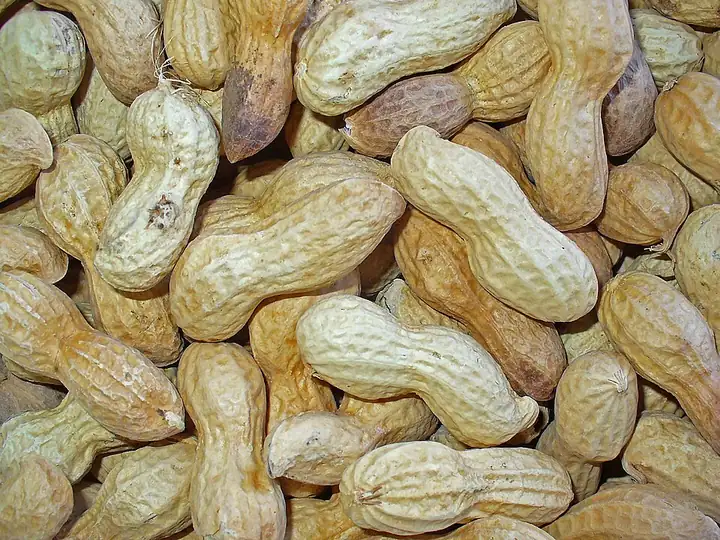
Peanut
Arachis hypogaea · Pea family (Fabaceae)
| Hardiness zones | 5 to 11 |
|---|---|
| Sun | full sun |
| Water | moderate |
| Life cycle | annual |
| Frost | Tender: killed by frost |
| Soil pH | 5.8–6.2 |
| Spacing | 4 to 18 inches |
| Days to harvest | 90 to 150 days |
| Soil temperature to plant | at least 65°F |
About Peanut
Peanuts are a low, bushy South American legume with an odd habit: after a flower is pollinated, a stalk called a peg pushes into the soil, and the pod forms underground. Home gardeners grow four types: big-podded Virginia, small Spanish, flavorful Runner, and Valencia with 3 to 5 red-skinned seeds per pod. They need a long, warm season and loose, calcium-rich soil.
Grown as a warm-season annual; what matters is season length: at least 110 to 120 frost-free days. That is easy in the South; in short northern seasons choose fast Valencia or Spanish types (Utah, Wisconsin and Canadian gardens have grown them).
When to plant
Timing is counted from your average last spring frost (and first fall frost). Sow & Tell works out the actual dates for your ZIP code.
- Sow seeds outdoors: up to 4 weeks after the last frost
Days count from seeding: about 90 to 110 days for green boiling peanuts (Valencias as early as 75) and 130 to 155 days for dry roasting peanuts. Sow raw peanuts (in the shell or shelled) 1 to 3 inches deep once soil is above 65F, around the last frost or a few weeks after; North and Central Florida plant March to May, and in South Carolina early May is ideal.
Soil
Loose, light sandy loam with good calcium in the top 6 inches, so pegs can push in and pods can be dug.
Test soil in fall and aim for pH about 5.8 to 6.2, working in lime 2 to 3 months before planting; add phosphorus and potash the fall before as the test says, and gypsum if calcium is low.
Feeding
- About a month after planting, only for plants grown without inoculant: fertilizer as your soil test recommends. Utah State suggests feeding uninoculated peanuts at planting and again a month later, following the soil test; broadcast it and water in.
- If plants turn yellow because the inoculant failed: nitrogen fertilizer such as 34-0-0. Clemson suggests 3 to 4 lb per 1,000 sq ft, spread evenly rather than over the row.
- Just after the plants bloom: agricultural gypsum (calcium). UF/IFAS suggests spreading gypsum beside the row right after bloom so the developing pods get calcium; Clemson advises it where a soil test shows low calcium.
Too much potash near the pods blocks calcium and gives empty pods; don't hoe under the plants once pegs go into the soil, and stop watering 10 to 14 days before harvest.
Harvest
Dig a few test plants starting 2 to 3 weeks before the expected date. For roasting, harvest when most pods are dark inside the hull and the seed coats have turned pink to copper-red, or when leaves yellow in fall. Loosen the soil with a fork, lift and shake the plants, and dry them roots-up before pulling the pods.
The whole plant is dug once: as early as 75 days for Valencias to boil green, or about 130 to 155 days for dry roasting peanuts. Dig a few test plants first.
Varieties (33)
| Variety | Type | Days | Notes |
|---|---|---|---|
| AT 215 | Runner | One of the earlier-maturing runner types (most runners take 125 to 165 days). | |
| C-99R | Runner | Spreading plants; 2 small seeds per pod with excellent flavor; the usual peanut-butter type. | |
| Florida 07 | Runner | Spreading plants; 2 small seeds per pod with excellent flavor; the usual peanut-butter type. | |
| Florunner | Runner | 135 days | Florida's commercial runner type; UF/IFAS rates it good for home gardens. |
| Georgia 06G | Runner | Spreading plants; 2 small seeds per pod with excellent flavor; the usual peanut-butter type. | |
| Georgia 07W | Runner | Spreading plants; 2 small seeds per pod with excellent flavor; the usual peanut-butter type. | |
| Georgia Green | Runner | Spreading plants; 2 small seeds per pod with excellent flavor; the usual peanut-butter type. | |
| Sunrunner | Runner | 135 days | Runner type that UF/IFAS rates good for home gardens. |
| TUFRunner 297 | Runner | Spreading plants; 2 small seeds per pod with excellent flavor; the usual peanut-butter type. | |
| TUFRunner 511 | Runner | Spreading plants; 2 small seeds per pod with excellent flavor; the usual peanut-butter type. | |
| Early Spanish | Spanish | 105 days | Small kernels, 2 or 3 per pod, high in oil; upright, compact and heavy yielding. |
| Improved Spanish | Spanish | 115 days | Early-bearing bunch type with larger kernels, 1 or 2 per pod; yields more than Spanish. |
| Sancross | Spanish | Small-kerneled Spanish type suggested by UF/IFAS. | |
| Spanish | Spanish | 110 days | Small kernels, 2 or 3 per pod, on compact upright plants; fast growing and heavy bearing. |
| Star | Spanish | 120 days | Small-kerneled Spanish type. |
| Tamnut 74 | Spanish | Small-kerneled Spanish type suggested by UF/IFAS. | |
| Tifspan | Spanish | Small-kerneled Spanish type suggested by UF/IFAS. | |
| Georgia Red | Valencia | 3 to 5 small seeds per pod with red seed coats; often boiled. | |
| Georgia Valencia | Valencia | 3 to 5 small seeds per pod with red seed coats; often boiled. | |
| New Mexico Valencia A | Valencia | 3 to 5 small seeds per pod with red seed coats; often boiled. | |
| New Mexico Valencia C | Valencia | 3 to 5 small seeds per pod with red seed coats; often boiled. | |
| Valencia Tennessee Red | Valencia | 110 days | Long pods with 2 to 5 kernels; easy to grow and a heavy yielder. |
| Bailey | Virginia | Large 'ballpark' pods; Clemson rates Virginia types the best all-around peanut for boiling and roasting. | |
| Champs | Virginia | Large 'ballpark' pods; Clemson rates Virginia types the best all-around peanut for boiling and roasting. | |
| Florigiant | Virginia | 135 days | Large seeds, well suited to roasting. |
| Gregory | Virginia | Large 'ballpark' pods; Clemson rates Virginia types the best all-around peanut for boiling and roasting. | |
| Improved Virginia | Virginia | 135 days | Large pods with 1 or 2 kernels; bush type about 18 in tall. |
| Jumbo (Mammoth Jumbo) | Virginia | 135 days | Large pods that shell easily; easy to grow and harvest. |
| Sugg | Virginia | Large 'ballpark' pods; Clemson rates Virginia types the best all-around peanut for boiling and roasting. | |
| Sullivan | Virginia | Large 'ballpark' pods; Clemson rates Virginia types the best all-around peanut for boiling and roasting. | |
| Virginia Jumbo | Virginia | 135 days | Large kernels; spreading vines about 18 in tall and 3.5 ft across. |
| Wynne | Virginia | Large 'ballpark' pods; Clemson rates Virginia types the best all-around peanut for boiling and roasting. | |
| Carolina Black | 110 days | Sweet-tasting black skins. Rare heirloom; kernels a bit larger than Spanish, 2 per pod. |
Pests to watch for
Wireworms, Cutworms, Aphids, Thrips, Corn earworm (tomato fruitworm), Mice (house mice and deer mice)
Diseases and problems
Leaf spot, Tomato spotted wilt, Rust, Pod rot, Alfalfa mosaic
In the kitchen
Boil freshly dug green peanuts in the shell, or cure and roast them; runner types are the classic peanut-butter peanut.
Keeping it: Cure in-shell peanuts for a few weeks, then keep them in loosely woven bags hung in a cool, dry, rodent-proof spot for several months (Clemson), or at 35-40F (Utah State).
Safety: Peanut allergy is a food allergy, and food allergy reactions can be severe or life-threatening (NIH NIAID); keep homegrown peanuts away from anyone with a peanut allergy. Throw out moldy or diseased nuts, and cure and store peanuts dry so mold can't grow (Clemson, Utah State).
Pets: Not listed by the ASPCA
Sources
- hgic.clemson.edu
- extension.usu.edu
- uaex.uada.edu
- gardeningsolutions.ifas.ufl.edu
- niaid.nih.gov
- aspca.org
- aspca.org
- aspca.org
Photo: Photo: H. Zell / Wikimedia Commons, CC BY-SA 3.0 (CC BY-SA 3.0). Photo resized for the web.

Planting dates and advice are general guidance; check with your local Cooperative Extension office for your area.