
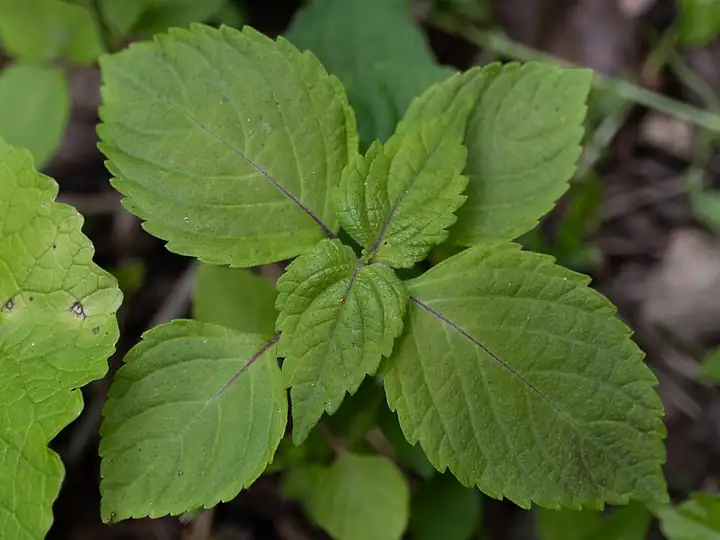
Perilla (shiso)
Perilla frutescens · Mint family (Lamiaceae)
| Hardiness zones | 2 to 11 |
|---|---|
| Sun | full sun to part shade |
| Water | moderate |
| Life cycle | annual |
| Frost | Half-hardy: takes a light frost |
| Soil pH | 6.0–8.0 |
| Spacing | 6 to 12 inches |
| Days to harvest | 60 to 70 days |
| Soil temperature to plant | at least 59°F |
About Perilla (shiso)
Perilla is a fragrant annual in the mint family with green or purple toothed leaves, known as shiso in Japanese cooking and as perilla leaf in Korean cooking. It is easy to grow, but it self-sows heavily and has escaped into woods and pastures across the eastern U.S., where several states list it as invasive. Its flowering tops and seeds are poisonous to cattle, horses and sheep, so snip off flowers before seed sets.
Grown as a summer annual, sown after the last frost; it takes only light frost (OMAFRA), and Alaska gardeners grow it too (UAF Extension). Invasive-plant councils or state agencies in Kentucky, Tennessee, Virginia, West Virginia and South Carolina list it, and NC State calls it invasive in North Carolina; none of these is a planting ban.
When to plant
Timing is counted from your average last spring frost (and first fall frost). Sow & Tell works out the actual dates for your ZIP code.
Sow after the last frost, or start seed indoors in late winter; seeds need light to sprout, so barely cover them and keep them moist at about 68-75 F (UAF Extension; OMAFRA). Chilling the seeds in moist soil at about 41 F for 3 days before sowing helps, and soil should be above about 59 F (OMAFRA). Days to harvest count from sowing.
Soil
Fertile, well-drained sandy or loamy soil; it tolerates heat and drought once established (NC State; OMAFRA).
Use fertile, well-drained soil with compost worked in; no fertilizer rates are published, so follow a soil test.
Feeding
- as needed during the growing season: a balanced garden fertilizer. Feed lightly if growth is pale or slow and keep the soil moist; an Alaska grower used compost and a 4-6-4 fertilizer.
Don't let it flower and drop seed: it self-sows heavily and the flowering tops are toxic to livestock.
Harvest
Start picking leaves about 60 to 70 days after sowing and keep going until frost; pinching leaves and tips makes the plant branch and make more leaves (UAF Extension). Leaves wilt fast, so pick in the cool part of the day (OMAFRA).
Pick leaves from about 60 to 70 days after sowing until frost; pinching the tips makes the plant branch and grow more leaves. Snip off flower spikes so it doesn't seed everywhere.
Varieties (3)
Extension and botanical-garden sources name only 3 forms; most seed is sold simply as green or purple (red) shiso.
| Variety | Type | Days | Notes |
|---|---|---|---|
| Crispa (curly shiso) | Perilla frutescens var. crispa | A different flavor from plain perilla. More deeply toothed, frilly leaves. | |
| Atropurpurea | Purple-leaved | Hairy annual up to about 3 ft tall with dark purple, round-toothed leaves and small white flowers. | |
| Purple Shiso | Purple-leaved | Purple leaves; used to color pickles. |
Pests to watch for
Japanese beetle, Slugs, Brown garden snail
In the kitchen
Use the leaves with sushi and sashimi, in tempura, salads and noodles, or as Korean wraps for grilled meat, in stir-fries and kimchi; purple leaves color pickles (Clemson). Dried, crushed leaves top rice, and flower stalks and fresh seeds are eaten as a garnish (UAF Extension; NC State).
Keeping it: Leaves wilt fast: chill them right after picking and keep them cold and humid, such as in a bag in the refrigerator.
Safety: Pulling plants by hand can cause a skin rash in some people (Missouri Invasive Plant Task Force). We found no NIH or MSKCC review of perilla as a food herb. The flowering tops and seeds are toxic to cattle, horses and sheep (Purdue).
Pets: Not listed by the ASPCA. Toxic to cattle, horses and sheep: perilla ketone in the flowering tops and seeds causes severe breathing trouble, worst from July to October (Purdue; Mississippi State).
Sources
- plants.ces.ncsu.edu
- hgic.clemson.edu
- extension.msstate.edu
- ag.purdue.edu
- alaskamastergardener.community.uaf.edu
- omafra.gov.on.ca
- moinvasives.org
- tnipc.org
- gardenclubky.org
- dcr.am.virginia.gov
- wvdnr.gov
- aspca.org
- aspca.org
- aspca.org
Photo: Photo: Alex Abair / Wikimedia Commons, CC BY 4.0 (CC BY 4.0). Photo resized for the web.

Planting dates and advice are general guidance; check with your local Cooperative Extension office for your area.