
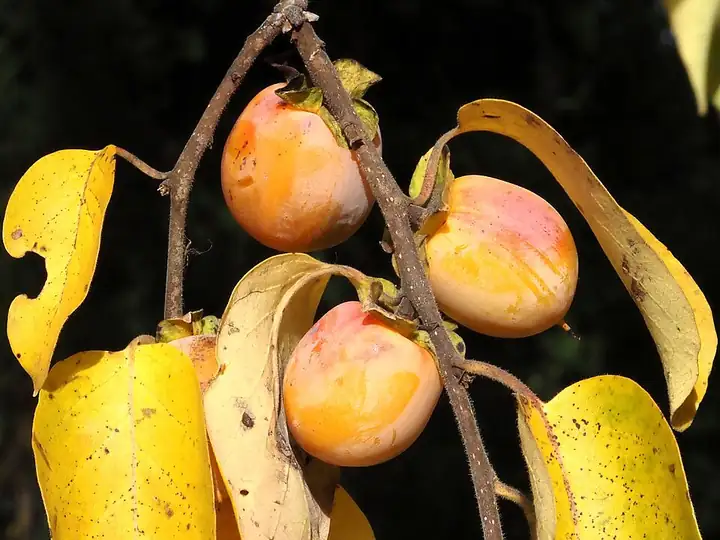
Persimmon (American and Asian)
Diospyros virginiana (American persimmon) and Diospyros kaki (Asian persimmon) · Ebony family (Ebenaceae)
| Hardiness zones | 4 to 10 |
|---|---|
| Sun | full sun |
| Water | moderate |
| Life cycle | perennial |
| Frost | Hardy: takes frost |
| Soil pH | 6.0–6.5 |
| Spacing | 144 to 288 inches |
About Persimmon (American and Asian)
American persimmon is a tough native tree with small, sweet fruit once fully soft. Asian persimmons have larger, higher-quality fruit on smaller trees but are much less cold-hardy.
American persimmon grows in zones 4-9 and survives -20 to -25 F; Asian persimmon grows in zones 7-10 and only survives to about 10 F (NC State; Clemson).
When to plant
Timing is counted from your average last spring frost (and first fall frost). Sow & Tell works out the actual dates for your ZIP code.
Asian persimmon trees are usually 4-6 years old before they bear (NC State). Space Asian persimmons at least 15 feet apart (NC State); American persimmons grow into large trees and send up root suckers.
Soil
Adaptable and tolerant of many soils as long as they drain well; Asian persimmon does best around pH 6.0-6.5 (NC State).
Persimmons grow in many soils; a pH of about 6.0 to 6.5 in loamy, moist but well-drained soil is best.
Feeding
- Young trees: early spring and again in mid-summer: balanced fertilizer such as 10-10-10. About 2 ounces per year of tree age each time (Georgia), spread evenly under the tree; avoid fertilizer spikes.
- Bearing trees: late winter, only if leaves are pale and growth is under 10-12 inches a year: balanced fertilizer such as 10-10-10 or 13-13-13. Feed lightly; a tree in a fertilized lawn often needs nothing more.
Too much nitrogen makes persimmons drop their fruit; they need less fertilizer than peaches.
Harvest
American persimmons are astringent while firm and sweet only when soft and ripe (NC State). Astringent Asian types must also be fully soft before eating, while non-astringent types can be eaten while still firm (Clemson).
Persimmons give one crop a year, late in fall, and the fruit can hang on the tree into winter after the leaves drop. Astringent types (and most American persimmons) must be fully soft before eating, while non-astringent types can be eaten firm; fruit keeps ripening after picking.
Varieties (19)
| Variety | Type | Days | Notes |
|---|---|---|---|
| C-100 | American (native) persimmon | Grown for its red fall color. | |
| John Rick | American (native) persimmon | Excellent flavor and firm fruit with 2-8 seeds. Productive. | |
| Killen | American (native) persimmon | Good flavor; firm, medium-size fruit. Moderately productive. | |
| Meader | American (native) persimmon | Deep orange, apricot-size fruit. | |
| Miller | American (native) persimmon | Good flavor; large, firm fruit. Productive. | |
| Morris Burton | American (native) persimmon | Considered one of the best native persimmons. | |
| Prok | American (native) persimmon | NC State calls it the best-tasting American persimmon. | |
| Woolbright | American (native) persimmon | Excellent flavor, but soft fruit that splits easily. Productive. | |
| Peping | Asian persimmon | Georgia Extension says it can be grown in north Georgia when grafted on native rootstock and is hardy to about 0°F. | |
| Eureka | Asian persimmon, astringent | Flat, red, good-quality fruit; must soften fully before eating. Heavy producer on a small tree. | |
| Great Wall | Asian persimmon, astringent | Small, flat, orange-red fruit; must soften fully before eating. Vigorous tree. | |
| Sheng | Asian persimmon, astringent | Large, flat, orange-red fruit; must soften fully before eating. Moderately vigorous tree. | |
| Tamopan | Asian persimmon, astringent | Large, flat orange fruit with a pinched 'waist'; must soften fully before eating. | |
| Tanenashi | Asian persimmon, astringent | Seedless, cone-shaped orange fruit; must soften fully before eating. | |
| Fuyu | Asian persimmon, non-astringent | Medium, somewhat square red-orange fruit that can be eaten while firm. Great fall leaf color. | |
| Hana Fuyu | Asian persimmon, non-astringent | Large, round, yellow-orange fruit of good quality. Moderately vigorous and productive. | |
| Hana Gosho | Asian persimmon, non-astringent | Vigorous, upright tree with strong branching. | |
| Ichikikei Jiro | Asian persimmon, non-astringent | Flattened, good-quality fruit that can be eaten firm. Productive. | |
| Jiro | Asian persimmon, non-astringent | Non-astringent; can be eaten firm. Showy fall color, and fruit stays on the tree into winter. |
Pests to watch for
Scale insects, Annual cicadas (dog-day cicadas), Bagworm, Granulate ambrosia beetle
Diseases and problems
Powdery mildew
In the kitchen
Eaten fresh when ripe, or used in baking.
Keeping it: Let firm persimmons ripen at room temperature. Eat soft-ripe fruit right away or refrigerate it in a bag for up to 3 days; unripe fruit keeps about a month in the fridge.
Pets: Not listed as toxic by the ASPCA
Sources
- plants.ces.ncsu.edu
- plants.ces.ncsu.edu
- hgic.clemson.edu
- content.ces.ncsu.edu
- aspca.org
- aspca.org
- extension.msstate.edu
- fieldreport.caes.uga.edu
- blogs.ifas.ufl.edu
Photo: Photo: Peterwchen, CC BY-SA 4.0, via Wikimedia Commons (CC BY-SA 4.0). Photo resized for the web.

Planting dates and advice are general guidance; check with your local Cooperative Extension office for your area.