
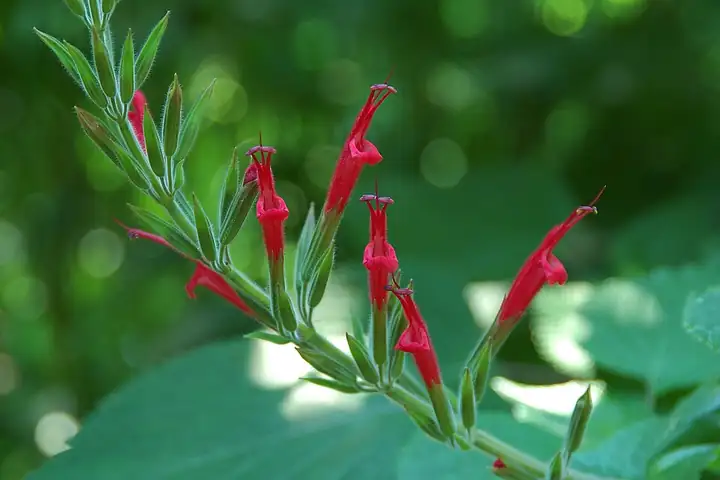
Pineapple sage
Salvia elegans · Mint family (Lamiaceae)
| Hardiness zones | 2 to 10 |
|---|---|
| Sun | full sun to part shade |
| Water | moderate |
| Life cycle | tender perennial (grown as an annual) |
| Frost | Tender: killed by frost |
About Pineapple sage
Pineapple sage is a fast-growing Mexican salvia, 3 to 4 feet tall, whose soft leaves smell like pineapple when you brush them (NC State, Arkansas). In late summer and fall it opens spikes of scarlet tubular flowers that are a hummingbird favorite, just when migrating hummingbirds need food (NC State, Illinois). Leaves and flowers are both edible; it is a cousin of the ornamental salvias and kitchen sage in this guide.
Grown as a summer annual anywhere (Illinois grows it as an annual in zone 5); it lives through winter only in zones 8-10, where frost cuts it to the ground and it regrows in spring (NC State, Arkansas).
When to plant
Timing is counted from your average last spring frost (and first fall frost). Sow & Tell works out the actual dates for your ZIP code.
Set plants out after the soil has warmed in spring (Arkansas). It is usually grown from stem cuttings; NC State advises against seed unless you start it indoors and transplant a well-grown plant. Pinch tips early for a bushier plant (UGA, Arkansas).
Soil
Rich, moist, well-drained soil high in organic matter; it needs steady moisture, and leaves drop if it gets too dry (NC State, Arkansas, Illinois).
Work compost into the bed for rich, moist, well-drained soil high in organic matter.
Feeding
- Through the growing season, for plants in containers: balanced fertilizer. Feed potted plants on a steady monthly schedule, and water until it runs out the bottom so fertilizer salts don't build up.
Don't let it dry out, or it drops leaves; plants kept indoors over winter often pick up whiteflies and mealybugs.
Harvest
Pick leaves any time once the plant is growing well; flowers open in late summer to fall, as days get shorter (NC State, Arkansas). Pinching tips through summer keeps it bushy (UGA).
Pinch and pick leaves all summer to keep it bushy; the red flowers come in late summer and fall, until frost.
Varieties (1)
Extension sources document one named variety; plain green-leaved pineapple sage is the other common form.
| Variety | Type | Days | Notes |
|---|---|---|---|
| Golden Delicious | Bright chartreuse to lemon-yellow leaves and red flowers on a 2-3 ft plant; found in Illinois and introduced in 2001. Too much shade dulls the gold color. |
Pests to watch for
Whiteflies, Mealybugs
Diseases and problems
Southern blight, Southern bacterial wilt
In the kitchen
Leaves flavor hot or iced tea, fruit salads, jams and jellies, chicken, cream cheese and baked goods like pound cake and shortbread; the sweet, fruity red flowers garnish salads, pasta and desserts (NC State, UT Gardens, UGA, UF/IFAS).
Keeping it: Use fresh leaves and flowers soon after picking; dried leaves keep in airtight jars away from light.
Safety: Leaves and flowers are listed as edible by Extension sources, with no warnings for food amounts. Eat only flowers grown without pesticides (UF/IFAS).
Pets: Not listed by name by the ASPCA; its relatives garden sage (Salvia officinalis) and scarlet sage (S. coccinea) are listed as non-toxic to dogs, cats and horses.
Sources
- plants.ces.ncsu.edu
- extension.illinois.edu
- uaex.uada.edu
- utgardens.tennessee.edu
- gardeningsolutions.ifas.ufl.edu
- fieldreport.caes.uga.edu
- extension.missouri.edu
- aspca.org
- aspca.org
Photo: Photo: Eric Hunt, CC BY 2.5, via Wikimedia Commons (CC BY 2.5). Photo resized for the web.

Planting dates and advice are general guidance; check with your local Cooperative Extension office for your area.