
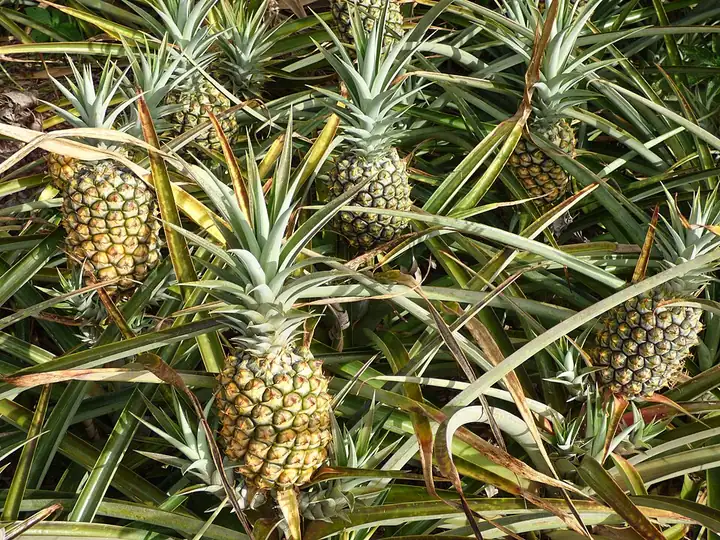
Pineapple
Ananas comosus · Bromeliad family (Bromeliaceae)
| Hardiness zones | 10 to 12 |
|---|---|
| Sun | full sun |
| Water | low |
| Life cycle | perennial |
| Frost | Tender: killed by frost |
| Spacing | 12 to 36 inches |
About Pineapple
Pineapple is a low, spiky-leaved bromeliad from South America that grows in the ground, 3-6 ft tall and wide, and makes one fruit in the center of each plant. It is one of the easiest tropical fruits to start at home: twist the leafy crown off a store-bought pineapple, root it, and grow it in a 3-7 gallon pot. Expect about 18-24 months or more to the first fruit.
NC State lists zones 10a-12b; in Florida it grows best along the warm southeast and southwest coasts and in sheltered dooryards across the state, and freezing below 28 F damages or kills it (UF/IFAS). We found no U.S. invasive or noxious listing in the sources we checked.
When to plant
Timing is counted from your average last spring frost (and first fall frost). Sow & Tell works out the actual dates for your ZIP code.
No source ties planting to a frost date; growth slows below 60 F (UF/IFAS). Start from a crown, slip or sucker: let it dry in shade for 1-2 days (UF/IFAS; NC State suggests about a week for a cut crown) and plant it 3-4 inches deep. Plants flower about 14-18 months after planting and fruit ripens 5-7 months later, so harvest comes about 18-24 months after planting, or longer in cooler places (UF/IFAS).
Soil
Moderately fertile, well-drained sandy loam that is neutral to slightly acid; it can't take flooding, which brings on root rot (UF/IFAS).
Mix a little compost or topsoil into the soil at planting to help roots and hold moisture, but no fertilizer in the hole (UF/IFAS); in pots use a clean, well-drained potting mix.
Feeding
- Every 6-8 weeks for the first 3 months: dry fertilizer with 6-10% nitrogen, 6-10% phosphate, 6-10% potash and 4-6% magnesium. 1-2 oz per plant each time; use the lower rate for a stronger mix such as 10-10-10 (UF/IFAS).
- Every 6-8 weeks, months 4-16: the same fertilizer. Raise the amount as the plant grows: 1-3 oz at 4-6 months, 2-6 oz at 6-12 months and 3-6 oz at 12-16 months (UF/IFAS).
- Warm months, 2-3 times a year: micronutrients (zinc, manganese, sometimes iron). Spray on the leaves or apply to the soil; on alkaline soil use a chelated iron drench. A mild liquid fertilizer sprayed on the leaves every 8-10 weeks also works; follow the label to avoid leaf burn (UF/IFAS).
- About 16 months on, when you want it to flower: less nitrogen. Cut back nitrogen once the plant is big enough to flower; 5-8 oz per feeding is the top rate for plants 17-24 months old (UF/IFAS).
Overwatering and soggy soil cause root rot, and neglect or long cold spells make plants flower early with small fruit; never use calcium carbide to force bloom (UF/IFAS).
Harvest
Pick when one-third to two-thirds of the shell has turned from green to yellow, the fruit smells sweet and the little fruitlets flatten out; or pick it full-size and green and ripen it at room temperature (UF/IFAS). Don't chill green fruit. Each plant gives one fruit, plus a later second fruit if you keep one sucker.
Each plant makes one fruit about 18-24 months after planting. Keep one sucker or underground ratoon pup after harvest and pull the rest, and it will give a second fruit in the same spot.
Varieties (8)
UF/IFAS documents these 8 pineapples; sizes are fruit weights.
| Variety | Type | Days | Notes |
|---|---|---|---|
| Green Spanish | UF/IFAS lists it among the less common pineapples; no other details given. | ||
| MD-2 (Del Monte Gold) | High sugar and low acid; high in vitamin C. Leaves about 3 ft, spineless except at the tip; cylindrical 3-4 lb fruit with yellow flesh. The common grocery-store pineapple. | ||
| Queen | Mild flavor, crisp texture. Spiny leaves; small 2-3 lb fruit with golden yellow flesh that keeps well after ripening. Harder to find. | ||
| Red Spanish | Pleasantly fragrant. Spiny leaves; squarish 2-4 lb fruit with pale yellow flesh. Harder to find. | ||
| Singapore Spanish | Leaves about 3 ft with spines near the tip; 3.5-5 lb fruit with golden yellow flesh. Harder to find. | ||
| Smooth Cayenne | High in both sugar and acid. Leaves about 3 ft with spines at base and tip; cylindrical 5-6 lb fruit with pale yellow to yellow flesh. Once the most widely grown pineapple, now less common. | ||
| Sugarloaf (White or Kona Sugarloaf) | Smooth leaves; cylindrical 5-6 lb fruit with white flesh and a core you can eat. | ||
| Tropical Gold | High sugar and low acid. A clone similar to MD-2, common in U.S. grocery stores (UF/IFAS). |
Pests to watch for
Mealybugs, Scale insects, Twospotted spider mite, Root-knot nematodes, White grubs, Garden ants, Raccoon, Tree squirrels, Opossum
Diseases and problems
Root and crown rot, Heart rot, Black rot, Chilling injury
In the kitchen
Eaten fresh or juiced, dried, candied, and cooked in main dishes and desserts (UF/IFAS).
Keeping it: Keep a ripe pineapple in the refrigerator for up to about a week; ripen green fruit at room temperature first, since chilling green fruit keeps it from ripening properly (UF/IFAS).
Safety: NC State rates pineapple low in toxicity: the fruit, leaves and juice can irritate skin, eyes, mouth and throat in sensitive people, eating lots of the tough core can cause a gut blockage, and the leaf edges are sharp, so wear gloves. UF/IFAS warns against using calcium carbide to force flowering because its impurities can be toxic.
Pets: Not listed by the ASPCA
Sources
Photo: Photo: Forest and Kim Starr / Wikimedia Commons, CC BY 3.0 US (CC BY 3.0 US). Photo resized for the web.

Planting dates and advice are general guidance; check with your local Cooperative Extension office for your area.