
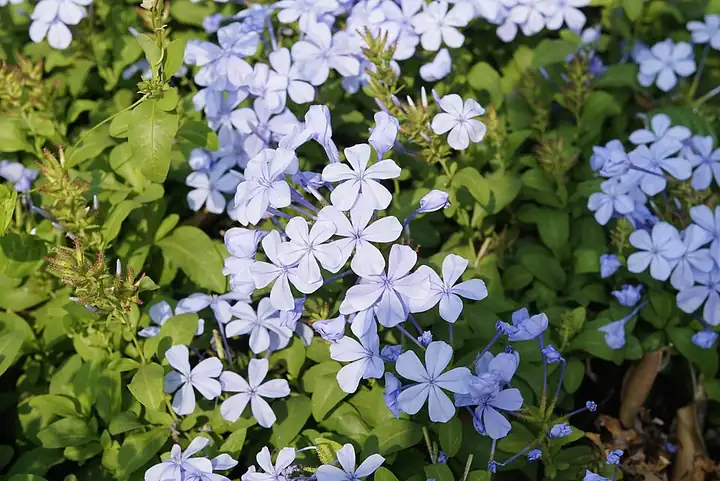
Cape plumbago
Plumbago auriculata (formerly P. capensis) · Leadwort family (Plumbaginaceae)
| Hardiness zones | 8 to 11 |
|---|---|
| Sun | full sun to part shade |
| Water | moderate |
| Life cycle | tender perennial (grown as an annual) |
| Frost | Half-hardy: takes a light frost |
| Spacing | 36 to 60 inches |
About Cape plumbago
Cape plumbago is a sprawling evergreen shrub from southern Africa with clusters of phlox-like flowers in a rare sky blue (or white). It shrugs off heat and drought, blooms from late spring to frost, draws butterflies and is a host plant for the cassius blue butterfly (UGA; UF/IFAS). It's a shrub or cascading mass planting in the far South and a container plant or annual farther north; it was named a Texas Superstar plant in 2005.
Evergreen in zones 9-11 (NC State, UF/IFAS); root-hardy to about zone 8b, where a freeze kills it back but it usually regrows in spring (UGA, UF/IFAS). Grown as an annual or overwintered indoors farther north. UF/IFAS rates it not a problem species in Florida.
When to plant
Timing is counted from your average last spring frost (and first fall frost). Sow & Tell works out the actual dates for your ZIP code.
Plant nursery plants in spring after frost; give mass plantings 4-6 ft so the arching stems can spread (UF/IFAS). In zone 8 add an extra layer of winter mulch over the roots (UGA). Farther north, grow it in a pot and bring it into a bright, sunny room for winter, or cut it back and keep it in a cool, dark place with little water (NC State). Days to first bloom aren't documented.
Soil
Well-drained soil of almost any type; in alkaline (high pH) soil the leaves may yellow from mineral shortages (UF/IFAS, UGA).
Any well-drained soil works; avoid very alkaline spots, where leaves may yellow (UF/IFAS).
Feeding
- Growing season (spring into summer): general-purpose shrub fertilizer. UF/IFAS says it responds well to one or two fertilizer applications a season; follow the label and a soil test.
Shearing it as a tight hedge removes most of the flowers, since it blooms on new growth (UF/IFAS).
Harvest
Blooms on new growth from late spring until frost, and almost all year in central and south Florida (UGA, UF/IFAS). Cut back leggy stems to bring on more flowers, and prune freeze-damaged growth in spring (UGA, UF/IFAS).
Varieties (3)
Extension sources document only 2 cape plumbago cultivars plus the native white doctorbush.
| Variety | Type | Days | Notes |
|---|---|---|---|
| Alba | Cape plumbago | White flowers. | |
| Imperial Blue | Cape plumbago | Sky-blue flowers. | |
| Doctorbush (P. zeylanica, also called P. scandens) | Native relative | White-flowered plumbago native to Florida, Texas and Arizona; hardy in zones 9b-11 and a host plant for the cassius blue butterfly. |
Good neighbors
Petunia, Coleus, Salvia (ornamental sage)
UGA suggests pink petunias, orange coleus and 'Black and Blue' salvia as color partners in beds and pots; that's a design pairing, not a tested pest benefit.
Pests to watch for
Thrips, Scale insects, Twospotted spider mite
Diseases and problems
Nutrient deficiency
In the kitchen
Safety: All parts contain plumbagin, a skin irritant: the sap can cause redness and blisters, so wear gloves when pruning (NC State). Don't eat any part.
Pets: Not listed by the ASPCA (its plumbago entries are Ceratostigma, a different plant). NC State rates cape plumbago as poisonous with medium severity, so keep pets from chewing it.
Sources
- plants.ces.ncsu.edu
- gardeningsolutions.ifas.ufl.edu
- ask.ifas.ufl.edu
- fieldreport.caes.uga.edu
- aspca.org
- aspca.org
Photo: Photo: Vengolis / Wikimedia Commons, CC BY-SA 4.0 (CC BY-SA 4.0). Photo resized for the web.

Planting dates and advice are general guidance; check with your local Cooperative Extension office for your area.