
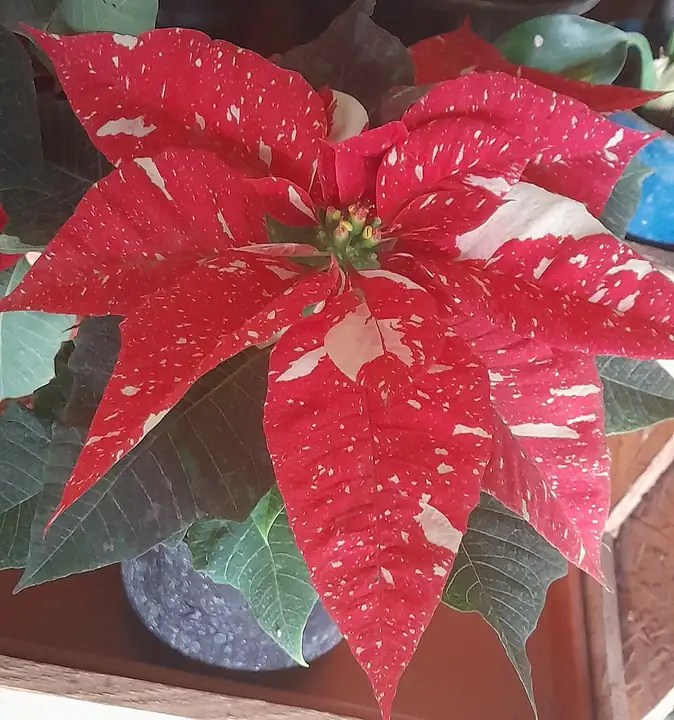
Poinsettia
Euphorbia pulcherrima · Spurge family (Euphorbiaceae)
| Hardiness zones | 9 to 11 |
|---|---|
| Sun | part shade |
| Water | moderate |
| Life cycle | tender perennial (grown as an annual) |
| Frost | Tender: killed by frost |
About Poinsettia
The poinsettia is a shrub of Mexico's dry tropical forests that Joel Poinsett brought to the United States in the 1820s, and it is now the best-selling potted plant of the Christmas season, more than 70 million a year (NC State, Clemson). The 'flowers' are colored leaves, or bracts, in red, pink, white, peach and marbled bicolors around tiny yellow true flowers. It is a perennial that can be cut back, summered outdoors and coaxed to recolor with 14-16 hours of darkness each night from early October, but most people enjoy it for the season and compost it. Poison Control says it is irritating, not deadly.
Hardy outdoors only in zones 9-11, where it grows into a 10-15 ft shrub (NC State, Clemson); it is grown indoors everywhere and can summer outdoors in a sunny to lightly shaded spot once nights stay above 50 F, coming back in when nights reach 55-60 F (Clemson).
When to plant
Timing is counted from your average last spring frost (and first fall frost). Sow & Tell works out the actual dates for your ZIP code.
Bought as a nursery plant in color in November and December; pick one with dark green leaves all the way down the stem and center flowers not yet fully open, and it can be propagated from stem cuttings in early summer (Clemson, NC State).
Growing it indoors
- Light: Give it at least 6 hours of bright indirect light a day; direct sun fades the bracts, so filter a sunny window with a sheer curtain, and a kept plant moves to a sunny window after the holidays (Clemson, NC State).
- Water: Water thoroughly when the surface of the mix feels dry, taking the pot out of its foil sleeve so water drains freely, then let it drain; never let the mix dry out completely and never let it stand in water, since overwatering causes root and stem rot (Clemson, NC State). Water less after the bracts fade and the plant rests.
- Humidity: Keep it away from dry air blowing from fireplaces, appliances and heat ducts (Clemson).
- Temperature: It is happiest at 65-70 F by day, drops its leaves if chilled below 50 F, and dislikes drafts, heat vents and fireplaces; nights in the low 60s are needed for the bracts to color (Clemson, NC State).
- Feeding: Don't feed while it is in color; from spring through fall feed a balanced fertilizer such as 10-10-10 every 2-3 weeks, and stop once the dark treatment starts in October (Clemson).
- Repotting: If you keep it, cut it back to about 8 in in March or April when the bracts fade, then repot in early June into a pot 2-4 in larger with a mix rich in organic matter (Clemson).
Soil
A well-drained potting mix rich in organic matter such as compost, leaf mold or peat, in a pot with a drainage hole; take off the foil sleeve so it can drain (NC State, Clemson).
Pot in a well-drained mix rich in organic matter such as compost, leaf mold or peat, in a container with a drainage hole (Clemson, NC State).
Feeding
- While in color, November through February: none. Don't fertilize a plant in bloom (Clemson).
- Spring through fall, after cutting back in March or April: balanced complete fertilizer such as 10-10-10. Feed every 2-3 weeks through spring, summer and fall (Clemson); NC State says to begin feeding in spring.
- From the first week of October, during the dark treatment: none. Stop feeding once the long nights start and water only when the surface dries (Clemson).
Pinching after September 1 removes the shoots that would color up, and any stray light at night during October and November stops the bracts coloring (Clemson, NC State).
Harvest
The bracts color up in November and December and hold for weeks; to recolor a kept plant, give it 14 hours of total darkness every night from the first week of October for 8-10 weeks, with 6-8 hours of bright light by day (Clemson).
Varieties (19)
| Variety | Type | Days | Notes |
|---|---|---|---|
| Enduring Marble | Bicolor | Creamy bracts marbled with rose pink. | |
| Ice Punch | Bicolor | Red bracts with a frosty white center. | |
| Peterstar Marble | Bicolor | Pink and cream marbled bracts. | |
| Orange Spice | Orange | Orange-peach bracts. | |
| Luv U Pink | Pink | Pink bracts. | |
| Pink Champagne | Pink | Coral pink bracts shaded deep rose. | |
| Christmas Day | Red | A red Clemson lists among the popular cultivars. | |
| Christmas Mouse | Red | Small, rounded red bracts shaped like mouse ears. | |
| Cortez Burgundy | Red | Deep burgundy bracts. | |
| Grande Italia | Red | Red bracts on a taller plant. | |
| Kayla Red | Red | Ruby red bracts. | |
| Oakleaf | Red | The oldest named variety, from 1923, with oak-lobed leaves. | |
| Prestige | Red | The most widely sold red, with strong branches that are less likely to break. | |
| Winter Rose Dark Red | Red | Curled, rose-like dark red bracts. | |
| Jingle Bells | Speckled | Red bracts speckled with pink or white; 'Jingle Bell Rock' is similar. | |
| Sky Star | Speckled | Crimson bracts sprinkled with white dots. | |
| Tapestry | Variegated leaf | Yellow and green variegated leaves under bright red bracts. | |
| Alaska | White | Frosty white bracts. | |
| Peterstar White | White | White bracts in the Peterstar series. |
Pests to watch for
Whiteflies, Mealybugs, Scale insects, Twospotted spider mite
Diseases and problems
Root and crown rot, Stem rot
In the kitchen
Safety: Not deadly, whatever the old story says: Poison Control found no poisonous dose even at 500-600 leaves, and eating a leaf causes at most mild nausea, vomiting or diarrhea, while Clemson says the plant 'is not considered toxic'. The milky latex can give a rash (wash it off with soap and water), can set off a reaction in people with latex allergy, and NC State warns it can damage the eye, so flush eyes with water and keep sap away from them.
Pets: Toxic to dogs and cats (ASPCA): the irritant latex sap is 'irritating to the mouth and stomach, sometimes causing vomiting, but generally over-rated in toxicity'.
Sources
Photo: Photo: Yercaud-elango, CC BY 4.0, via Wikimedia Commons (CC BY 4.0). Photo resized for the web.

Planting dates and advice are general guidance; check with your local Cooperative Extension office for your area.