
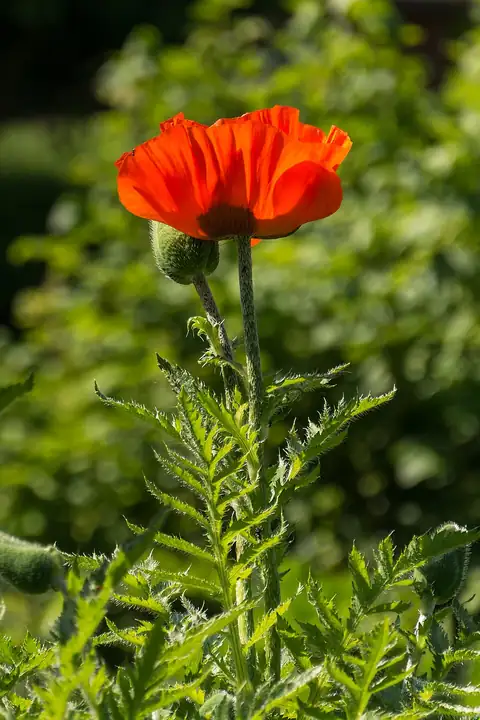
Poppy (Oriental, Iceland, corn and breadseed poppies)
Papaver orientale (Oriental poppy), P. nudicaule (Iceland poppy), P. rhoeas (corn, field, Flanders or Shirley poppy), P. somniferum (breadseed or opium poppy) · Poppy family (Papaveraceae)
| Hardiness zones | 3 to 10 |
|---|---|
| Sun | full sun |
| Water | moderate |
| Life cycle | annual |
| Frost | Hardy: takes frost |
| Spacing | 6 to 12 inches |
About Poppy (Oriental, Iceland, corn and breadseed poppies)
Poppies bring silky, cup-shaped flowers in red, orange, pink, salmon, yellow, white and purple. Corn (Shirley) and breadseed poppies are annuals sown in fall or early spring, Iceland poppy is a short-lived perennial grown as a cool-season annual, and Oriental poppy is a long-lived perennial with huge early-summer flowers that then goes dormant. Breadseed poppy (Papaver somniferum) is the opium poppy: federal law lists the opium poppy plant, apart from its seeds, as a Schedule II controlled substance, and growing it to make opium or other drugs is illegal under federal law (this is general information, not legal advice).
Oriental poppy is a perennial for zones 3-7 and does poorly in hot, humid summers (NC State). Corn poppy grows as an annual in zones 3-10 (NC State), and Iceland poppy, a 2-3 year perennial, prefers cool temperatures and is grown as an annual in warm areas (CSU, NC State). Corn poppy can escape gardens and act weedy (NC State).
When to plant
Timing is counted from your average last spring frost (and first fall frost). Sow & Tell works out the actual dates for your ZIP code.
- Start seeds indoors: 4 to 6 weeks before the last frost
- Set out plants: around the last frost
Sow annual poppies outdoors in late fall or very early spring; freezing and thawing helps the seed sprout (UGA, USU). Seed needs light, so press it in and cover with no more than 1/8 inch of soil; it comes up in 7-28 days depending on soil warmth, and seedlings are cold hardy (USU, UC). Poppies have taproots and move poorly: thin seedlings to about 6-12 inches rather than transplanting, or start breadseed poppies indoors at 60 F 4-6 weeks ahead and set them out carefully around the last frost (USU, UC). Oriental poppies are grown from root cuttings or nursery plants (NC State).
Soil
Well-drained soil is a must; poppies rot in soil that stays wet. Oriental poppies tolerate dry, sandy or loamy ground (NC State, CSU).
Test the soil and prepare the bed the fall before spring sowing; work any fertilizer the test calls for into the top 6 inches and add no more than about 1 inch of well-composted organic matter (USU).
Feeding
- After thinning, before flower buds form: nitrogen fertilizer such as 21-0-0. Side-dress with 1-2 Tbsp per 10 ft of row and water it in; water about an inch a week (USU, for breadseed poppies).
Wet, poorly drained soil rots poppy roots, and transplanting breaks the taproot; thin seedlings instead (NC State, CSU, UC).
Harvest
Annual and Iceland poppies bloom from spring to early summer, and Oriental poppies in late spring to early summer, about June-July (NC State, UC). Deadhead often for more flowers, or leave some for seed pods (UC). For the vase, sear the stem end with a flame right after cutting (NC State).
Varieties (12)
Extension sources document 12 varieties across Oriental, corn and breadseed poppies; we found no extension source naming Iceland poppy varieties.
| Variety | Type | Days | Notes |
|---|---|---|---|
| Bread Seed Poppy | Breadseed poppy (P. somniferum) | Pink, purple and red flowers; smooth gray scalloped leaves and large seed heads. | |
| Elka | Breadseed poppy (P. somniferum) | Large seed heads with white, sweet, nutty seed. | |
| Heirloom Pepperbox | Breadseed poppy (P. somniferum) | Purple, red and pale lilac flowers on gray-green plants; dark, nutty seed. | |
| Hens and Chicks | Breadseed poppy (P. somniferum) | Red or pink flowers about 8 in across; one big seed pod ringed by small ones. | |
| Hungarian Blue | Breadseed poppy (P. somniferum) | 2-3 ft tall with silvery leaves and purple petals; self-sows readily. | |
| Hungarian Bread Seed | Breadseed poppy (P. somniferum) | Eastern European heirloom with white to pale lavender flowers and blue-black seed. | |
| Ziar | Breadseed poppy (P. somniferum) | Light lavender petals with dark red centers; large heads of sweet seed. | |
| Shirley Double | Corn or Shirley poppy (P. rhoeas) | Double, ruffled flowers in white, pink, orange and red over finely divided, silvery-haired leaves. | |
| Patty's Plum | Oriental poppy (P. orientale) | ||
| Peter Pan | Oriental poppy (P. orientale) | Compact Oriental poppy. | |
| Raspberry Queen | Oriental poppy (P. orientale) | ||
| Watermelon | Oriental poppy (P. orientale) |
Pests to watch for
Aphids, Slugs, Brown garden snail
Diseases and problems
Root and crown rot, Downy mildew, Powdery mildew, Gray mold (Botrytis)
In the kitchen
Only the seeds of breadseed poppies are eaten, as the familiar nutty poppy seed for baking (UC, USU).
Keeping it: Store ripe breadseed poppy seed in a cool, dry, dark place; it keeps its flavor a long time, but seed saved for planting should be sown within a year.
Safety: Every part except the ripe seeds should be treated as poisonous: the milky sap of poppies is rich in alkaloids, may harm an unborn baby, and NC State rates Oriental poppy as mildly poisonous in all parts. Only breadseed poppy seeds are eaten (UC). Growing opium poppy to make drugs is a federal crime.
Pets: Not listed by the ASPCA (we found no poppy entry). NC State notes poppy sap is rich in alkaloids and calls Oriental poppy low in toxicity to animals, so keep pets from chewing plants or pods.
Sources
- plants.ces.ncsu.edu
- plants.ces.ncsu.edu
- plants.ces.ncsu.edu
- planttalk.colostate.edu
- extension.usu.edu
- ucanr.edu
- fieldreport.caes.uga.edu
- law.cornell.edu
- law.cornell.edu
- depts.washington.edu
- rutgersgardens.rutgers.edu
- aspca.org
- aspca.org
- aspca.org
- aspca.org
Photo: Photo: Uoaei1 / Wikimedia Commons, CC BY-SA 4.0 (CC BY-SA 4.0). Photo resized for the web.

Planting dates and advice are general guidance; check with your local Cooperative Extension office for your area.