
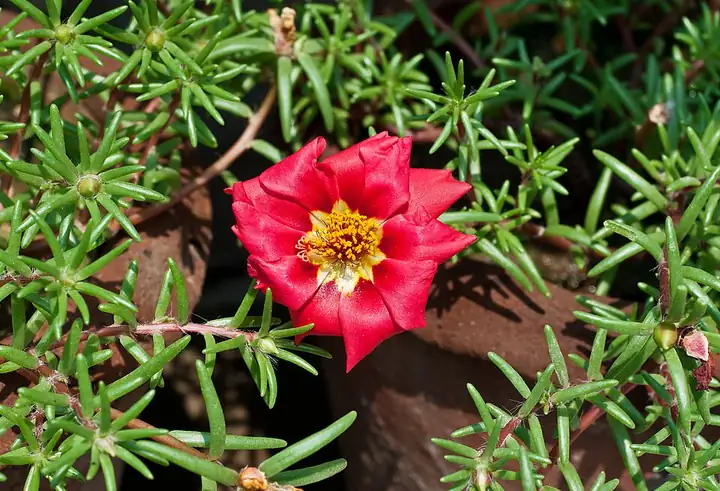
Portulaca (moss rose)
Portulaca grandiflora (garden hybrids may involve P. oleracea or P. umbraticola) · Purslane family (Portulacaceae)
| Hardiness zones | 2 to 11 |
|---|---|
| Sun | full sun |
| Water | low |
| Life cycle | annual |
| Frost | Tender: killed by frost |
| Spacing | 10 to 12 inches |
About Portulaca (moss rose)
Moss rose is a low, creeping succulent annual from the hot, dry plains of Argentina, southern Brazil and Uruguay. Its fleshy, needle-like leaves hold water, and its little rose-like flowers come in almost every warm color plus white. It's one of the toughest choices for hot, dry spots, edging, rock gardens and hanging baskets. Common purslane, the edible garden weed, is a close cousin in the same genus, and some 'purslane' bedding plants with flat leaves are hybrids of the two.
Grown as a summer annual in every zone; freezing weather kills it (UF/IFAS). UF/IFAS rates it not a problem species in Florida, though Wisconsin notes it has escaped onto roadsides in places.
When to plant
Timing is counted from your average last spring frost (and first fall frost). Sow & Tell works out the actual dates for your ZIP code.
- Start seeds indoors: 4 to 10 weeks before the last frost
- Set out plants: up to 2 weeks after the last frost
- Sow seeds outdoors: up to 2 weeks after the last frost
No days-to-bloom figure was sourced; plants flower all summer, and indoor starts bloom earlier. Start indoors 4-8 weeks before the last frost (Wisconsin; Iowa State says 10), or sow outdoors once the soil is warm and frost is past. The seed is dust-fine: mix it with sand, barely cover it, and thin seedlings to at least 3 inches. Seedlings don't like being moved, so handle them gently (NC State). UF/IFAS spaces bedding plants 10-12 inches apart.
Soil
Any well-drained soil, including lean sandy, gravelly or rocky ground; wet soil causes stem and crown rot (NC State, Wisconsin).
Any well-drained soil works, even lean, sandy or gravelly ground; plants grow fuller and flower more in richer soil with steady moisture (Wisconsin).
Feeding
- All season, especially in pots and hanging baskets: water-soluble fertilizer such as 20-10-20 or 20-20-20. MSU calls moss rose and purslane heavy feeders in containers; feed at the label rate through the season.
Soggy soil causes stem and crown rot (NC State); let the soil dry a bit between waterings and keep it on the dry side as fall cools (MSU).
Harvest
Blooms from early summer into fall. Flowers open in bright sun and close at night and on cloudy days, though many newer series stay open longer. Pinch or deadhead for more flowers and fewer volunteers, and shear leggy plants in midsummer (Wisconsin).
Varieties (14)
Wisconsin Extension and NC State document 14 series and cultivars.
| Variety | Type | Days | Notes |
|---|---|---|---|
| Afternoon Delight | Flowers about 2 in across that stay open later in the afternoon. | ||
| Calypso Mix | Bright double flowers in mixed colors. | ||
| Duet | Bicolor single flowers on compact, free-flowering plants. | ||
| Fairy Tale series | Pom-pom centers ringed by flat petals; flat leaves like purslane. Includes 'Cinderella', 'Snow White' and 'Sleeping Beauty'. | ||
| Happy Hour series | Large double blooms that start early; fuller plants in 8 colors and 3 mixes. | ||
| Margarita series | Compact, mounding, early-flowering plants in many colors. | ||
| Mega Pazzaz series | Large flowers in 10 colors on semi-trailing plants about 14-16 in tall and 16-18 in wide. | ||
| Mojave series | Large flowers in white, pink, red, tangerine and yellow. | ||
| Rio series | Large, bright flowers. | ||
| Sundance series | Semi-double flowers in four colors that stay open most of the day. | ||
| Sundial series | Early, double flowers that stay open in cool, cloudy weather; compact plants in nine colors, including 'Fuchsia', 'Peppermint' and 'Mango'. | ||
| Sunnyside Flame | |||
| Tequila series | Hybrids in mixed colors, some bicolor; handles cool, damp weather better than most. | ||
| Yubi Summer Joy series | Single flowers nearly 3 in across that stay open late in the day; more trailing, with broad leaves. |
Pests to watch for
Aphids, Slugs, Mealybugs
Diseases and problems
Stem rot, Root rot, Crown rot
In the kitchen
Safety: Don't eat it: UF/IFAS says moss rose isn't edible, and the ASPCA lists portulaca as toxic to pets. Its cousin, common purslane (P. oleracea), is the one grown as a vegetable.
Pets: Toxic to dogs, cats and horses (ASPCA): its 'moss rose' and 'portulaca' entries (filed under Portulaca oleracea) list soluble calcium oxalates, with weakness, depression, diarrhea, tremors and drooling, and rarely kidney failure in dogs and cats. The ASPCA has no separate entry for P. grandiflora, and UF/IFAS also calls moss rose toxic to pets.
Sources
- plants.ces.ncsu.edu
- hort.extension.wisc.edu
- mastergardener.extension.wisc.edu
- blogs.ifas.ufl.edu
- blogs.ifas.ufl.edu
- extension.msstate.edu
- extension.okstate.edu
- assessment.ifas.ufl.edu
- yardandgarden.extension.iastate.edu
- aspca.org
- aspca.org
Photo: Photo: Joydeep / Wikimedia Commons, CC BY-SA 3.0 (CC BY-SA 3.0). Photo resized for the web.

Planting dates and advice are general guidance; check with your local Cooperative Extension office for your area.