
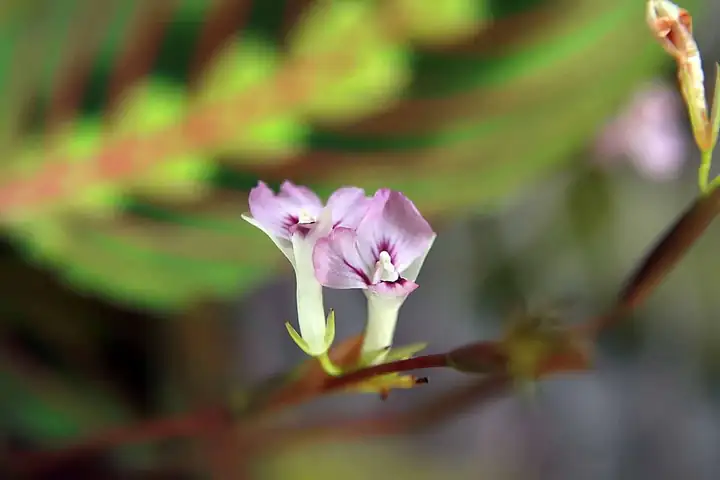
Prayer plants (calathea, maranta)
Maranta leuconeura (prayer plant) and Goeppertia species, formerly Calathea (peacock plant, rattlesnake plant, zebra plant, rose-painted calathea) · Arrowroot family (Marantaceae)
| Hardiness zones | 11 to 12 |
|---|---|
| Sun | shade |
| Water | high |
| Life cycle | perennial |
| Frost | Tender: killed by frost |
About Prayer plants (calathea, maranta)
Prayer plants are low, clumping tropicals from the forest floors of Brazil and tropical America whose patterned leaves lie flat by day and fold upward at night, like hands in prayer (NC State). Maranta is the small spreading one with red fishbone veins and purple undersides, 6-12 in tall; the calatheas (now Goeppertia) are taller, 9 in to 3 ft, with leaves striped, feathered or painted in silver, cream, pink and lime. They are among the showiest foliage plants for a dim room and the ASPCA lists them as safe for pets, but they demand humid air, steady warmth and water that isn't hard or fluoridated.
Hardy outdoors only in zones 11-12 (NC State); they are grown indoors everywhere and can summer outdoors in deep shade once nights stay above about 65 F, though they resent any chill.
When to plant
Timing is counted from your average last spring frost (and first fall frost). Sow & Tell works out the actual dates for your ZIP code.
Usually bought as a nursery plant or started by dividing the rhizomes of a crowded clump at repotting (NC State, RHS).
Growing it indoors
- Light: Bright indirect or medium light suits them and they tolerate low light, but direct sun scorches the leaves and bleaches the pattern; colors also fade in very dim rooms (NC State).
- Water: Keep the mix evenly moist but never soggy during the growing season and let it dry a little more in winter (NC State); use rainwater or distilled water, since fluoride and salts in tap water burn the leaf edges (NC State). Overwatering rots the stems and roots, so the pot must drain.
- Humidity: They need high humidity and get brown, crispy leaf edges without it; stand the pot on a tray of wet pebbles, run a humidifier, or keep them in a bright bathroom or kitchen (NC State).
- Temperature: Keep them at 65-75 F (NC State) with nights around 65 F (MU Extension), away from cold drafts, cold windows and sudden temperature swings, which make the leaves droop and the stems rot.
- Feeding: Feed a houseplant fertilizer at half strength only during the growing season, about monthly (NC State, RHS); too much fertilizer burns the leaf tips, so none in winter.
- Repotting: Repot every one to two years, preferably in spring, into fresh rich mix one size up, dividing a crowded clump at the same time (NC State).
Soil
A rich, moist but well-drained potting mix high in organic matter, never soggy (NC State).
Pot in a rich, moist but well-drained potting mix high in organic matter, in a container with a drainage hole (NC State).
Feeding
- Spring through summer, while new leaves are unrolling: houseplant fertilizer at half strength. NC State feeds only during the growing season at half strength; RHS feeds monthly. Water first, and flush the pot with rainwater now and then to wash out salts.
- Fall and winter: none. Skip feeding and water a little less while growth has stopped (NC State, MU Extension).
Over-fertilizing and fluoridated tap water both burn the leaf edges; feed lightly and use rainwater or distilled water (NC State).
Varieties (9)
NC State Extension names 3 maranta cultivars and 4 widely grown calathea species.
| Variety | Type | Days | Notes |
|---|---|---|---|
| Goeppertia orbifolia | Calathea | Compact and dense, with big round leaves striped silver-green. | |
| Peacock plant (Goeppertia makoyana) | Calathea | Pale green to cream leaves feathered with dark green, purple beneath. | |
| Rose-painted calathea (Goeppertia roseopicta) | Calathea | Rounded leaves marked with pink and silver. | |
| Zebra plant (Goeppertia zebrina) | Calathea | Velvety dark green leaves with lime-green midrib and veins; one of the larger kinds. | |
| Fascinator Tricolor | Maranta | Dark green leaves with light green margins, red rib veins and a yellow center. | |
| Lemon Lime | Maranta | Dark green leaves with a yellow-green center and striping. | |
| Rabbit tracks (Maranta leuconeura var. kerchoveana) | Maranta | The form sold as rabbit tracks or rabbit's foot; NC State now folds it into M. leuconeura with the red-veined kind. | |
| Red-veined prayer plant (Maranta leuconeura var. erythroneura) | Maranta | The common herringbone plant: dark green leaves with bright red fishbone veins and purple undersides; 6-12 in tall and spreading. | |
| Silver Band | Maranta | Dark green leaves with a broad silver-green patch down the center. |
Pests to watch for
Twospotted spider mite, Mealybugs, Aphids, Scale insects
Diseases and problems
Root and crown rot, Gray mold (Botrytis)
In the kitchen
Safety: None of the Extension pages we opened list prayer plants or calatheas as poisonous to people, and the ASPCA lists them as non-toxic to pets; as with any houseplant, don't let children chew the leaves.
Pets: Non-toxic to dogs, cats and horses (ASPCA, listed under both calathea and prayer plant).
Sources
Photo: Photo: David J. Stang, CC BY-SA 4.0, via Wikimedia Commons (CC BY-SA 4.0). Photo resized for the web.

Planting dates and advice are general guidance; check with your local Cooperative Extension office for your area.