
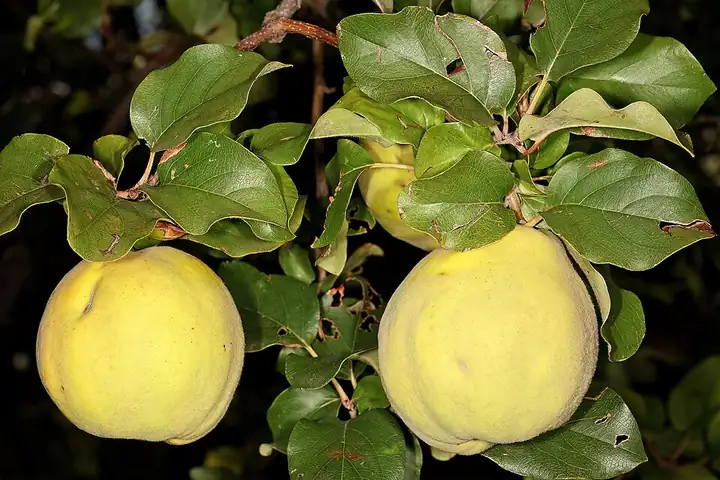
Quince
Cydonia oblonga · Rose family (Rosaceae)
| Hardiness zones | 5 to 9 |
|---|---|
| Sun | full sun |
| Water | moderate |
| Life cycle | perennial |
| Frost | Hardy: takes frost |
| Spacing | 192 to 240 inches |
About Quince
Quince is a small, often gnarled tree with pink-white spring flowers and big golden, very fragrant fruit. The fruit is hard and sour raw but turns soft, sweet and rosy when cooked, and its high pectin makes it a classic for jelly. It is not the same plant as flowering quince (Chaenomeles), a spring-blooming shrub whose small, hard fruit is mostly ornamental.
Cornell lists zones 5-9 and says flower buds are hurt below about -15 F; a Wisconsin trial calls it hardy to zone 4, though late varieties may not ripen there. Oregon State says it is not suited to the warm, humid parts of the U.S.
When to plant
Timing is counted from your average last spring frost (and first fall frost). Sow & Tell works out the actual dates for your ZIP code.
Quince is sold as a grafted tree (University of Missouri). Pick a sunny spot sheltered from strong wind and sudden temperature swings, and space trees about 16-20 feet apart (Cornell; Penn State orchard spacing). Trees start bearing in 2 to 3 years and can produce for 25 years or more if fire blight is kept in check (University of Wisconsin).
Soil
Adapts to many soils and puts up with wet soil better than most fruit trees, but crops most reliably in moist, well-drained soil (Cornell; UC); leaves may yellow in alkaline soil (Oregon State).
Choose a sunny, sheltered site with moist, well-drained soil; no pre-plant fertilizer rate is published for home quince, so follow a soil test.
Feeding
- Once a year, only if a soil test or weak growth shows the tree needs it: A light nitrogen feeding. Keep nitrogen light: heavy feeding pushes soft, leafy shoots that fire blight attacks (University of Missouri; Cornell; Penn State).
Too much nitrogen and heavy pruning both invite fire blight; prune lightly and pull root suckers in winter or early spring (Cornell; Penn State).
Harvest
Pick when the fruit turns golden yellow and smells strongly fragrant; many varieties lose most of their fuzz as they ripen (Cornell; University of Wisconsin). In California, varieties ripen from early September through October (UC). The fruit is firm but bruises easily; cut it from the branch with a sharp knife rather than pulling (Penn State; University of Wisconsin).
One crop each fall, starting 2 to 3 years after planting. Fruit softens and improves the longer it stays on the tree, so pick when it is golden and fragrant.
Varieties (8)
Extension and USDA sources document 8 quince varieties for U.S. home growers; Cornell notes only a handful are sold, and USDA ARS says only a few cultivars are offered by mail-order nurseries.
| Variety | Type | Days | Notes |
|---|---|---|---|
| Angers | Listed by Cornell and Oregon State as one of the quinces generally available. | ||
| Aromatnaya | Strong lemon-like scent. Large, uniform, deep yellow fruit and big crops nearly every year in a Wisconsin trial; vigorous and disease resistant except for fire blight. | ||
| Champion | Pear-shaped fruit with green-yellow flesh. | ||
| Jumbo | White-fleshed fruit; USDA ARS shows it as 'Cooke's Jumbo'. | ||
| Orange | Rich flavor; orange-yellow flesh. Rounded fruit with golden skin; low chill. | ||
| Pineapple | Pineapple-like flavor with white flesh. Golden skin; low chill. UC calls it the preferred variety. | ||
| Smyrna | Light, tender flesh. Large, fuzzy fruit with waxy yellow skin; pink flowers; low chill. | ||
| Van Deman | Pale yellow, coarse flesh. Orange skin that turns red when cooked. |
Pests to watch for
Codling moth, Plum curculio, Scale insects, Eastern tent caterpillar, Deer
Diseases and problems
Fire blight, Brown rot, Quince leaf blight (leaf fleck)
In the kitchen
Raw quince is hard, sour and astringent; cooked or poached it turns soft and sweet and goes into jelly, jam, tarts, pies, warm desserts and meat dishes (University of Missouri; USDA ARS). It also adds aroma to hard cider (University of Missouri).
Keeping it: Firm quinces have a long shelf life, and some varieties keep almost until spring (University of Wisconsin; USDA ARS). Handle them gently, since they bruise easily.
Safety: Cooked quince is a common food; raw fruit is hard and astringent, so it is usually peeled, cored and cooked (University of Wisconsin). We found no Extension or NIH source that names toxic parts, drug interactions or pregnancy cautions for the fruit.
Pets: Not listed by the ASPCA
Sources
- ucanr.edu
- ccfruitandnuts.ucanr.edu
- homeorchard.ucanr.edu
- ipm.missouri.edu
- landscapeplants.oregonstate.edu
- uncommonfruit.cias.wisc.edu
- hort.cornell.edu
- extension.usu.edu
- agresearchmag.ars.usda.gov
- plantvillage.psu.edu
- aspca.org
- aspca.org
- aspca.org
Photo: Photo: SAplants / Wikimedia Commons, CC BY-SA 4.0 (CC BY-SA 4.0). Photo resized for the web.

Planting dates and advice are general guidance; check with your local Cooperative Extension office for your area.